Page text
IXI&U7
£ f c ffStf’0 9

                                v


    Marie Neurath and J. A. Lauwerys
No text on this page.
No text on this page.
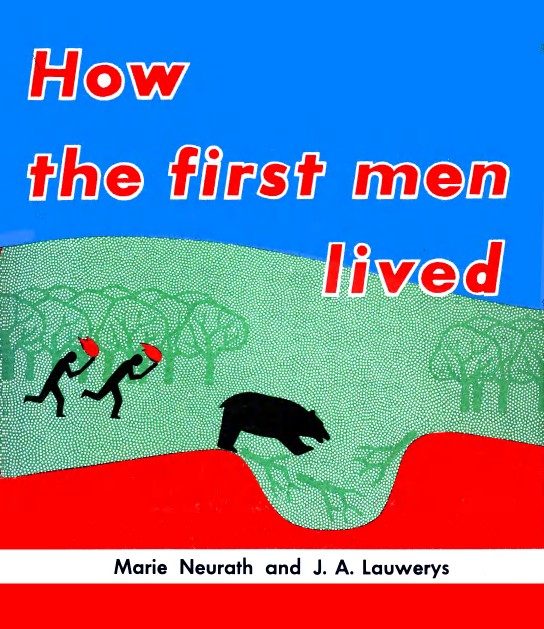
How the first men lived
How
 PREPARED BY


        and
the first men lived
M A R I E N E U R A T H DIRECTOR OF THE ISOTYPE INSTITUTE
J. A. L A U W E R Y S p r o f e s s o r o f c o m p a r a t iv e e d u c a t io n , u n i v e r s i t y o f L o n d o n
M A X PARRI SH & CO. L I M I T E D A D P R IN T H O U S E , L O N D O N , W .l
LIST OF CONTENTS

                                                 Page
Monsters that Lived Before Men                      5
Man Comes on the Scene                              6
Man Learns a Mighty Secret                          8
The Chariot of the Sun                             10
Early Men’s Struggle for Food                      12
How Cave Men Hunted Big Animals                    14
Pictures Painted Thirty Thousand Years Ago         16
How Fire Served the Men o f the Bow                18
M an Makes Friends with Animals                    20
Dog and M an Get Together                          22
A Lesson Which has Lasted Half a Million Years     24
Tools in Flint, Tools in Copper, Tools in Iron     26
How Early Men Found Shelter                        28
Building Homes and Temples                         30
The God of Growing Things                          32
The Lake Dwellers                                  34
The Magic Marks Which Led to Writing               36
Monsters that Lived Before Men
The two giant reptiles on the left were as long as buses, the two in the centre as
big as camels, those on the right longer than taxi-cabs. The Diplodocus, at the
bottom, was as long as a locomotive. All lived millions o f years before men.
Long before Christopher Columbus These creatures, which lived when
first landed in America, long before the great coal forests grew, were
Julius Caesar lived, man’s history had like large dragonflies. After millions
already begun. It began more than of years came fishes and creatures
five thousand years ago, when men which could live either on land or in
first began to write. But it is much water. Still later there were reptiles.
more than a hundred times as long Some were no larger than a tortoise
ago as that since the first men lived, but others were huge monsters as big
and more than fifty thousand times as a large locomotive. At last there
as long ago since creatures like any came animals like those we know
now living appeared on the earth. today, and finally man appeared.
5Man Comes
on the Scene
All creatures which had f - s f t
lived during the hundreds
of millions of years before
man came had been con
tent to let themselves fit
into the world. Man not
only tried to fit himself
into the world, he also
tried to alter things in the
world around him so that
they might suit him better.
When long ages of in
tense cold came and thick
ice covered much of the
earth, some men moved
away to warmer places.
Some found shelter in
deep caves. They began
to use fire to keep away
wild beasts, such as the
giant woolly mammoth,
while they slept. Instead
of always running from
such creatures in fear, men
gradually learned to hunt
and kill them, using their
skins for clothing and their
flesh for food. The top picture shows the earth before mart appeared.
6
Then, about ten thou
sand years ago, the last
ice age ended. Life was no
longer so hard. Manmade
friends with such animals
as horses, dogs, cows and
sheep, training them to
help him and giving them
food and shelter in return.
Besides gathering wild
fruits, berries and herbs,
men slowly learned to dig,
sow seeds and reap crops.
As the years passed by,
people had time for other
things besides just trying
to find enough food to
keep them alive. Forests
were cleared, large fields
ploughed and planted,
h o u ses, tem p les and
churches built.
At last man learned to
make coal, steam, elec
tricity and oil do work
for him. He built rail
ways, locomotives, roads,
motor cars and great
cities. He had become
the kind of person we
Then man came, learned to find food, farm, and build. know today.Man Learns a Mighty Secret
How was it that man was able to the future, think out problems, and to
do all these things which no other find new uses for things around him.
living creature could do ? It was only by making full use of
First, his feet and legs were so his brain that man learned one of
well made and strong that he could his mightiest secrets—the secret of
walk with only two limbs instead of fire. When early men first saw fire,
using all four. This left his hands it is unlikely that they thought of
and arms free to do all kinds of other any possible use for i t ; they were
things. (Several animals, like apes probably terrified. Perhaps they saw
and moles, have “ hands ” almost high walls of flame sweeping through
as well made as ours, but they are the forest ; tall trees were charred
used all the time for moving about. and blackened, fruit and berries were
Other animals, like kangaroos, have destroyed, wild animals were mad
two limbs free, but they have no dened with terror.
way of grasping things as we have.) Very slowly men realized that fire
Another advantage was a fine pair could be made to serve them. Its
of eyes which could see just as clearly heat could be used to warm their
close up as at a distance, so that man caves, its flames to light the dark
could carefully examine the things night, its terror to frighten away wild
he picked up with his hands. Even beasts.
more useful was his jaw, with its We do not know for sure how men
many tongue muscles ; this gave him first got their fires. Perhaps when
the chance of learning to speak, so they were trying to sharpen one stone
that he could increase his knowledge against another a spark fell on to
by exchanging thoughts with his fel some dry leaves and set light to them.
lows. The greatest advantage of all Perhaps a pile of rotting leaves or
was his splendid brain which enabled grass would become hot enough to
him to compare one thing with an catch fire. But other accidents, too,
other, to remember the past, plan for might start a fire.
A chain o f fires can carry news quickly. The man who sees this ship sinking,
lights a fire to pass on the news to the next hill-top. Fire after fire is lit on
other hills until a messenger who sees the last one takes the news to the king.
The Chariot of the Sun
                       A tree might be struck by lightning and burst
                    into flames. People would be frightened at first,
                    but if the fire did not seem dangerous they might
                    venture to light one of their own from it. In
                    some places, too, men may have lit fires from
                    trees set ablaze by hot lava from volcanoes.
                       One thing is certain. Getting fire was not easy.
                    Once men had it they tried to keep it burning as
                    long as possible. They could do this by lighting
                    it in a shallow hole in the ground. A t sunset the
                    hole would be almost covered with turf so that
                    the fire smouldered all night. In the morning the
                    turf would be removed and fresh fuel added.
                       Taking fire from one place to another also was
                    not easy. People could certainly carry fire a
                    short distance by using lighted sticks as torches,
                    but it took many centuries to learn a simple way
                    of carrying fire a long way. Then people living
                    on the islands near Greece found they could keep
                    a tiny fire smouldering inside a hollowed-out
                    stalk of a plant called fennel, and take it where
                    they liked. The ancient Greeks had a story of
                    Prometheus, who stole fire from heaven and gave
                    it to men. Cheating Zeus, King of the Gods,
                    Keeper of Fire, he lit a torch at the chariot of
                    the sun and brought fire to earth in a hollow
                    fennel stalk. In this way, they said, he gave men
                    a power that might go on growing until one day
     Getting fire   they would be equal to the gods.

10
Before history began
men had nothing much
better than the fire-drill to
help them to make fire.
This was a bow with its
string wound round a
wooden cylinder which
rested on a board. As the
bow was drawn back
wards and forwards the
cylinder whirled round
fast and made the board
hot. In time a spark flew
out and set light to pieces
of dry straw placed on the
board.
Until about a hundred
years ago fire-making was
still a slow job. Our
great - great - grandfathers
used to carry tinder-boxes
containing a flint and
some dry, powdery fuel
to start their fires.
Making fire first became
easy only when matches
were invented, just before
1840. Since that time we
Keeping fire
m
Making fire
have almost forgotten how
hard it was for people to
make fires in the past.
11Early Men’s Struggle for Food
The man floats gourds on the lake until the ducks are used to them.
Then, wearing a gourd on his head, he catches the ducks by their legs.
It is easy to understand why early Cave men, too, probably ate many
men took so long to find new ways things which we would not eat. No
of doing things. Almost all their doubt some of them suffered sickness
time was taken up in the struggle and even death after trying new food
to find food for themselves and their stuffs. The berries of the deadly
children. nightshade looked just as delicious
Fortunately men can eat, and even as the blackberry, and the poisonous
enjoy, many more different foods toadstool as tempting as the whole
than most animals can. The Bush some mushroom. So people soon
men of South Africa, for instance, learned to eat only what they had
used to eat grass-seed, lizards and seen other people eat before.
ant-eggs, as well as the flesh of the The great difficulty was to find
ostrich and the hippopotamus ; the enough to eat. During late summer
Indians of Tierra del Fuego, at the and autumn there were plenty of
tip of South America, eat snails, nuts and fruit, but in winter there
frogs, toads and sea urchins. were few growing things except
12grasses and roots. Then men had to kill a rabbit or a hare with a stick or
depend mainly on what they could a well-aimed stone. In east Asia
get by hunting and fishing. small birds were sometimes caught by
Perhaps the first fishermen stood smearing branches with a kind of
knee-deep in a stream, with a stone- thick glue made from the sap of
tipped stick poised above the water, trees. The natives of Mexico floated
and speared the fishes. Perhaps they hollow gourds on the lakes until the
lay patiently on their bellies by the wild ducks were quite used to them ;
water’s edge and made a grab at then they swam about with these
every likely fish which came near gourds on their heads and caught
them. Thousands of years had to ducks by pulling them under water
pass before men learned to fish with by their legs.
rod, line and hook. But men wanted animals which
Catching animals was much more would provide more meat, and so
complicated. Sometimes a man might they took up big-game hunting.
Early men not only killed such animals as the wild horse, the reindeer
and the boar; they also hunted large, fierce animals like the
rhinoceros, the mammoth and the sabre-toothed tiger.
13How Cave Men
HuntedBig Animals
Try to imagine what
happened when a group
of hungry cave men, look
ing for herbs and berries,
suddenly spied a bear in
the distance. Perhaps they
were unarmed. Was the
bear hungry like them
selves ? Would it attack
them before they could
race back to the safety of
their cave with its blazing
fire ? They were afraid,
but they were also hungry,
and a bear would mean
plenty of meat.
After eyeing them cur
iously for a time the
animal might go loping
away into the forest.
During the next day or
two they would try to
discover whether it often
came that way. If it did
they dug a pit in its path,
and lay b ran ch es and
twigs over the top. While out looking for food, cave men see a bear. With
14
Then a number of men
would lie in wait for it,
some crouched behind
trees, gripping their spears,
others concealed in caves
or among rocks, carrying
torches. Suddenly the
bear comes out from the
forest. Immediately men
appear with flaming tor
ches, as if by magic, and
chase the terrified creature
towards the pit. There is
a sharp crack of snapping
branches as the bear falls
into the trap. Shouting
with excitement, the spear
men dash out and kill
their prey.
Large, fierce animals
were hunted in this way
even after men had in
vented bows and arrows
to kill smaller creatures.
To hunt deer or rein
deer, men sometimes dis
guised themselves in the
skins of those animals and
mingled with the herd
until they could get near
torches they chase him into a pit and kill him with spears. one and kill it.
15Pictures Painted Thirty Thousand Years Ago
Thirty thousand years ago, in caves dimly lit by torches,
early artists werepainting some o f the world's first pictures.
These often help us to understand how early men lived.
During fairly recent years modern evidence which the cave men them
men have learned quite a lot about selves have left us. In southern
how cave men lived. One way of France and northern Spain many
doing this was by studying how back stone-age paintings, mostly of animals,
ward peoples still live today. In re have been found on the walls and
mote parts of Africa, Australia and ceilings of deep caves. Some of these
South America there are primitive paintings, made perhaps thirty thou
tribesmen who have not yet caught sand years ago, are extremely beauti
up with modern ways of life and are ful—so beautiful that we cannot help
still living in the same kind of way thinking that men must have begun
as the old cave men did. to learn something about drawing
Watching these primitive tribes and painting long, even, before that.
gives us a good clue to the way in Maybe we shall never know why
which the cave men lived. But also cave men spent long hours painting
we have some evidence, and it is pictures in dark caverns where they
16would hardly ever be seen. Perhaps but we cannot be quite certain why
they did it simply for pleasure. More people thought of wearing them. It
likely they believed that if they paint may have been for warmth or the
ed a deer on the wall of their cave, sheer pleasure of dressing up, or it
a real deer would be found more eas may have been to help men disguise
ily the next time they went hunting. themselves to look like the animals
These pictures can tell us quite a they wanted to stalk. But what we
lot about the cave men of that time, know about backward peoples of
just as old photographs can tell us today leads us to think that these
a lot about our fathers and grand crude clothes were probably worn to
fathers. Some of them are hunting show rank, like an admiral’s hat or
scenes, and show us what weapons a king’s crown. On special occasions,
and hunting methods were used. perhaps when a young man had
Others show men dressed in animal reached the age to be told the secrets
skins and give us a clue about early of his tribe or clan, the chief of the
clothing. bear tribe would put on a bear’s
Animal skins must have been very skin ; the chief of the lion tribe
plentiful among those early hunters, would wear the skin of a lion.
Dried animal skins cut into rough cloaks made
a kind o f uniform fo r early chiefs and priests.
17How Fire Served
the Men of the Bow Roasting meat Warming water
By the time of the cave
artists, men had learned
new uses for fire.
Cooking began thou
sands of years earlier, pos
sibly when men found
some animal roasted by a
forest fire. Later, men
learned to roast whole
animals on a spit, turning
the carcass from time to
time to cook it evenly.
When they could grow
wheat, they ground the Boiling food
ears into flour with stones
and baked rough bread.
Boiling was more diffi
cult. The first pots, often
made of a basket-work of
rushes covered with clay,
would have cracked over
a fire. Water could be
heated in them only by
dropping hot stones into
it. Boiling food began
only when men learned
how to make stronger pots.
18
Protection against fierce animals
Attraction for friendly animals
Men found, too, that fire was useful But men did not try to kill every
for other things besides cooking and animal they saw. Some, like sheep
making pottery. They noticed that or horses, were quite harmless and
although fierce beasts did not rush men probably killed them only if
past fires to attack them, all kinds of they could find nothing else. Maybe
animals came near fires for warmth, they thought it unlucky to kill certain
or out of curiosity. So these bow animals, just as some people still
men might sometimes make two fires think it unlucky to kill spiders. These
a little apart and lie down in between animals were allowed to come near
with their bows and arrows. In time the fire without danger, and in time
a wolf or a bear would come along. they ceased to be afraid or shy of
The bowmen would slay it and have men. Some of them probably be
meat enough for several days. came regular visitors to the caves.
19Man Makes Friends with Animals
Not all animals work as camels and elephants do. Some, like seals and peacocks
are kept for amusement. Some o f the first animals were tamed mainly as pets.
Have you ever wondered why men instance, kept chickens, but they never
first began to tame and keep such ate eggs. The Chinese kept cows, but
animals as horses and cows ? Perhaps never milked them.
you can think of an answer straight Men may have kept animals for
away : horses to ride on, cows to reasons which do not seem very good
give milk and butter. That answer to us but which may have seemed
is quite simple, but it is also quite very good to them. For example,
wrong. Wild horses are often too the Burmese believed that they could
weak to carry a man more than a tell what was going to happen in the
very short distance. Wild cows give future by splitting open the thigh
hardly any milk and they are in bone of a chicken. Even the highly
clined to be very fierce, especially civilized Romans of Julius Caesar’s
when they have young calves. days “ told fortunes ” by gazing into
So it seems, then, that early men the livers of certain animals.
did not keep animals for any purpose It is also probable that some ani
which we should consider useful, and mals were first kept for no reason at
this opinion is strengthened by what all except that people liked them or
we know about other people, who were amused by them. There are
lived much later. The Burmese, for still backward tribesmen in parts of
20Australia who have no useful tame
animals, but they keep dingoes (a
kind of dog) and wallabies (a kind
of small kangaroo) as pets.
The strange thing is that after
animals have been tamed and
domesticated for many years they
are often altered quite a lot.
Domesticated horses are much big
ger and stronger than wild horses ;
domesticated cows yield more milk
than wild cows ; domesticated sheep
have far woollier fleece than wild
sheep. So although animals may not
be of much use to men when they
are first tamed, they often become
useful later.
Slowly men learned to get much of
their food by keeping cattle, sheep
and poultry. Instead of remaining
hunters, many men became herdsmen
and shepherds. They learned also
to use horses for riding across the
plains, and camels for carrying them
across the deserts.
Even birds sometimes help men. This
hooded hawk perches on a man’s wrist.
When wild ducks appear the hood is
removed. The hawk flies up, seizes
a duck, and brings it to the man.
21Dog and Man
Get Together
The first animals man
kept, about twenty-five
thousand years ago, were
dogs. Perhaps it began
when men first threw
bones to dogs standing
near their fires. Later on
dogs would follow hun
ters. After the kill the
hunters took what meat
they needed and the dogs
ate the rest.
Gradually men noticed
that dogs were useful for
helping them to follow the
trail of animals. When
dogs helped in this way
men would reward them
with bones or pieces of
meat. Instead of slinking
along behind the hunters,
dogs began to walk beside
them, with tails wagging.
Nowadays many dogs
are not useful to us at all,
but they still walk proud
ly beside us. The dog becomes a hunting partner and companion
22
But even today, as for thousands of years past,
some dogs still help men who go hunting, not
only by following the scent of animals but also
by fetching birds which have been shot.
   Try to imagine how excited an early hunter
must have been the first time his dog retrieved a
dead bird. Maybe his arrow had hit a wild duck
flying over a lake. The bird would fall into the
water far beyond his reach. Just at first he would
imagine that his shot had been wasted, and that
his prize was lost.
   Suddenly he hears a splash and sees the dog
striking out into the water. For a moment he
thinks the dog is going to steal the bird and eat
it itself. But in a short time the dog swims back
with the duck in its mouth and drops it at his
feet. Today, when people go shooting game,
they still take a dog with them to retrieve their
pheasants or partridges.
   When men became shepherds and herdsmen
they found that dogs could be trained to round up
their sheep and cattle. In the far north, too, dogs
were often used, and still are, for pulling sledges
over the snow and ice. In parts of Belgium
dogs are still used for pulling small, light carts,
 and in all parts of the world watch-dogs are kept
to frighten away burglars.
   In modern well-policed cities, where dogs have
 very little to do, we still sometimes keep them, just
 as people first did, mainly because we like them
 and they seem to like us.

                                                         23
A Lesson Which has Lasted Half a Million Years
a Y"
The first tool-makers had few materials to work with : stone,
wood from the forest, bone, horn and leather from animals.
Before men began to tame and These ape-men, too, certainly
keep animals, they had already picked up stones and handled them.
learned how to use a great number of Very slowly they learned just how
different tools and weapons such as useful stones can be. With a big
torches, fire-drills, spears, and bows. stone you can crack open a coconut
or an oyster; with a small one,
carefully aimed, you can kill a bird
Y ft A-
Learning to use tools is a lesson
or a rabbit ; you can hit one stone
against another to signal to a comrade
some distance away.
which began more than half a million
years ago and is still going on ! We An even more important discovery
know that apes use sticks to knock was that stones sometimes break when
down food which is out of reach, and knocked together, and one of them
probably the first ape-like men used is often left with a sharp edge which
them in the same way. In time, no can be used for scraping. Stone tools
doubt, they also used sticks as swords, roughly sharpened in this way have
to fight with, or as spades, to help been found in many parts of the
dig tasty roots out of the ground. world.
24After thousands of years men found spears, bows, arrows and clubs were
out that one common sort of stone mainly of wood. Then, also, the
—flint—was more useful than the bones of animals were often used for
rest. When flint is given a blow, making hooks, harpoons, drinking
sharp flakes of stone break off which horns and handles for daggers. Fine
can be used as crude knives. So fish-bones were useful for making
men began to make most of their needles, and the shells of sea urchins
tools from flint, sometimes using the sometimes provided ready-made cups
flakes which broke off, sometimes or scoops. The sinews of various
using the larger sharp “ core ” which animals could be used as string or
remained. By the time of the cave thread, while for tying handles to
artists, flintworkers were making an flint axe-heads fine strips of leather,
amazing number of tools—choppers, cut from animal-hides, were often
saws, knives, drills, harpoons, spear used.
heads, arrow-heads, and fish-hooks.
1 4 But, still, in most parts of the
world flint remained the chief material
for tool-making for many thousands
of years, and as time went by it
Of course flint was not the only became less and less easy to find.
material early men used for making
tools. The Aztecs of Mexico hardly
used any flint. They used a very
hard transparent mineral called ob
sidian, from which they made knives,
daggers, and even razors. Wood
was commonly used for the handles
A~\
of hammers, axes and knives, while
25Tools in Flint, Tools in Copper, Tools in Iron
The first mines supplied flint for tools
Later, men mined and smelted copper
Iron tools were made when smelting methods improved
26
At last men dug mines, and crawled along the
dark passages searching for the precious flints.
The remains of some of these old mines, which
made it possible to go on using flint tools for
thousands of years more, can still be seen in parts
of northern Ireland and eastern England. Though
flint tools were useful, they were easily broken.
Something tougher, like metal, was needed.
   But pure metals are not very easy to find. To
get a regular supply of metal men had to find the
stony or earthy ores, and learn to extract metal
from them. The ancient Egyptians first began
smelting copper about five thousand years ago.
   Sometimes the early copper-miners lit fires
under a seam of copper ore. When the ore was
hot they threw cold water over it, causing it to
break into lumps. These lumps were placed in a
stone furnace and heated with charcoal, which
was kept burning fiercely by means of a blow-pipe.
Molten copper ran to the bottom of the furnace.
This could be poured into moulds the shape of
axe-heads. A copper axe was stronger than a
flint one and a blunt blade could be softened
by heating and then beaten out sharp again.
   Later, iron ore was also mined. It was smelted
rather like copper but in a much hotter furnace.
Iron was not moulded, but had to be made red
hot and beaten into shape on an anvil. An iron
axe was sharper and stronger than a copper axe,
and when blunt it could be quickly sharpened on
a grindstone.

                                                 27
Early men often camped under an overhanging cliff. A few branches with skins
stretched over them would be placed at the entrance to keep out the wind and rain.
As men learned to make and use have been of little use to men who
better tools they were able to build spent their lives wandering from place
better shelters and homes for them to place searching for food.
selves. For thousands of years early Some primitive people who still
men, with only rough sticks and live by foraging and hunting, like
stones to help them, had to make the Waddis of northern Australia,
use of whatever natural shelters they build no permanent homes. But such
could find—caves, narrow valleys wanderers cannot always depend on
sheltered by trees, overhanging cliffs finding natural shelter just when it is
or rocks which might protect them needed. So in time men began to
from wind and rain. In any case, make shelters which they could carry
permanent well-built homes would about with them. Sometimes, like
28
the Waddis, they simply used animal      is stone, but since it was so heavy to
skins which could be hung over the       move about and so difficult to shape
boughs of trees to form a kind of        it was not often used at first for
roof. Sometimes, like the American       building ordinary homes.
Indians, they made real tents.               One of the many difficulties in
   Later, when men kept flocks and       using stone was leaving openings for
herds and began to grow crops,           doors and openings to let in the light,
they needed places where they could      for the first stonemasons had no
store their tools, cook their, food,     knowledge of the arch with which
and sleep securely year after year.      the Romans later built stone bridges.
These first homes were sometimes         Sometimes the problem was solved
made of mud, dried and hardened in       by using two or more tall stones as
the sun, like those of many African      pillars and resting another one on
Negroes today. Sometimes, when           top of them. Sometimes, too, a
men had axes strong enough to fell       mound or hillock was hollowed out
trees or to lop off stout branches,      to make a kind of great room inside
homes would be built of logs.             the earth ; stones were then used to
   Another building material which        shore up the roof and sides and to
has been used from very ancient times     strengthen the entrance.


                Sometimes a chamber was hollowed under a hill,
                and stones used to strengthen walls and roof.

                                                                             29
Building Homes
and Temples
The ordinary houses of
the first farmers were often
low wooden huts with
floors below the level of
the ground.
There were several
reasons for building huts
like this. The builders
needed less wood to com
plete their huts, and at a
time when every log had
to be cut to size with a
stone axe or saw, this
meant a big saving of
work. Then, too, the solid
earth which formed the
lower parts of the “walls”
kept out the cold better
than crudely-joined logs.
Sometimes a ridge of
earth was left along the
centre of the hut, to divide
it into two parts. This
ridge made a convenient
seat, and also served as a
base for the centre sup
ports of the thatched roof. Front, section and ground-plan o f an early home
30
The builders of ancient
temples, like Stonehenge
in England, worked with
huge rough stones which
they moved about on
primitive sledges drawn by
large teams of men. To
place one of these great
— /W fc
stones on top of two or
three “ pillar ” stones they
probably had to make a
sloping road of earth lead
ing from the ground to the
top of the pillars.
The more civilized
Egyptians who built the
great pyramids knew how
to cut stones into large
neat blocks, which they
moved on wooden rollers,
and the stones used in
building the early temples
of Crete and Greece were
sometimes moved in a
kind of cage shaped like a
cylinder.
The later Greeks and
Romans used smaller
stones, cementing them to
gether as we do now, and
carried them in carts. Moving stones fo r building temples
31The God of Growing Things
At night a broad ditch and a stout fence protected the homes and cattle of the first
villagers. By day, men laboured and cattle grazed in the nearby fields.
After- living as wanderers for thou to provide them with meat, but they
sands of years men had at last begun had also learned to grow grain and
to build homes and villages because vegetables for themselves.
they had found a way of living for How did men first learn that seeds
year after year in the same place. buried in the hard earth would grow
Not only had they cows and sheep and yield crops ? Perhaps when a
32cave and camp—the first farms.
This new way of life first began
between ten and fifteen thousand
years ago, and spread slowly over
many parts of Asia and Europe.
But agriculture was also begun quite
independently by other peoples at
other times. The Indians of Central
America found a way of cultivating
corn almost five thousand years ago ;
the people of southeast Asia found
wandering tribe found an abundance out how to grow bananas.
of ripe wild cereals growing they took The first farming villages of Europe
as much as they needed and buried and Asia were usually settlements of
some in the ground as a thanks a score or more wooden huts and a
giving to the God of Growing Things. few log barns. The whole settlement
Months later they might pass the was completely surrounded by a fence,
same spot and see that there was and sometimes also by high mounds
again an abundance of grain. Ah ! of earth to serve as protection against
The God of Growing Things was wild beasts and wandering tribes.
pleased with their offering ; they
Each village was built near a river or
must make him another ! Or perhaps
stream to ensure a supply of fresh
when wild grain was being pounded
water, and often there would be a
into flour, some of it fell and was
trampled into the earth. Again, pond for the use of the cattle.
somebody would notice months later Crops were grown in the fields
that new grain grew there. If this adjoining the village, and flocks and
happened by accident, could it not be herds grazed in the nearby meadows.
made to happen again by design ? At sundown the cattle were driven
Presently little clumps of growing into a compound inside the fence and
things would appear around many a all gates closed for the night.
33The Lake Dwellers
Once men became farm
ers they became men of
property. They had hoes
and axes, growing crops,
barns filled with grain, and
homes of their own which
they were determined to
protect carefully.
Many of the first farm
ing villages were fenced
and surrounded with
mounds, but others were
built on piles over the
waters of lakes for added
protection. Although the
first lake villages were
built more than ten thou
sand years ago, many more
grew up when men had
learned to use tools of
copper and iron.
Remains of these old
villages have been found
in many parts of Europe,
from the British Isles to
the Black Sea Coast.
Similar villages built over Many early settlements were built above water. At night a
lakes and rivers still exist The villagers knew how to make harpoons, fish-
34
in Borneo, New Guinea,
West and Central Africa,
and near the mouths of
the Amazon and Orinoco
rivers, in South America.
Some of the lake settle
ments of the Bronze and
Iron Age were far too
large to be called villages.
In some cases as many as
fifty thousand stout wood
en piles were driven into
the bed of a lake to serve
as foundations for build
ings. At Laibach, in
Yugoslavia, where a lake
used by these old farmers
has now completely dried
up, ancient pottery and
tools of very fine crafts
manship have been found
in recent years.
The people who lived
in these settlements were
no longer savages or bar
barians. They were men
and women who were
beginning to build up a
civilization, and they were
barricade was used to keep enemies and wild animals away. standing on the very
\ooks, saws, axes, sickles, spears, bows and arrows. threshold of history.
35The Magic Marks Which Led to Writing
Part o f a sentence written by a priest who lived in ancient Egypt.
In some of the more fertile parts sowing and reaping. They were the
of the world, especially in the valleys guardians of all things mysterious.
of the Nile and the Euphrates, crops The time came when the priests
could be grown more easily than wanted to make records of these
elsewhere. Some people had time for mysteries. Often, too, they wanted
other things—playing music, making to keep records of what tributes of
up stories, erecting buildings, serving grain and fruit had been brought
as priests and law-givers. to them for their services. So they
Amongst all these people the priests began to make marks on tablets of
were long thought to be the most soft clay or on animal skins to re
important. They not only offered mind them of these various things.
prayers and sacrifices to the gods ; These were indeed magic marks,
they also studied the movements of for in time they grew into whole
the sun, moon and stars, gave men a written languages. They were the
calendar, forecast when the rains beginnings of the records on which
would come, and fixed the times for our knowledge of history depends.
These ancient Babylonian words mean “ eldest son ” .
36No text on this page.
No text on this page.
A PARRISH COLOUR BOOK FOR CHILDREN
 Isotype Archive