Page text
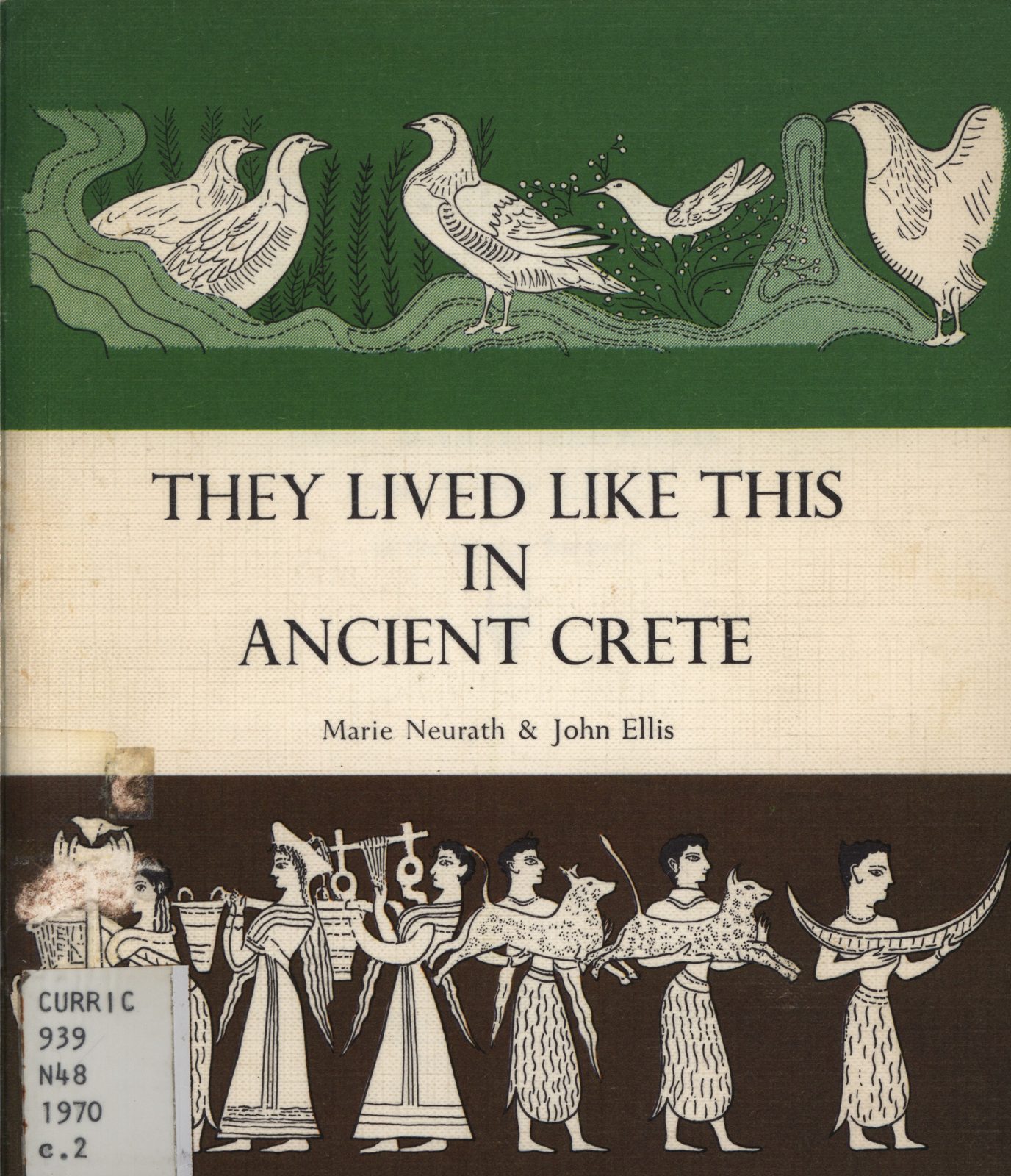
THEY LIVED LIKE THIS
             IN
  ANCIENT CRETE
    Marie Neurath & John
No text on this page.
They lived like this in
ANCIENT CRETE


 Author: MARIE NEURATH

    Artist: JOHN ELLIS

      of the Isotype Institute


               :


    THE RYERSON PRESS
   Toronto Winnipeg Vancouver
© 1965 Isotype Institute Limited
Published by Max Parrish & Co. Ltd, 2 Portman Street, W.1
This Canadian edition published in 1970 by
special arrangement with BPC Publishing Limited
Printed and bound in Canada
by Evergreen Press Limited, Vancouver, B.C.
ANCIENT CRETE


                                Greek legends tell of a mighty king,
                                Minos, who reigned on the island of
                                Crete long ago. He kept a gruesome
                                monster, the Minotaur, which was
                                half bull, half man. The city of
                                Athens had to send a regular tribute
                                of seven boys and seven girls for
                                sacrifice to the Minotaur.


Minos kept him in a labyrinth, or maze, beneath the palace. Here a
Greek hero, helped by the princess Ariadne, found and killed him.


Other legends tell of this great palace at Knossos, with its many
courtyards, rooms and passages. The people of Crete used a
maze symbol in connection with Knossos.
These legends seemed to show that there was a time when the Greeks
lived in awe of a mightier king on the island south of the Greek
sea. Indeed, palaces where great rulers lived before the time of
the Greek cities have now been found. They have been in ruins for
more than 3,000 years, destroyed perhaps by earthquakes. But from
the ruins we can learn how these early people, the Minoans, lived.
The palaces were the first buildings of their kind in Europe.
There were rows of columns in.the halls and along the staircases.
They are wider at the top than at the bottom, perhaps because the
first columns were made of tree trunks which had to be set upside
down so that they would not take root again and sprout.
The palaces were destroyed again and
                           again, and rebuilt each time in greater
                           splendour. Earthquakes were the greatest
                           danger on the island. Their rumble may
                           have sounded to the people like the roar
                           of giant bulls. The bull, a sacred
                           animal, was pictured on the walls, and
                           th is bu ll’s he ad, m ad e of dark ston e, is
                           hollow, to be used for pouring ritual
                           offerings of wine. Its angry eyes are
                           crystal surrounded by rims of precious
                           red stone. The horns were probably
                           of gold.


The shapes on the top of this shrine
represent bulls’ horns. They are found
on many shrines and buildings. They are
one of the symbols used by the Minoans
to mark sacred places.
The Minoans enjoyed
a gay social life.
These are court ladies,
well dressed, with
jewels and elaborate
hairstyles. They are
chatting while they look
at an open-air
performance.
These are some of the things they could have seen. There was music
and dancing. The Greeks said that they first learned both music and
dancing from Crete, although later they developed their own forms.There were many sports, like tumbling
and boxing. There was also wrestling.
There are many pictures which show
these sports. They are found on walls,
on vases, and engraved on stones
from which clay impressions were made.
Here we see the narrow-waisted men
in action.
The men have long hair, and for some
sports they wear protective helmets.
Models and small figures have also”
been found.
There are no Minoan pictures of warfare.Bull-jumping is the best-known of their sports. This picture from
a wall painting shows that both men and women, dressed alike, took
part in it. The athlete grasped the bull’s horns when it bent its
head to charge, somersaulted over it and landed on his feet. The
drawing below shows how he may have been thrown back by
the movement of the bull’s head and landed with his feet on its back
before jumping to the ground.
But the wild bulls had to
 be caught for the games.


 These pictures from a gold
 cup of the Minoan period
 show one way in which
 they were caught.


 A tamed cow was used to
 attract the bull’s attention.
 Then a man approached
 from behind, and slipped
 a noose around its foot.
ancifasiembeimsetoee.


Whether bull sports had anything to do with religious rites we
do not know. But this picture, from the side of a coffin,shows
a bull tied to a table near an altar, with people performing rituals.
One is playing music on two pipes. There are also offerings of
smaller animals, fruit and wine.


At the bottom of the page are some examples of small figures which
have often been found near altars. They were probably used as
offerings, although some may have been toys.


                                   IO
a lai
Nn
ih
ete ee ey aa SA
RGR
ih nah
“oe gia
This picture comes from the other side of the same coffin.
Both pictures show columns topped by double axes,
with sacred dove-like birds above them.
Double axes are shown on many pictures,
and large and small axes have been
found, sometimes placed between a
pair of sacred horns.
This miniature double axe, made of
gold, has an inscription on it.
Double axes were engraved on the
pillars of the king’s palace.
They were clearly an important
religious symbol, as well as being
used as tools in everyday life.
IIThe Minoans worshipped on mountain tops, in sacred caves and in special
rooms in their palaces. The kings probably also acted as chief priests.
There were few pictures of gods, but many statuettes and pictures of
goddesses have been found. We do not know whether it is always the
same goddess shown in different roles, or several goddesses each
with her own powers. Here is the goddess on a mountain with two
lions. She is the great huntress, the mistress of the beasts.
She may also be the Great Mother of the gods.
I2The Greeks believed that the Great
M o th er w en t to Cre te to g iv e b ir th
to Zeus, the father of future gods
an d m en. Sh e hid hi m in a ca ve on
one of the big mountains.
This is one of several figures
of a goddess with snakes.
What the Minoans believed
about her, we do not know.
She seems to have been important
in connection with the home.
Snakes may have been sacred.
a Be
SF
se
They were looked after.
There were special tubes
where they could rest,
and tables like this
for them to feed at.
‘5The palaces and great villas of Crete had piped water and drains,
bathrooms and toilets. Open courts let in the light and air.
Many people lived near the palaces, including the workmen and
craftsmen.
They lived in brightly coloured houses of several stories, with
storage cellars and upper floors with windows.
There are several different types, as these pictures show.
They are taken from a design representing a town.
14There were many workrooms
in the palaces. Among the
craftsmen they employed
were jewellers who worked
in gold.
They liked to copy shapes from nature,
similar to these leaves and flowers.
They shaped ear-rings for the elegant
ladies. This simple shape looks like
a bull’s head with its horns.
This ornament is composed
of the bodies and wings
of two bees.
"9Gaming boards were found, but we do not know how they were used.
The one shown here was made of costly materials: ivory, crystal
and gold. Much time and skill was needed to cut its lace-like
pattern. There were no elephants on the island, and ivory had
to be imported. Gold and other metals had to be imported too
to satisfy the elegant tastes of the Minoans.
Some of these things came from far away. But there was
much trade by sea and land, over long distances, even in those
early times.
16Some of the craftsmen were
skilled in cutting very hard
stone to make seals and vases.
They invented special tools
for this work.
This is a vase of black stone.
Some of the pictures on page 7
are from this vase. There is
also a bull-jumping scene.
In this way vases can tell us
about people’s ways.
One of the most important crafts was
pottery. Minoan pots and vases were
prized in other lands.
The potters made many shapes, for
many uses, and decorated them with
stripes and zig-zags, with flowers |
and wavy lines. Their free designs
twisted gracefully up and around the
vase.


  18
We notice some of the familiar sacred symbols: the double axe and
the bull’s head with its horns. We also find spirals, single and
in pairs. The Minoans made oil and wine and stored them in huge
jars in special storerooms. They stored barley and wheat, and
probably made some sort of bread — but no ovens have been found.


                                   ,
From designs like these we know
that there were tall lilies in
Crete. From remains in the
storage jars and Greek writings
we know that there were grapes
and olives. The Greeks, who may
have learned how to grow them
from the Minoans, spread this
knowledge wherever they settled.
The Minoan artists observed the plants
carefully before they drew them. They saw
how leaves and flowers spring from the stems.
They copied the beautiful shapes of nature. |
207 =
wo see ant ek
“=.
°.
In this picture they showed partridges walking on the ground and
a smaller bird sitting in the branches of a bush.
The Minoans hunted birds like partridges and pigeons.
They also hunted stags and boars, and probably trapped animals
for their skins. They kept herds of sheep, cattle, goats and swine.
Here is a goat feeding her young.
et
21Being an island people,
the Minoans knew many
sea creatures. On many
of their vases they
painted an octopus
with its eight arms.
They went out fishing in their
boats—a difficult task in the
deep water near the steepest
part of the coast, which had no
harbours. But spears, fishhooks
and a fish trap have been found.
22They drewa starfish
with fifteen arms.
They also drew a great
variety O f shell-fish.
There were mussels,
crabs and oysters
along the coasts.
These are whorl-shells.
23In Crete, a hilly country,
transport was difficult. Goods
were carried on long poles or
on the backs of donkeys, and
important people were carried
in litters. |
But models of carts
with two or four wheels
have also been found.
24On one of the seals there is a chariot pulled by goats.
The model on the opposite page shows bullocks.
Horses were not known to the early Minoans.
A great road crossed the island from north to south. It was well
built, with culverts and a viaduct where it had to cross a waterway.
Near the king’s palace there was a resting place with rooms and
fresh water for animals and men.
The most important transport was by sea, Without ships, settlers
would not have come to Crete. The first people probably came from
Asia, crossing from one to another of the many small islands
between the mainland and Crete. |
#5Without ships, the people
of Crete would have been
isolated from the rest of
the world.
These pictures show that
their ships had masts and
sails as well as oars for
rowing.
26Other peoples living around the Mediterranean also had ships in
which they visited Crete. Some came from Syria, but most were
from Egypt. The Egyptians had many ships for inland travel on
the Nile, but they had also a fleetin the Red Sea and another
in the Mediterranean.
The Egyptians imported wood and many other things. They also
exported their own products. There was contact between Egypt
and Crete for a long time. As the countries developed they traded
with one another.
This Egyptian ship had oars for steering as well as rowing.
Ba   Sis

                                ayeweit:Bs   e  e e
                                        eee EsSaneeines
                                       ess   tysera


From a number of things found in the two countries and also from
pictures like these, we know that Minoans and Egyptians exchanged
pottery. This picture was found in an Egyptian tomb. It shows men
dressed like Minoans, with tight belts around their narrow
waists, carrying pots decorated with the familiar spirals and
bulls’ heads.


On the opposite page is a picture, made by the Minoans themselves,
of cup-bearers, arching their backs as if to balance their heavy
loads.


                                 28
: > SSS
5 So y= =
=
The Minoans bought Egyptian ware too.
This vase shows an inscription in
Egyptian hieroglyphic writing.
Writing is one of the most important
things that the Minoans seem to have
learned from Egypt. They took over
some Egyptian symbols.
29As in most countries, writing started
in Crete with pictorial symbols.
But in time, as writing
was more widely used,
simpler geometric shapes
were introduced.
scmcaegninenenntaaaomntt
ete
=
Here are some of the symbols of earlier pictorial writing. We can
recognise parts of a man’s body and some tools in the first line,
and some of the well-known sacred symbols in the second.
30Here is an example of later linear writing. Some of it has been
deciphered, showing that an early form of the Greek language was
in use. The writing records lists of goods and weapons.
31DUE
w
|__APRI 61989
y
mM MY J oy
Life on ancient Crete was peaceful. Farming and crafts, trade and
art flourished. Crete was the bridge between the ancient civilisations
of the East and the new ones growing up along the southern coasts of
Europe. The Greek cities were. already becoming powerful when fires
and earthquakes destroyed the palaces of Crete for the last time.
32e a l t p a
PHECCULL Loeli
CURRIC
939
N48 SUPE . Try
te Neurath, M SRSEDED TEXB
They lived like this in...
UNIVERSITY OF VICTORIA
Library
VICTORIA, B.C.No text on this page.
 Isotype Archive