Page text
No text on this page.
Nine Times Faster
Than the Moon
The great Moon itself, travelling at
2,300 miles an hour, takes more than
twenty-seven days to complete its
million-and-a-half-mile journey round
the Earth. The very first man-made
moon travelled at over 22,000 miles an
hour. In twenty-seven days it travelled
more than fourteen million miles!
  Every intelligent youngster is keen
 to know more about the many wonders
 of this kind which mark the opening of
 the Space Age. How is a man-made
 moon sent up? What decides its speed?
  How does it get electric power to work
  its radio? Can it discover anything new
 about outer space?
    Such questions are here really and
  truly answered, in simple words and
  crystal-clear explanatory pictures. Look
  at just a few of the exciting subject
  Three Rockets Which Send a “Moon”
  Up—Making Electricity from the Sun
   —Measuring the Swift Rays of Space—
  Viewing the Whole Earth in One Day
  —Hitting and Rounding the Moon—
  The First Living Space Travellers.
     This book is a “must” for every
   young person—and a boon to every
   parent who doesn’t profess to know all
   the answers.


                                       7s.
                                       NET
No text on this page.
Nine '
Than

The grea

2,300 mil
twenty-se"

million-ar
the Earth
moon tra’

hour. In
more tha
  Every

to know
of this kia
the Spac

moon sen

How doe
its radio?
about ou
   Such «

 truly an
 crystal-cl
 at just a

 Three R
 Up—Ma
 —Measv

 Viewing
 —Hittin
 The Firs
    This

 young Ff
 parent v

  the answ
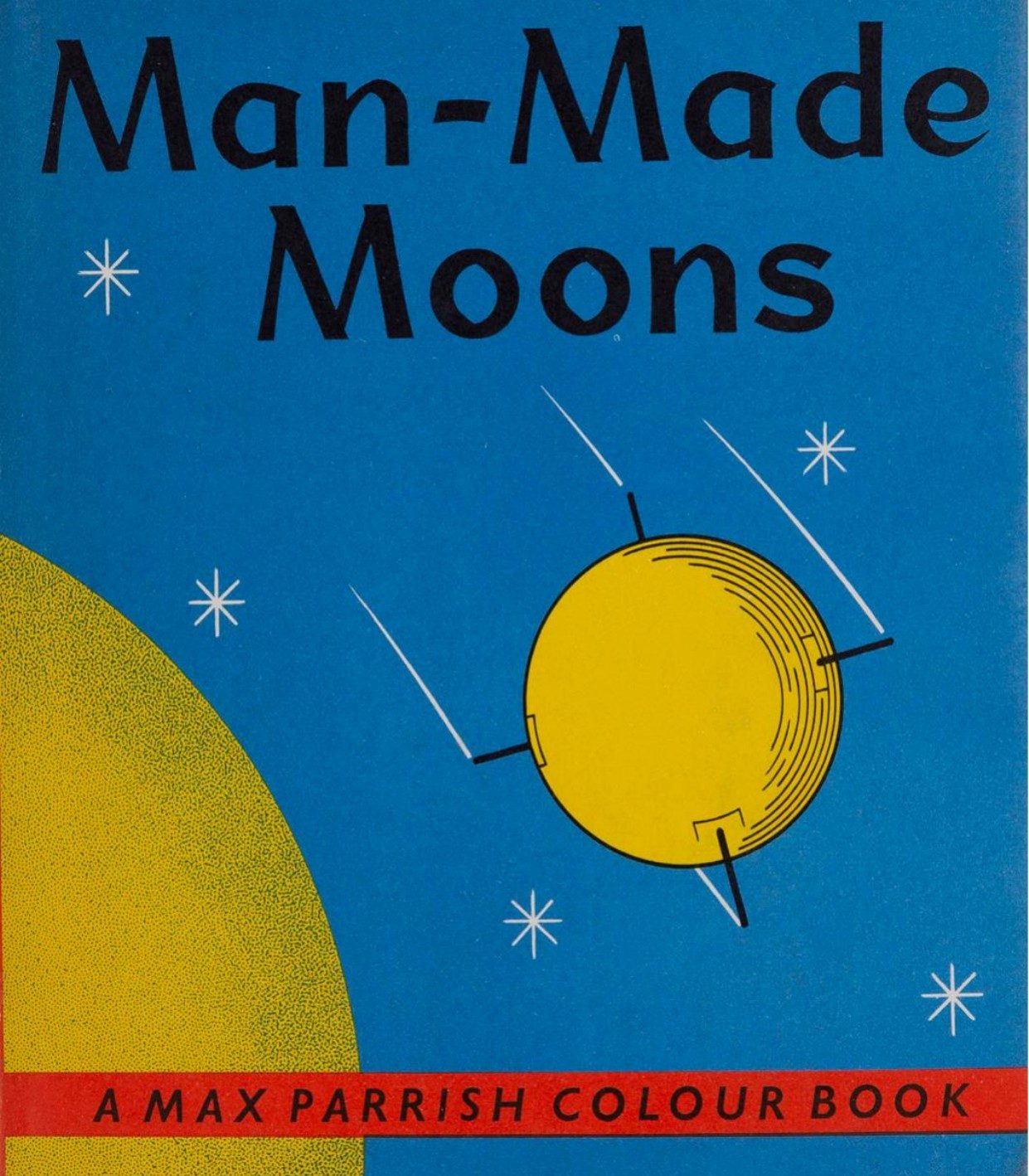
MAN-MADE MOONS
fe) ISOTYPE © MAX PARRISH & CO LTD 1960 PRINTED IN GREAT BRIT. ‘AIN BY FLET! CHER
Made Moons

                       Marie Neurath


idkedleeneenie   Max Parrish   London
LIST OF CONTENTS
Three Rockets Send a “Moon” Up
nann
The Furious Burning Which Drives the Rockets
Firing the Fuel in the Third Rocket
wc
How We May Use the Atom’s Power
Getting Up to Great Speeds 10
The First Man-Made Moons 12
Seeking New Knowledge of the Stars 14
How Fast Must a “Moon” Travel? 16
Seeing the Same TV Anywhere on Earth 17
Aiming the “Moon” to Hit a Target 18
Viewing the Whole Earth in One Day 20
The “Eyes” Which Will Look at the Earth 22
The First Discovery the Satellites Made 24
Making Electricity from the Sun 26
Spinning Paddles Which Catch the Sun 28
Hitting and Rounding the Moon 30
Measuring the Swift Rays of Space 32
The Earth’s Magnetic Pull in Spac 33
e
The First Living Space Travelle 34
rs
Man-Made Planets 36Three Rockets Send a “‘Moon”’ Up
él
A single large rocket can soar up many miles, pushing
its way through the densest layer of air and over-
coming the strongest part of the earth’s pull (which
weakens rapidly as we go higher and higher). A smaller
rocket fired from it can then reach a height of hundreds
of miles. To launch a man-made moon, we use three
rockets. The first two carry it to a great height. The
third shoots it out so that it circles the earth. = t al
aThe Furious Burning Which
The first two rockets both work the same way.
Each has two tanks holding different liquids.
These are sprayed into a strong metal chamber
where they burn furiously together, produc-
3B ing huge quantities of hot gases which push
violently in all directions. The gases which
| back, so those which thrust against the top of
escape from the bottom do not hold the rocket
the chamber send the rocket hurtling upward.
i
MOTT,
]Drives the Rockets
The liquids are forced into the chamber by a pump
(shown black), at the right rate to keep the burning
going long enough for the rocket to build up speed.
The gases become so hot that the metal of the
chamber might melt, so one of the cool liquids
is made to circulate round it.Firing the Fuel
in the Third Rocket
Just as the second rocket reaches its
highest point, an electric battery in
the third and smallest one makes a
spark. This sets light to a highly
explosive solid fuel. Although this
quickly burns out, it gives the rocket
enough extra speed to take it far into
space. All rocket fuels, liquid or solid,
can burn without air around them,
and thus can travel in space.
How We May Use


Lu
cesPeaeee
                the Atom’s Power

            Here is a rocket of the future, fitted

            with a reactor where atomic changes

            produce tremendous heat. This could

            turn liquids into large volumes of gas

ARR
            to thrust the rocket along.


  y
  |
  4
  |
  4


 SuyspS
  y
  S
  kA
  Ka


  y
  g
  s
  4
  y
  gy
  S
  4

  z
  z
  A


            To fly far would need too much liquid,

            but a small weight of atomic fuel goes
            on producing great heat for a long
            time, so atomic rockets may some day

            be invented to fly millions of miles.
Getting Up to Great Speeds
When the first and largest rocket has burnt all its
fuel
it drops away. The second, already travelling fast, starts
its engine automatically and leaps up faste
r still. When
it, too, has exhausted its fuel the third rocket makes the
final spurt. As soon as this is fast
enough to stay up,
rocket and “moon” separate and continue the journe
y.
10Soon ‘“‘moon-carriers” may consist of only one set of
engines. The rocket shell will consist of several fuel
tanks, arranged in rings (blue and yellow). Each ring
will fall away as its fuel is used up, leaving the rocket
lighter. With them will go the outer engines, leaving
the inner rocket to continue on its own fuel.
llThe First Man-Made Moons
Sputnik 1 was a small polished metal _ .
ball with four rod-like aerials. Its \. SeuTNiee
scientists could track it. Sputnik 2 EN
radio sent out signals from which
was much bigger and travelled farther
from the earth. It carried instruments
for measuring the rays which travel
through space, radio (in the ball) j/
which sent the measurements back to X I <
earth, and a chamber for the dog
Laika, whose journey proved tha
t live
creatures can survive the shock.
SPUTNIK |
12SK
vi VANGUARD |
SPUTNIK 3
SS
EXPLORER
The next satellites to be sent up could signal back how hot or cold they were, in
sun and shadow; how much dust was hitting them; how intense were the rays and
particles in space and how strong was the earth’s magnetism. Sputnik 3 was
large, with many instruments, Explorer and Vanguard 1 much smaller, but packed
with skilfully made tiny instruments. All had radio sending sets and aerials.
13Seeking New Knowledge of the Stars
The earth’s air-cover stops some of the
rays from the stars. To study these rays,
we must send a satellite above the air.
What is the simplest way?
We launch it from near the equator, in the
same direction as our earth spins. The
speed of the turning earth added to the
speed of the rocket helps to carry it up.
14To someone outside the earth’s air-cover, the sky would look ack, It looks
blue to us only because the air catches the blue re s in the sun’s light. By
studying the rays from the sun and the stars we can find out what they are
made of, how hot they are, how they are born, grow and die. Especially those
rays which are shorter than blue light can best be studied from above the air.
15How Fast Must a “‘Moon”’ Travel?
© aa ee
.
a ics ~
ra bie
4 .
‘ NX
7A
V4
/
/
/
/
|
|
|
|
| \
\\
\
soS
\
\ \
‘‘ |
\. :
= SUE Se ae e /
/
:
2 /
' /
: /
‘ VS
= 7
: a
S Fe
& ts
= =
~~ Ca
The ne: ‘arer to the earth a sate|
ti bi u IP D
Ss, the faster it
tellite ircle:
circles, vel ti 0 sta
must travel
If it is Bh
2,000 miiles
le: up,
p> it mus’$ t travel
el oy
over 12,000
A mile: sS per h our.
ur, irclijing
circling the
earth in three h ‘ours. If itit iis 6,000 i
miles up, it must go half ro und in in t three
hours ; if 2:
3 if 22,000 miles up, one eighth round, or once round in 24 h ours.
16Seeing the Same TV Anywhere on Earth
Our earth turns round once every 24 hours. So if a satellite like the last were
above the equator and moved the same way, it would seem to us to stand still.
With three like it, we could broadcast TV to one, which would reflect it to
the others. The three together would reflect it back to all parts of the earth.
ueAiming the “Moon” to Hit a Target
A satellite can circle the Ear
th any way we wish to mak
e it. But if we want
to hit the Moon, or
a planet, or to circle roun
d one of them, we must not only
remember that the Earth
is turning round and circ
ling the Sun, but also we
must
know how the Moon and planets
move. We can think of the Sun
as the spindle
of a giant record-player, with discs
put on at different angles. The dise
round
the edge of which Mercury mo
ves is tilted a different way
from the one which
marks the path of
Venus, Earth and
Mars both lie on yet another disc tilted
at another angle. The
path of the Moon round the Ear
th tilts another wayNo text on this page.
Viewing the Whole Earth


                The red line is the
                                            track
             of a satellite    which
                                is 6,000
        miles above the
                        earth’s surface,
circling from
                north     to south   and back.
On page 16 we fo
                 und that it goes
                                  round
once every
             six hours.
                          But during
                                     that   time
the earth belo
               w   makes exactly
                                 a quarter
of its daily sp
                in from west
                             to east.


20
in One Day
So in a single day this satellite makes four complete journeys
round the earth, passing over different parts of it each time.
(It crosses the equator eight times, at eight different points.)
If it carries the right instruments, it can view the whole surface
of the earth, or the clouds above it, every day.The “Eyes” Which Will Look at the Earth
This satellite will spin round, so that its
two window “eyes”
together will receive heat rays from all the surface over
which it passes. The rays will fall on
electric cells, strong
rays causing strong currents, weak rays weak ones. These
will tell us, by radio, where the rays
are strong.When the strips which the satellite
“sees” are pieced together, they will
form a map every day showing rays re-
flected from all over the earth. Experts
will know that strongest rays mean
snow, next strongest clouc nd weakest
earth or sea. So they can watch the
clouds and storms everywhere, and
how they are moving from day to day.
At present we only know fully what
the weather is like near weather ships
and weather stations (shown by clear
circles above). So we can only be sure
what the weather will be near these
and for a short time ahead. If we
knew conditions everywhere, we could
forecast the weather anywhere, and
for a longer time in advance.No text on this page.
The signals sent back by the satellites now make us think that the earth’s

magnetism collects the particles into two belts, going all round except at the
poles. Within these belts the particles fly from end to end at great speed.
They will be dangerous to spacemen passing through. If particles crowd into
the belts, some may overspill towards the poles, causing the lights in the sky.

                                                                            25
Making Electricity from the Sun
is ev)
Pe SP! ae erystal of pure silicon the
electrons are arranged in a regular
a s A ‘pattern, four outer electrons to each
atom. But if the crystal contains
a 2» small quantities of an impurity with
f | os as “ five electrons, a few atoms will be
, different from the pattern,
When sunlight strikes a crystal of pure silicon some electrons are knocked out
of place. But they simply change places with electrons from other atoms. In an
impure crystal, extra electrons are moving about, but the extra spaces are not
so easy to find. Some reach the edge of the crystal before they can settle again.
AAAI
26\\\. If a barrier at the edge of the erystal
lets these electrons through but will
not let them back, a pure silicon
crystal beyond the barrier collects
extra electrons. These will flow through
a wire connecting the two crystals,
making an electric current.
=)
While the sun shines, many crystals arranged in this way will make a current
strong enough to send radio signals and also to charge a battery. In darkness,
when the crystals make no current, the battery will keep the signals going.
aM
zy
27Look at the top rocket of this American moon-carrier
on the left. The satellite inside it (red) looks like a ball
with a flat package under it. Just as the top rocket has
almost completed its spurt into space, its nose opens up.
Springs release the package and out shoots the satellite,
spinning as it goes. The spin makes the package spread
out into four paddles like the sails of a windmill. Both
sides of each paddle are covered with many crystals
which will make electricity when the sun shines on
them. The paddles are arranged so that at least one side
of one paddle will always catch the sun, and electricity
will be made continuously unless the paddles are in the
shadow of the earth. The current can be strong enough
to send radio signals from fifty million miles away:
2829
ii
     The earth is spinning like a top and the
     moon is circling round it. The moon will
     moye round while a rocket is                     flying
     towards it. So only if the rocket is fired
     at the right moment, at the right speed
     and in the right direction will it cross
     the moon’s path so that they collide.
     The rocket’s path (dotted line) is curved.
       To send a rocket flying round the moon
     is still more difficult;        for it       must be

     flying just fast enough to pass and come

     back round the earth. The third Russian
     moon-rocket passed only a few thousand
     miles from the moon, and just at the time

     when the back of the moon was lit up by
     the sun. At a signal from the earth, gas-

     jets   stopped   Lunik’s   spin,       its   cameras

     pointed towards the moon, opened their

     shutters and took a film of the surface.

       Lunik’s    journey    (full    red     line)    then

     took it back round the earth. When it

     was nearest, at another signal, the film was

     televised   back   to   earth—the        first    view

     man has ever had of the back of the moon.


30
(es
{
31Measuring the Swift Rays of Space
Rays ofvarious kinds, waves and particles, fly swiftly through space. To measure
them, satellites carry tubes with windows which let only one kind in, When a
tay strikes through, it knocks electrons out of the atoms of a thin gas in the
tube. The electrons make a bridge between wires from a battery. A current
flows; its strength, signalled to earth, tells us the strength of the ray.
32
The Earth’s Magnetic Pull in Space


How can we measure how far, and how strongly, the earth’s magnetism stretches
into space? If we put water between the poles of a magnet, the cores of atoms
in it line up like tiny magnets. If we turn the poles, the cores turn.

ae | See


A signal to the satellite starts a current through a coil in water. This lines up
the atom cores along the coil. When the current stops, the cores turn to the
earth’s magnetism. As they turn, they make a weak current in the coil; its
strength, signalled to the earth, tells us the strength of the earth’s magnetism.

                                                                              33
The First Living Space Travellers
How would space travel affect men’s health? To help find out, Sputnik 2 carried
a live dog. Special instruments read its pulse, breathing rate and blood-pr
essure,
and all the readings were radioed to earth. The dog lived in an air-conditioned
chamber and an automatic machine gave it food and water at regular times.
The dog was strapped down to avoid injuries while the carrier-rocket soared up.
34tes
ee
=
we
=
Laika, in Sputnik 2, circled the earth
many times but was never brought
back. Later, American scientists sent
two monkeys into space in the nose of
a rocket. It was made to go up and
then drop them into the sea on para-
chutes. Both monkeys were safe. First
the instruments fixed to their bodies to
take readings were removed, then they
had a thorough medical examination.
35Man-Made Planets
low str on
stro } gly
g anc
nother heavenly y body
a
pu s a rocket depeon
I nd its
s own
on how far away
way the
the rocke t is. Once a rocket escapes the
rocket pull of the Earth, the
small M Moon pulls it
only ly weakly.
wea If it mo ves fast
last enoug! h it esc .ape
? s that 2
pu
T hen, aah held bb y the e gian
giant t Sun, it 0 may circ
circlele rc round d it ao 2 manera
made plNo text on this page.
No text on this page.
The Maz Parrish

                         Colour Books
  Here is a complete list of the books which
 are like this one. You can buy them through
 any bookshop anywhere in the world.

  Wonders of the Modern World
 WHAT'S NEW IN FLYING?
 BUILDING       BIG      THINGS

 EXPLORING           UNDER THE       SEA

 INSIDE THE          ATOM

 MACHINES WHICH SEEM                 TO THINK

 SPEEDING       INTO      SPACE

 A    MESSAGE       ROUND      THE   WORLD

 LET’S LOOK AT THE SKY
 FLYING THE ATLANTIC             (by Manfred Reiss)

 ROCKETS       AND JETS

 FIRE!
 RAILWAYS           UNDER      LONDON

 I'LL SHOW YOU HOW IT HAPPENS
 IF   YOU     COULD      SEE   INSIDE

 THIS    IS   HOW    IT WORKS


 The Wonder World of Nature
 ANIMAL       TRAVELLERS

 EARTH        AND   SKY

LAND     AND    WATER

TOO     SMALL       TO   SEE

STRANGE        PLANTS

THE     DEEP    SEA

LONG     AGO

THE     SEASHORE

BIRDS

INSECTS

ANIMALS


A New Look at World History
HOW     THE    FIRST MEN        LIVED

THE    FIRST GREAT INVENTIONS

HOW     THE    WORLD       WAS    EXPLORED


          by Marie Neurath
Standard Edn. 7s. net Library Edn. 8/6 net.
No text on this page.
 Isotype Archive