Page text
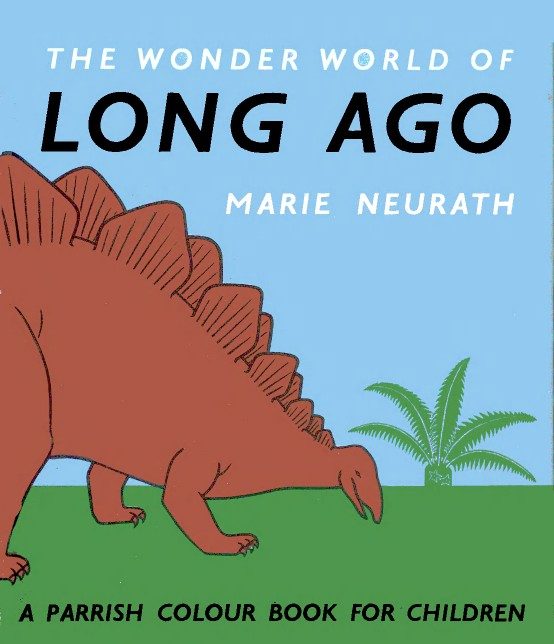
THE W O N D E R    WORLD       OF


 LONG AGO
             MARIF    hi F11R A T FI


A PARRISH COLOUR BOOK FOR CHILDREN
No text on this page.
No text on this page.
No text on this page.
T HE   WONDER   WO RLD   OF

       LONG AGO
T HE WONDER WORLD OF
ISOTYPE
M ax Parrish London
LIST OF C O N T E N T S


The Buried Bones o f Early Living Things            5
The Ancient Sea Where Life Began                    6
A Bare, Silent, Empty World                         8
The First Creatures to Breathe the Air              10
Learning to Live on the Dry Land                    12
The Strange First Forests o f Giant Ferns           14
The Age o f the Monsters Begins                     16
The Largest Land Creature that Ever Lived           18
When Giant Jaws Met Giant Armour                    20
Seeking Safety in the Sea                           22
Monsters which Fought with Teeth and Horns          24
Gliding Reptiles, Birds with Teeth                  26
The Monsters Die Out, the Small Creatures Live On   28
How the Horse has Changed in Sixty Million Years    30
The Sabre-Toothed Hunter Meets his Match            32
From Snout to Trunk and Tusks                       34
Men, the New Masters o f the Earth                  36
The Buried Bones of Early Living Tilings

                  Buried in the rocks lie the bones
                  o f strange animals which lived
                  long before there were men on
                  the earth.


                  Deeper down are the remains
                  o f fishes, birds and giant lizards
                  which lived more than seventy
                  million years ago.


                  Deepest o f all are the shells o f
                  some o f the first living things,
                  whose home was in the sea.
The Ancient Sea Where Life Began
In those far-off times, there were no fish like those we know to
day, but seaweed was already growing and jellyfish and squids
swam among it. The most powerful creatures were those on
the right. Some scientists believe that the young ones had only
6
a head, and grew by adding new sections to their bodies. Each
section had a pair o f legs, used not only for moving about
but also for breathing. I f a sea-scorpion attacked with its
claws, they could roll up like a ball and keep safe.

                                                            7
A Bare, Silent, Empty W orld
On the dry land there was no life at a ll: no animals, no birds,
no insects, no trees; not even a blade o f grass. Rain fell on
the bare earth and rivers carried mud down to the sea, where
it sank to the bottom and very slowly hardened into rock.
The only sounds were the rushing o f waters, the rumbling o f
volcanoes, the roaring o f storms.

                                                            9
The First Creatures to Breathe the Air
The first fish-like creatures had no real backbones. The front
part o f their bodies had a covering o f bone, like thin armour.
Long ages later, real fish with backbones lived in seas and rivers.
io
yff 3 j 0 0 ji P:if:


   Nobody knows why, but in time some went to live in rivers.
   Perhaps other creatures made life too hard for them in the sea.


Some had lungs; they could raise their heads and breathe the air.

                                                                11
Learning to Live on the Dry Land
When there was little rain, rivers dried up. Some kinds o f fish,
by flapping across the land, were able to find new water to live
Ages later, some creatures lived on land, but laid their eggs in
12
in. They were the first creatures to live for a few minutes on
dry land. Those kinds which did this best did not die out.


water.   The young lived first in water, then on land, like frogs.

                                                                !3
The Strange First Forests o f Giant Ferns
Long before the first animals lived on dry land, plants had
begun to grow there. In time, much o f the earth was
covered with hot, steamy forests o f horse-tail plants and ferns
J4
as big as trees. In them lived strange creatures like giant
newts, some small, some bigger than a pig. There were no
birds yet, but already the first winged insects flew overhead.

                                                            15
i6
These flesh-eating reptiles lived in the desert, where food was
scarce. At times they fought to the death, and winner ate loser.

                                                              17
No text on this page.
This giant reptile, three times as big as a bus, had a small
head and a tiny brain. It lived on plants and spent most o f
its time paddling in shallow water, eating, eating, eating.
The water helped to support its enormous weight.


                                                          *9
When Giant Jaws Met Giant Armour
20
Both these creatures were far bigger than the biggest elephant.
The giant lizard had over twenty thick bony plates on its
back, a strong defence against the sharp teeth o f its enemy.
Seeking Safety in the Sea


With hungry monsters on the land, many reptiles found it
safer in the sea. Those which were best suited to life in the

22
sea spent more and more time there. Millions o f years later
some reptiles had fins or flippers and lived there always.

                                                          23
Monsters which Fought with Teeth and Horns
The monster on the right stood three times as tall as a man.
Almost every other creature could be defeated by his great
sharp claws and his dagger-like teeth. But he would avoid
the smaller creature, with its three horns and great ugly head
as strong as armour.
24
25
Gliding Reptiles . . .


No reptile could really fly, but this one, the size o f a small
airplane, could glide from a cliff-top and scoop fish from the
sea. It is called a pterodactyl, which means “winged finger”.
It used the free “fingers”on its wings to help it to climb.

26
The first feathered birds lived at the same time as the gliding
reptiles. With light bones and strong wing muscles they could
flap their wings arid really fly. But they were not like any
birds we know. In their beaks they had a row o f teeth.

                                                             27
The Monsters Die Out . . .
the Small Creatures Live On
The giant reptiles laid their eggs
and left them. Small warm
blooded animals, to which the
eggs were food, stole and ate
them. As time passed, fewer and
fewer new monsters hatched out.
28Times came when the climate o f the earth grew colder. The
giant reptiles, with no way of keeping warm or feeding their
young, died out. The much smaller animals lived on : they
had warm blood and furry coats, and fed their babies with milk.
29t. u
30
Sixty million years ago the first
horses, no bigger than growing
puppies, padded through the hot
jungle, cropping the green plants.
They had four toes on the fore
feet and three on the hind ones,
and small hooves. They were
at the mercy o f giant birds, taller
than the tallest man.
Much later, when the earth was
cooler and the forests less dense,
horses were larger. They now
had three toes on each foot and
could run very well. Though,
they were no longer eaten by
giant birds, they were often
attacked by savage animals.
Ages passed by and the earth’ s
climate altered. Where forests
once grew there were now grassy
plains. On these lived horses
much more like those we see
to-day. Now only one toe on
each foot touched the ground.
With long legs and strong hooves,
they were swift, powerful runners.
31Sabre-Toothed Hunter Meets liis Match
The sabre-toothed tiger was a swift runner and a fierce fighter.
The giant armadillo moved slowly, like a huge tortoise.
But when the tiger leapt upon him, the armadillo drew his
head and legs under his strong shell and kept safe.
32
But the giant sloth had no hard shell and was too heavy to
run away. How could he defend himself?


He could use his great weight. Falling over backwards, he
could crush the tiger beneath him.

                                                        33
From Snout to Trunk and Tusks
The first elephants were like pigs with very long snouts, and not
much bigger. They lived about the time of the earliest horses.
Millions o f years passed before elephants had trunks and tusks.
34
By the time the woolly mammoth, the largest elephant o f all,
lived on the earth, new and active hunters had appeared. . . .

                                                           35
Men, the New Masters of the Earth
The new hunters were early men. They were not so big as
many o f the creatures which lived before them. But they had
useful hands and better brains. They had learned to use
tools, hunt animals, light fires. They were to become the
masters o f the earth.
36
No text on this page.
No text on this page.
No text on this page.
DESIGNED BY ISOTYPE
 Isotype Archive