Page text
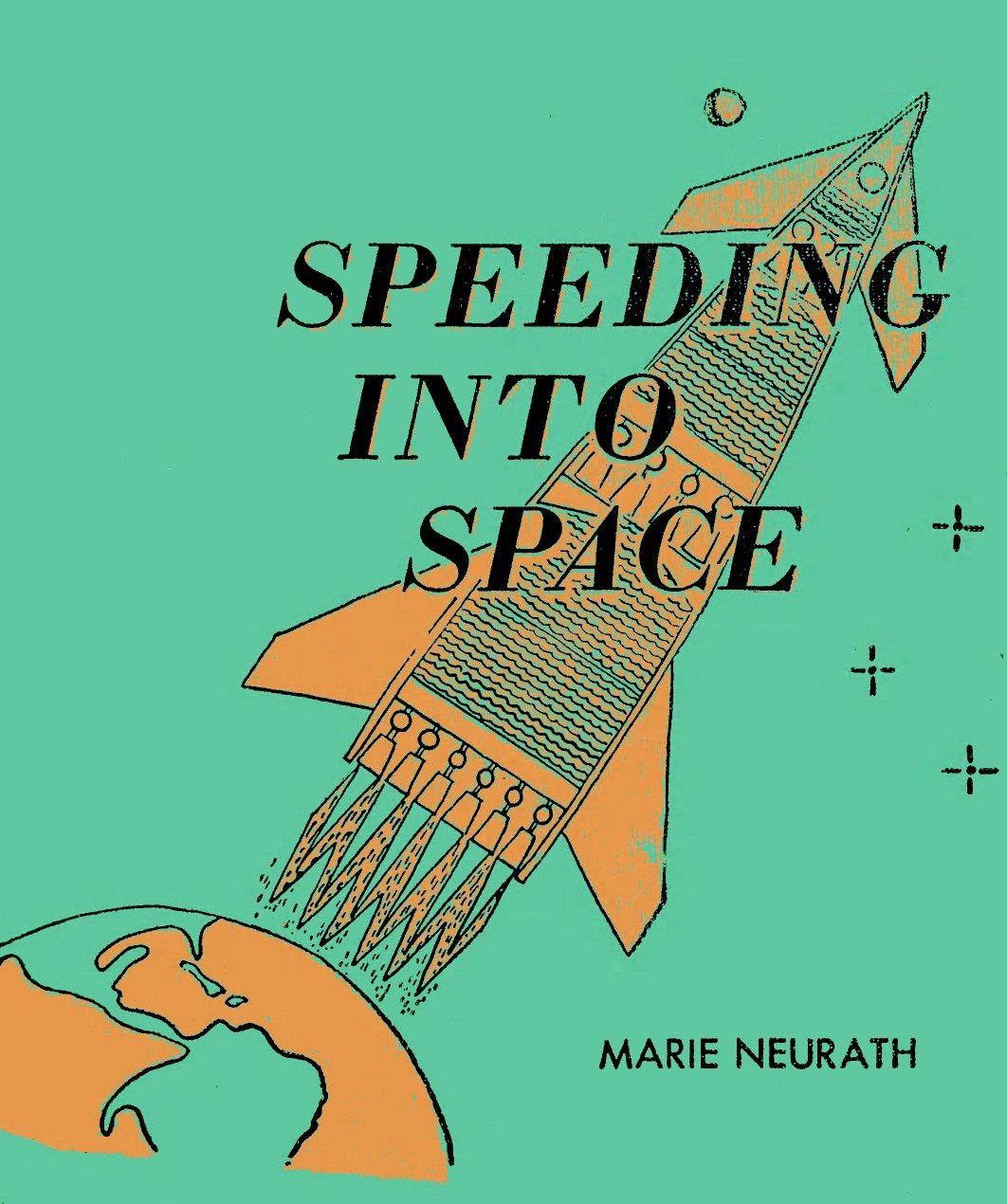
MARIE NEURATH
No text on this page.
No text on this page.
No text on this page.
No text on this page.
No text on this page.
No text on this page.
No text on this page.
Speeding into Space
No text on this page.
LOTHROP, LEE & SHEPARD NEW Y O R I N E W A R K A CHANTICLEER EDITION
List of Contents

A Thousand Times Farther than Ever Before                                           5
Getting Away from the Pull of the Earth                                             6
The Spiral Course that Makes the Climb Easier                                       8
Flying too Fast to Fall                                                            10
Shaped Like an Arrow to Cut Through the Air                                        12
Dropping the Fuel Tanks to Lighten the Load                                        14
When a Man Will Weigh Nothing at All                                               16
Stepping Out into Empty Space                                                      18
Firing a Pistol to Move About                                                      20
Speaking Where Voices Cannot Carry                                                 21
The Spinning Station in Space                                                      22
How Can We Land on a Moving Station?                                               24
Blazing Heat and Flying Metal                                                      26
Reaching a Moving Speck in Space                                                   28
Strange Worlds which Men May One Day See                                           30
Slowing Down the Journey Home                                                      32
From Moving Earth to Moving Planets                                                34
Distant Worlds Men May Never Reach                                                 36


The pictures and text of this book have been carefully examined by Kenneth W. Gotland,
a founder-member of the British Interplanetary Society and author of “ Space Travel ”
A Thousand Tim es Farther than E ver B efore


Men h a v e n e v e r y e t tra v e lle d far fro m t h e E a r t h : a few feet on h o rse -b a c k , a few
miles in balloons a n d a irplanes.                  N o m ore.        D o u b le ro ck ets h a v e soared tw o
h u n d red and fiftv miles a w a y b u t h a v e n e v e r carried passengers.                             E v e n our
E a r t h ’s n e a re s t n e ig h b o r, th e M oon, is a t h o u s a n d tim es f a r t h e r t h a n t h a t .   Shall
vve e v e r rea c h it ?


                                                                                                                        D
Getting Away from the Pull of the Earth
ii this book we shall see how the journey may some day be made. The hardest
art   will be getting away from the Earth. When a space-ship first takes off, the
artli will pull strongly against it. It will need tremendous power and a great deal
I lut'l to overcome the Earth's pull. But the farther it travels from the centre of
In- Earth, the weaker the pull becomes. Twice as far away it is only a ifuarter as
imug: three times as far away it is only a ninth part as strong.


                                                                                      7
T h e S p ir a l C o u r se th a t M akes th e C lii
A tra in c lim bing a m o u n ta in also has to o v ercom e the pull to w a rd s th e c e n tre of
th e E a r t h . It could n e v e r clim b s tra ig h t up th e steep face, but h\ ta k in g a long,
spiral ro u te it fa n reach the top. A space-ship m ight overcom e th e E a r t h ’s pull
in th e sa m e w ay. I n s te a d o f flying s tr a ig h t up, i i could t r a \ el in a spiral.
8
asier


On th e slope o f a high m o u n ta in th e re is som e tim e s a s ta tio n w here p assengers
can c h ange to a n o th e r k in d o f t r a i n to c o m p le te th e ir j o u r n e y , a n d w h e re fuel
is s to re d . \ \ e shall see t h a t it m a y one d a y be possible to b u ild s ta tio n s in space
for th e sa m e k in d o f p u rp o se .


                                                                                                            9
Flying too Fast io Fall
11 this space-ship were i<> s ta r t off .si miles a second (w hich seven t h o u s a n d
miles a n ho u r), II w ould soon be pulled b a c k to E a r th .
I f it s t a r t e d at th re e miles a second it could go f a r t h e r before crashing.
I f it s t a r t e d at a b o u t five miles a second it could keep circling ro u n d th<- E a r th
just as th e Moon itself does - a n d w ith its engines shut off.
10
H e re we are above th e E a r t h , w a t c h
ing th e tra c k s o f th e four space-ships
sh o w n op p o site . The tw o slower
s ta r te r s crash. T h e t h ir d circles ro u n d
a n d r o u n d th e E a r t h . T h e f o u rth an d
fa s te st spirals o u t in to space.
I f th e re w ere a s p a c e - s ta tio n circling
ro u n d th e E a rth , one space-ship,
leaving th e E a rth a t five miles a
second, could reach th e s ta tio n .
A n o t h e r ship could ta k e off from th e
s ta t io n a n d c o n tin u e th e j o u r n e y .
11S h ap ed L ike an Arrow to Cut T h ro u g h I
12
L
S o m etim es w hen a w ind is blow ing we h a v e to w o rk h a r d to w a lk ag a in st it. An
express tra in has to w o rk h a r d to p u s h t h ro u g h th e a ir even w h e re th e r e is no
w ind. I f th e f a s te s t tra in s a n d m o to r cars are m a d e s m o o th , or s tre a m lin e d , th e ir
task is easier. A j e t p lan e flies so fa s t t h a t it m u s t w o rk v e ry h a r d , a n d a sp a c e
ship, w h e n it leaves th e E a r t h , Mill c u t th r o u g h th e air so q u ick ly t h a t it m u s t
w ork m u c h h a r d e r still. So th e j e t p lan e a n d th e space-ship are s h a p e d like an
arrow , to help t h e m to c u t th r o u g h as easily as possible. B u t a ship ta k i n g off
from a s p a c e -s ta tio n to c o n tin u e th e j o u r n e y w ould t ra v e l only in e m p t y space
and w ould n o t have to w ork a g a in s t air a t all. I t could be a n y s h a p e we liked
to m a k e it.
13D ropping the Fuel Tanks to
V- a space-ship tak e s off, a g re a t je t of h o t gases will ru s h fro m its engines. A
channel c u t th r o u g h th e g ro u n d will h a d th e gases safely a w a y . T o ov e rc o m e th e
irst s tr o n g pull o f the E a r t h , th e ship will c a r r ) h u g e q u a n ti ti e s of fuel (an d
jx y g e n for it to b u r n w ith) s to r e d in six s e p a r a te ta n k s . As th e tw o larg e r d o u b le
tanks becom e e m p t y th e y will b r e a k off a n d glide to E a r t h on p a r a c h u te s , leaving
the ship m u c h lig h ter. Bv th e n th e ship will be far a w a y , w h e re t h e E a r t h ’s p u ll is
weaker. T h e fuel a n d o x y g e n in th e sm a lle st t a n k will h e all it needs.


                                                                                                             15
\\ hen a Mail Will \\ eigh
e?
Nothing at All
L y in g on In- b u n k before the trip begins, .1 m an will In- pressed a g a in s t th e m a t-
lrrs> I>\ 1In- pull of ilu E a r th . S u d d e n ly , w 1i ii a ro ar, I In- ship will rise in to th e air.
T h e b u n k a n d th e m a ttr e s s '.'ill be p rked u p w a rd s w ith th e ship, a n d th e m a ttr e s s
will press against th e m a n , m ak in g him feel heavier.
L6Once th e ship is m o v in g so fast t h a t the
E a r t h 's pull c a n n o t d ra w it h a c k , it will
keep up t h a t speed w i th o u t its engines,
b ecause th e re will be no air a r o u n d it to
slow-it dow n. T he m a n inside th e ship will
he m o v in g a t th e sa m e speed a n d the
E a r t h ’s pull c a n n o t d ra w him h a c k either.
He will n o t press a g a in s t th e m a t tr e s s a n d
th e m a t tr e s s will not press a g a in s t him .
He will feel no w e ig h t a t all. To m ove, he
will h a v e to p u s h ag a in st th e wall or
a g a in s t s o m e th in g fixed to th e ship.
17Stepping Out into Em pty Space
E v e n if a m a n leaves th e ship he will go on m o v in g a t th e sam e speed as th e ship.
Y e t he will n o t n otice he is m o v in g , for he will pass n o th in g w hich is s ta n d in g
still a n d th e re will he no w in d ru sh in g p a s t. B u t if s o m e b o d y throw s a hall a t him
he m a y float off" n e v e r to r e tu r n . H e m u s t he tied to the ship b y a rope. Since the
rope has no w e ig h t it m a y cu rv e in a n y direction.
18
No m a n d a re s te p o u t j u s t as he is. In sid e t h e ship he has air to b r e a th e . O u tsid e
th e re is n o th in g . So first he e n te rs a room w ith a do o r a t e a ch e n d a n d p u ts on a
s tro n g ly b u ilt suit, r a t h e r like a d i v e r ’s, w ith air inside it. T h e n , closing th e
second door b e h in d him , he passes th r o u g h a n o th e r ro o m a n d o u t in to space.
T h u s v e r y little air escapes fro m th e ship.


                                                                                                       19
Firing a P istol to Move About
H ow c a n people b uild a s ta t io n in space, w here e v e ry th in g b e h aves as if it h a d no
w e ig h t? I f a m a n p u shes a piece of m e ta l fo rw ard , he will he p u s h e d b a c k w a rd s
as well. T o o v ercom e th is, he m u s t lire a je t- p is to l b e h in d him . T h e n the m a n a n d
the w eig h t will m ove forw ard.
20
Speaking W here Voices Cannot Carry
                                                  W h e n we s p e ak , the s o u n d o f our
                                                  voices is ca rrie d b y w aves in th e air.
                                                  In sid e a space-ship people will be
                                                  able to s p e a k to each o th e r cpiite
                                                  n a tu r a lly ,   b ecause   th ere   will be
                                                  air. (“ Good a i r ” , or oxy g e n , will
                                                  e n te r th e ship from a c o n ta in e r ;
                                                  “ b a d a i r ” , or ca rb o n -d io x id e , will
                                                  be d r a w n out.)


I n space, w h e re th e bu ild e rs o f th e
s ta tio n m u s t w o rk , t h e only air
will be     th at   inside    th e ir space-
suits. Voices w ould c a rr y n o f a r t h e r
t h a n th e linings. T o s p e a k to each
o th e r, w o r k m e n will n e e d walkie-
talkie wireless sets. T h e n th e s o u n d
will be carried b y wireless w aves,
w hich do n o t need air to tra v e l in.


                                                                                                 21
The Spinning Station in Space
T h e c o m p le te d s p a c e -s ta tio n m a \ look like th e wheel o f som e g igantic car. Besides
circling r o u n d th e E a r t h it will also spin like a g ra m o p h o n e tu r n ta b le . T h e long
a rm will not spin (we shall see why later). A huge m irro r could collect h e a t from
th e s u n ’s rays to be tu r n e d into electricity to use inside the s ta tio n .
22
The spin o f the s ta t io n will p u s h e v e r y th in g inside it to w a rd s th e o u te r edge.
People will feel w eightless no longer, as t h e y will w hile m o v in g freely in space.
T h e y , a n d all th e th in g s t h e y need to use, will he p resse d firm ly to w a rd s th e
“ r i m ” , w hich will serve as a floor. To reach th e h u b will he like clim bing u p sta irs.


                                                                                                  23
H ow ( ^an W e Land oil a
M oving Station ?
T h e a rm w hich does n o t spin (show n black) is used lor landing. S te erin g to w a rd s
th e c u p -s h a p e d p a r t is a “ s p a c e - t a x i " , c a rry in g passengers from a ship.
into th e “ c u p ” , this b a n d presses tig h tly a g a in s t th e rim.
24
Vir p a ssin g in to th e cup c a n n o t escape in to space b ecause th e tax i m a k e s an air-
ight fit. P a s s e n g e rs can safely leave the ta x i a n d e n te r th e s ta tio n .


                                                                                               25
T h e ship w hich m akes th e second a n d lo n g est p a r t of th e j o u r n e y m a y look like a
gig an tic m e ta l ball, w ith a c lu ste r o f ro c k e ts a t its base. H o w could it t u r n ?
Som e ro ck e ts could be on a sw ivel; th e p ilo t could s te e r b y c h a n g in g th e d ire c tio n
o f th e je ts . A ship like this, w hich is n o t stre a m lin e d , could n o t be ta k e n t h ro u g h
th e air r o u n d th e E a r t h . So i t w o u ld b e p u t to g e th e r, a n d fitte d o u t w ith all the
stores it needs, in space.
2b
H o w could we g u a rd a g a in s t being
h i t b y m e te o rite s - b its o f iron
h u r tl in g th r o u g h space at high
s p e ed ? W e c o u ld n ’t, b u t th e ship
could h a v e a do u b le wall. M ost
m e te o rite s w o u ld n o t g e t th r o u g h
th e o u t e r wall, b u t som e m ig h t
pierce it. I f so, m o st w o u ld be so
w o rn a w a y a n d slow ed d o w n t h a t
t h e y could n o t b r e a k t h r o u g h th e
in n e r wall.
W i t h no a ir to disperse t h e m , th e
s u n ’s ra y s w o u ld beat on th e
sp ace-ship w ith g r e a t p ow er. A l
th o u g h th e s h ip ’s h ig h ly polished
surface w o u ld reflect b a c k m u c h o f
t h e h e a t, t h e o u t e r w all w o u ld still
be c o m e to o h o t. T o k e e p th e ship
cool inside th e r e will be a v a c u u m
b e tw e e n th e tw o walls, j u s t as th e re
is in a T h e r m o s flask. Sm all double
w indow s will let in som e light.
27T h e long j o u r n e y from s p a c e -s ta tio n to Moon m ig h t ta k e a b o u t five days. B u t
(luring t h a t tim e th e Moon itse lf will tra v e l m a n y th o u sa n d s o f miles on its w a y
ro u n d th e E a r t h . O nce th e engines h a v e s ta r te d his ship, the p ilot w ould n o t ste e r
In space th e Moon is no m ore th a n a tin y , m o v in g speck. I f th e sp ace-pilot m a d e
even tilt' sm a lle st e rro r in w o rking out th e M oon’s po sitio n he m ig h t n e v e r reach it.
28
to w a rd s th e p o in t w here th e Moon was a t th e m o m e n t o f s ta r tin g , h u t to th e
point w here it w ould be five da y s late r. Before lan d in g , th e ship w ould reverse
a n d use th e t h r u s t of its engines to sto p it being pulled too r a p id ly to th e Moon.


On th e E a r t h , e x p e rts w o u ld check his figures w ith th e help o f m o d e r n c a lc u la tin g
m ac h in es. H e w o u ld keep in to u c h w ith th e m b y radio.


                                                                                                         29
Strange W orlds w hich Men May One Day S
I f tra v e lle rs reach th e M oon, w h a t will t h e y see a n d do th e r e ? B ecause th e re is no
air, t h e y can n e v e r t a k e oil th e ir sp a ce-suits. A n d w ith no air to s c a t t e r th e s u n
light, th e sk y will look b lac k , as e v e ry w h e re in space, w ith ou r E a r t h sh in in g in it
like a huge b luish-green hall. T h e pull of th e M oon is n o t n e a rly as s tr o n g as t h a t of
th e E a r t h , so e v e ry th in g will seem lighter. People will c a rr y w ith ease things
w hich th e y could scarcely lilt on E a r t h .
30
But space tra v e lle rs m ay visit
o th e r w orlds t h a n th e M oon. M ost
likely t h e y w ould feel m ore a t hom e
on M ars t h a n on V enus, w hich is
n e a re r to us. T h e a tm o s p h e re of
Mars is p r o b a b l y sim ila r to ou r
ow n, b u t m u c h too th in to b r e a th e .
Som e a s tro n o m e rs believe visitors
m a y also find green p la n ts grow ing
on M ars.
P e r h a p s m en will n e v e r v isit J u p i
ter. T h e clim a te is f a r colder t h a n
a t o u r Poles, a n d th e h e a v y a t m o
sp h e re c o n ta in s p oisonous gases. I t
is so v a s t, a n d its pull is so p o w e r
ful, t h a t a s tro n g m a n could h a rd ly
lift his feet fro m th e g ro u n d . B u t
one d a y m en m a y s t a n d on one of
th e m oons t h a t circle ro u n d J u p i t e r
a n d see th e g ia n t p l a n e t close u p ,
in t h e sky.
31Slowing Down the Journey H om e
32
Im a g in e you are on a ship just beg in n in g the last stage of th e h o m e w a rd jo u r n e y —
from s p a c e -s ta tio n to E a r th . Before th e ship leaves th e s ta tio n , b o th ship an d
s ta tio n are m oving so fast t h a t th e E a r t h c a n n o t pull th e m dow n. So the sh ip m ust
begin slowing down from the m om ent it starts. This it does b y p u s h in g w ith its je ts
in th e opposite w a y to t h a t in w hich th e s ta t io n is m oving. T h e n th e ship c ontinues
in th e sam e w a y as th e s ta tio n , b u t m ore slowly. I t spirals d o w n w a rd s , still tail
first, using its j e t s as a b ra k e a g a in s t th e grow ing pull o f the E a r t h .

W h e n th e ship e n te rs th e air it m u s t go slow er still, or it m a y becom e h o t a n d
c a tc h fire. So it tu r n s nose-first (to m a k e use o f its stre a m lin in g ) a n d trails o u t
p a ra c h u te s to slow' it dow n. F in a lly th e p ilot lowers th e u n d e rc a r ria g e a n d th e ship
glides dow n on to th e ru n w a y .


                                                                                                           33
From M oving Earth to M oving Planets
O u r E a r t h (show n green) a n d Mars
(show n blue) b o t h m o v e ro u n d th e
S un , h u t M ars h a s f a r t h e r to tra v e l
a n d ta k e s a lm o s t tw ice as long to
m a k e th e c o m p le te circle. T o keep
th e ir j o u r n e y as s h o r t as possible,
th e tra v e lle rs o f th e f u tu r e will set
off for M ars w h e n t h a t p l a n e t is
well “ a h e a d ” o f th e E a r t h . T h e ir
long v oyage, sh o w n b y th e b lack
line, will t a k e a b o u t nine m o n th s .
D u rin g t h a t tim e th e E a r t h will
have m ade th r e e - q u a r te r s o f its
j o u r n e y ro u n d th e Sun, o v e rta k in g
Mars.
To m a k e th e s h o r te s t possible j o u r
n e y h o m e, tra v e lle rs will h a v e to
w a it fifteen m o n th s , u n til th e E a r t h
a n d M ars are b a c k ro u g h ly w here
they w ere when th e ou tw ard
v o y a g e s ta r te d . B y th e n M ars will
h a v e c o m p le te d one circle r o u n d th e
S u n ; th e E a r t h will h a v e c o m p le te d
tw o.
The retu rn jo u rn ey will take
a n o th e r nine m o n th s .
34
T h e g re a t p la n e t J u p i t e r ta k e s a m u c h longer a n d slower j o u r n e y ro u n d th e S u n
t h a n M ars does. I t is so far a w a y t h a t th e v o y a g e w o u ld t a k e n e a rly th re e y e a r s ;
in t h a t tim e J u p i t e r w o u ld h a v e done less t h a n a q u a r t e r o f its tre m e n d o u s
j o u r n e y . B u t th e E a r t h w o u ld h a v e circled r o u n d t h e S u n a lm o s t th r e e tim es!


                                                                                                                  35
Distant Worlds
Men May Never Reach /'T > >
• / \ yy *
< ? * ___-
Many scientists believe that some boys and girls now
living will one day reach the Moon and the Sun’s planets.
But will men ever reach the stars? No, because the stars
are burning hot - many of them bigger and hotter than
our own sun. Some stars may have cool planets circling
round them, but if it would take five days to reach the
Moon, it would take many lifetimes to reach these
distant worlds.
! ,[
* */ » \ i . ‘. l
I 1
* *v *
\ \ \\ i V/j
—
V ». yNo text on this page.
No text on this page.
No text on this page.
No text on this page.
No text on this page.
No text on this page.
No text on this page.
No text on this page.
 Isotype Archive