Page text
nen


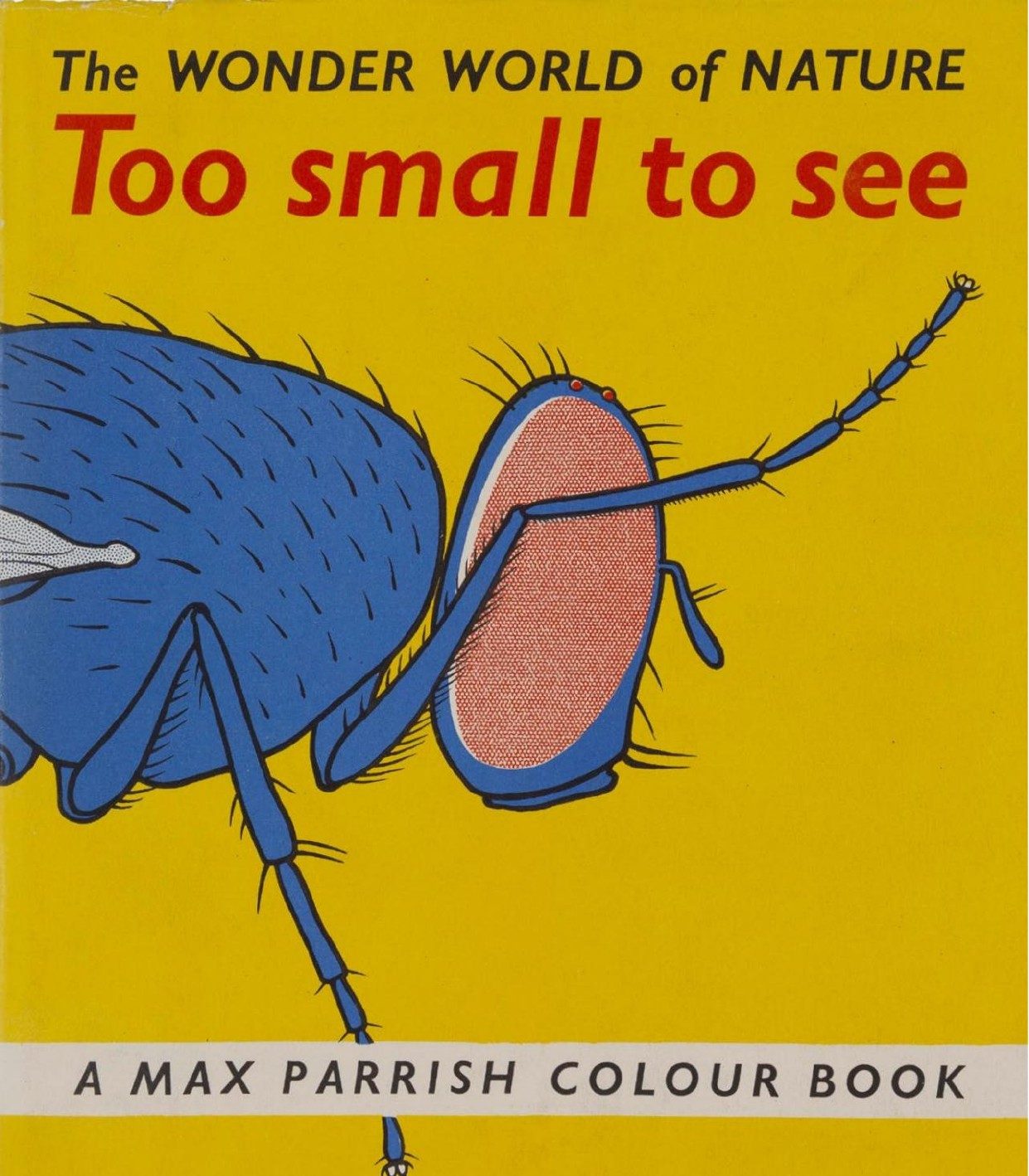
The WONDER WORLD of NATURE
No text on this page.
Too small to see |


ROZELAAR   &   WILKES   LTD   -   LONDON   Max Parrish   London
List of Contents

You Have Seen This Many Times!

                                            aooauw
The Brush and Comb of the Common Fly
A Thousand Eyes to make One Eye
The Shopping Basket of the Honey Bee       10


The Bee’s Sharp Sting May Mean its Death   12


The Mosquito Stings to Find Food           14

Two Strange Tongues                        16

Walking Upside Down on the Ceiling         18

Many Legs with Many Uses                   20


The Bath Sponge and the Blotting Paper     22


Millions of Shells Which Make Up Chalk     24
One Small Part of One Snowflake            25

A Tiny Drop of Clear Water                 26

Sharp Saws Too Small to See                28

The Spider Spins its Slender Threads       30


Oats Which Tell Us When it Will Rain       32


The Strange Network in a Patch of Mould    of
These Queer Things are All in This Book!
Here you see it through a magnifying glass. The rough surface
has spikes like the teeth on a comb. It is used as a brush and
combtoclean fur, It is a cat’s tongue.
The Brush and Comb                                                   in
of the Common Fly


Watch a fly on the table. It rubs its front legs over its head and
face, its back legs over its body and wings.

6
It is cleaning itself. The hairs on its legs act like a brush and
comb. And then it cleans one leg with another.
A Thousand Eyes to make One Eye


         More than ten thousand single lenses
         make up this large eye of the dragon-
         fly. It sees a pattern of many pictures.
         In front are three extra eyes (you can
         see two only) and a small feeler.
This moth, which flies by night, also
has an eye of many lenses. But these
are arranged to concentrate the pale
light, and the moth also has a large
feeler—with which it seems to smell!
The Shopping Basket
of the Honey Bee
After a visit to a flower, a bee
is covered in yellow pollen.
First it brushes its head and
eyes with its front legs; then it
brushes its front legs and its
body with the middle legs.
Then, with the stiff combs on
one back leg it rakes together
the pollen from its middle legs
and the back part of its body.
Finally it packs the pollen in
uny ‘baskets’ on its back legs.

10
Pee
    e
aN eee
The Bee’s Sharp Sting May Mean its Death
A bee’s sting is usually kept hid-
den in its body, but it can be
thrust down suddenly at any
time. The sting looks like a long
sharp thorn with barbed edges.
When the tip is thrust into your
skin, two needles inside slide
backwards and forwards, one
after the other. This helps to push
the whole sting deeper and the
barbs hold it in.Where the sting joins the bee’s
body it is shaped like a bulb,
and from this bulb the poison
flows into the wound. If you
knock the bee away, the sting
and the poison bag may be
torn out of its body. If this
happens the bee will die.
13
QThe Mosquito
Stings to
Find Food
The mosquito’s sting is hidden in a groove in its long lower lip.
To find the blood on which it feeds, it first feels for a soft spot.
Then it pushes in the fine needle points.
14
It sucks up the blood and
a liquid flows down which
makes the place itch.


                            a)
Two Strange Tongues
The long tongue of this moth is
kept coiled under its head like
a spring. But when unrolled
it is long enough to reach
into the deepest flower.
Its tongue is used as
a tube through
which it sucks
food from
flowers.
On     the        end   of    a    fly’s
                                         tongue       is    a    pad   like    a
                                         cushion.      Through         it   pass
                                         many tiny tubes which are
                                         used   to suck up the fly’s
                                         liquid food.


To     feed    from     something
solid like a lump of sugar,
the    fly    must    first   wet   it
with its tongue. Then it can
suck    up    the    liquid sugar
juice through the tubes.
Walking Upside Down on the Ceiling
fs
5 a
4
Yy
Ly
UY
rae
Vs
On the end of its feet a fly has two claws and two pads, covered
with hairs. When it lands on the ceiling, the fly presses hard
on the pads and a sticky liquid oozes from them. Now it can
stick to the flat surface and hold on upside down.
18t
tgp
PF .
WI the presses w th its
fly =
io) ] s ws,2 the o Za =
sticky pad
3 a g d hairs
a released nd then it can
WwW S Ik °
orke fly awayMany Legs with Many Uses
a od
Z
The watergnat runs rapidly on the top of the water. Its long
slender legs touch only lightly on the surface.
This flea has especially long and strong back legs with which
it can jump. The water scorpion catches food with its front
legs which have ‘elbows’ to help it to snap up its prey.
20The whirling beetle uses its legs as paddles and the water
boatman often turns over on its back to row itself along.
The mole cricket spends a great deal of time digging in the
ground. It burrows with its front legs which are shaped like a
shovel with teeth on the end.
21The Bath Sponge and the Blotting Paper
Squeeze the water out of a sponge and put it down. It regains
its shape. The sponge’s network of tiny, hollow, horny fibres
springs back into shape, drawing in air in the place of the water.
Se
If you put the corner of a
                                 piece of blotting paper into
                                ink, it soaks up the ink.


The blotting paper is made of cotton fibres which are fine
hollow tubes twisted and tangled together. The ink creeps up
into the fibres and the small spaces between them.
All chalk was once under the sea. You can still see in it many
shells of the sea-creatures of which it is made.
aoe
One Small Part of One Snowflake


Snowflakes are formed when many tiny crystals join together.
They form many patterns, but have always six sides.
A Tiny Drop of Clear Water


                              ne,


These strange living creatures can be seen in one tiny drop of
clear sea water. But you must magnify it many times.
26
hy SENNA
Kibo
ISLES
bast
eos
RON”
.
OE
There are strang € creatures, too, in a tiny dro p of pond water.
They are anim als and plants, alive and crowing.
5A snail has more than a
thousand teeth on the surface
of its tongue. Usually they lie
flat, but when it wishes to cut
a leaf, it raises the points and
uses them like the edge of a
saw, helped by a bar like a
knife on its jaw above. As the
teeth wear away, new ones
grow to take their place.
The saw-fly uses its saw to lay
its eggs. First it cuts a tiny
slit in the upper skin of a
willow leaf.


  But the saw is also part of
a hollow tube. It rolls the egg
down this tube and into the
slit it has made in the leaf.
It seals up the slit, and later a
spongy red blister forms on the
leaf. The egg finally hatches
into a tiny caterpillar which
feeds inside the leaf, biting
a hole underneath to let out
the waste material.
The Spider Spins its Slender Threads

This spider has built the frame-
work of its web. Now it is spin-
ning the fine spiral threads,
destroying as it goes the
thicker spiral it made first.
As it spins, it leaves tiny specks
of gum to catch and hold the
flies. You can see below one
of its six spinnerets. This has
many spinning tubes; for a
thin thread it uses few, for a
thick one many. And there are
special tubes from which the
gummy liquid comes.
No text on this page.
Oats Which Tell Us
When it Will Rain

 _*


v0    \


The thick parts of the oat’s
long bristles are twisted in a
spiral. When the sun shines
and they are dry, the long
thin arms turn one way.


     ff
(-dpetge
When the air is moist and rain -
is coming, the spirals untwist
and the arms turn the other
way. When the sun shines,
they turn back again.
The twisting spiral helps to sow the seeds. When the oat falls
to the ground, the long arm’keeps the seed pointing downwards.
When the air is moist and the oat gets damp, the spiral untwists
and worms the seed into the soft ground.
When the oat becomes dry again, the seed is held in the soil by
the short stiff hairs at its base.
33The Strange Network
ge.
in a Patch of Mould
&
=
The green smudge which you
TY
sometimes see on a piece of
cheese is really a network of
branching threads. They all
spread out from a central point.
Some grow into the cheese; some
thicker ones grow upwards, and
their tips swell and fill with tiny
spores. Later the tips burst and
the spores spread. Where they
fall they may start new mould.
SheNo text on this page.
These Queer Things are All in This Book!
                                          FRIES SRE       Rees,
                                 RIN
                                        :
                                       SNAR  E       RS   REESE
                               BEERS SSS SERS


Turn back the pages and see if you can find them
                                                 .
36
No text on this page.
DESIGNED BY ISOTYPE
 Isotype Archive