Page text
No text on this page.
No text on this page.
No text on this page.
No text on this page.
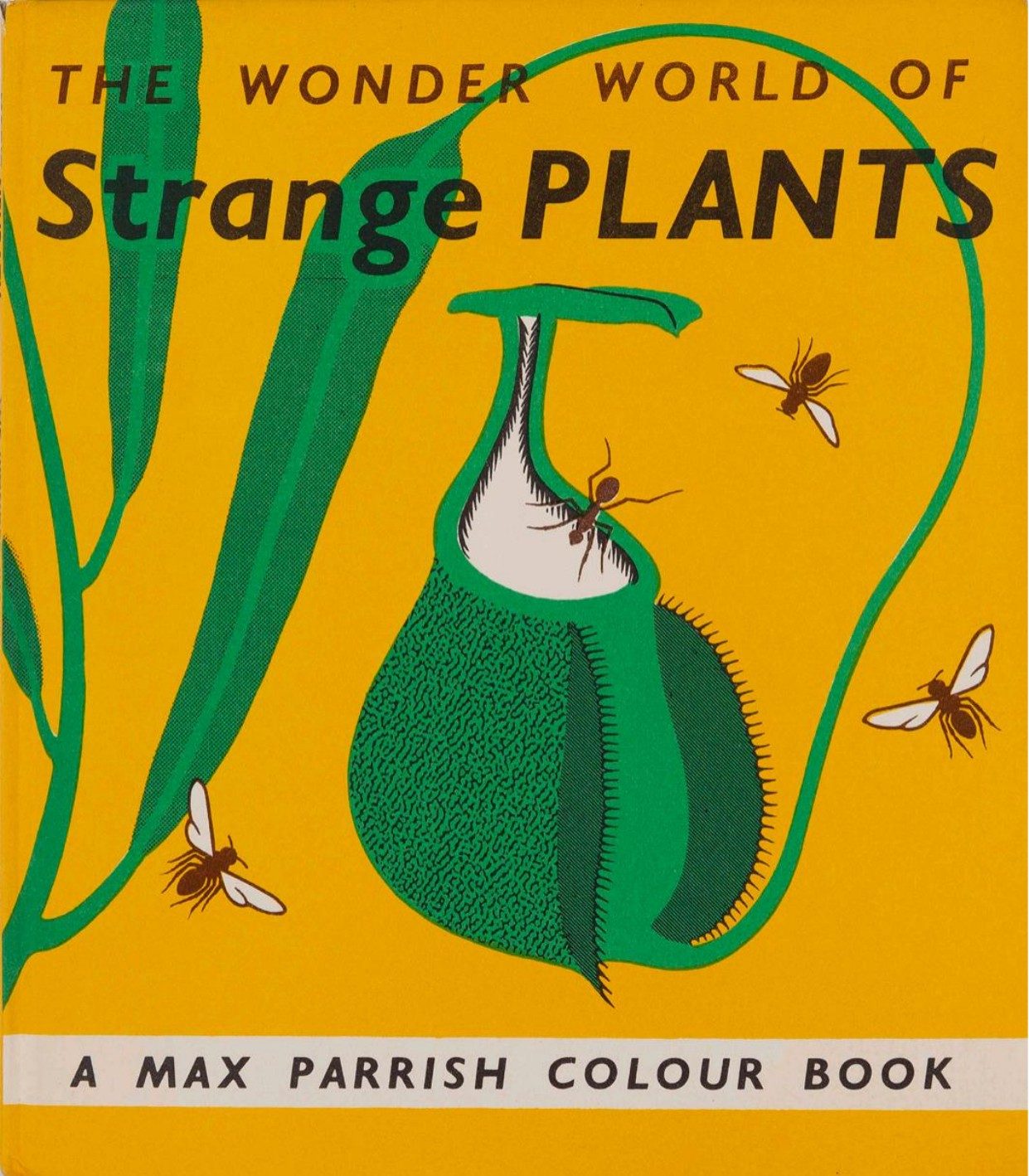
THE WONDER WORLD OF

  Strange PLANTS


                      ~? Pare
THE WORLD OF
ey ISOTYPE FIRST PUBLISHED 1956 - PRINTED IN GREAT BRITAIN BY GRA PHIC
Strange PLANTS
      MARIE NEURATH


REPRODUCTIONS LTD » LONDON   Max Parrish   London
LIST OF CONTENTS
The Water-lily Rises with the Sun
onw
Many Flowers Make One F lower
How Some Plants Catch and Eat their Insect Visitors
Slow-moving Plants which Can Set Traps for the Flies 10
The Largest Leaf in the World 12
The Largest Flower in the World Lives on the Roots of
Another Plant 14
A Tiny Seed which Kills a Mighty Tree 16
The Huge Strangler-tree which can Shelter a Village 18
The Long, Curled Tongue which Carries the Pollen 20
Insect Prisoners which Bring Pollen to the Plants 22
The Moth Lays its Eggs and New Plants Grow 24
The Strange Story of the Two Figs and the Wasp 26
Seeds are Spread in Many Clever Ways 28
How the Seeds of Some Plants Can Cross the Oceans and
the Deserts 30
How the Mangrove Forest Spreads in Muddy Swamps 32
The Tough, Prickly Plants of the Desert
34
The Beautiful Flower of the Desert Night 36
Sea
|Aneh
In the day, with petals wide open, it floats on the surface.
Many Flowers Make One Flower


 Inside a simple flower, like this
 wallflower,   we find    the pistil
 which holds the baby seeds.
 Nearby are the stamens, where
 pollen is formed. Pollen, usually
 from another plant, must reach the
 seeds before they can ripen.
                          Some-
 times it is blown by the
                           wind,
 sometimes carried by insect
                             s,
 6


esSe
This giant sunflower is made
up of many simple flowers.
The middle ones are still buds.
Those nearby have opened,
and show the tips of their sta-
mens. In other flowers, the
pistil has pushed past the sta-
mens. The outer ring is made
‘up of the petals of large
flowers; their bright colour
attracts the insects.
How Some Plants Catch and Eat their Insect


The flower of the bladder-
wort grows from a stem which
floats just below the surface of
the water. Among the leaves
of this stem are many small
bladders, tipped with tiny
bristles. When a water insect
touches the bristles, a trap-
door opens. The insect is
sucked inside, and the door
shuts behind him. Finally, he
falls into a pool of liquid.

8
This pitcher plant has some of
its leaves formed like small
vases. Under the lid and on
the rim there is a sweetish
liquid, like honey. An insect
may crawl along the rim to
get the honey, but when he
tries to explore inside, he slips
and falls in. He struggles to
climb out, but cannot get past
the ring of hairs. At last he is
eaten by the hungry plant.
Slow-moving Plants which Can Set Traps for


The leaves of the sundew plant
are covered with       hundreds    of
tiny club-shaped tentacles, each
tipped with a drop of liquid
which looks like dew. Any small
insect which ventures too near,
finds that this liquid, as sticky as
glue, holds him fast. As he strug-
gles to free himself, the tentacles
close round himone by one, press-
ing him tightly against the sur-
face of the leaf. The ‘dew’ which
oozes from    the   leaf helps    the
plant to digest him.

10
the Flies


   The slender flower of the Venus
   Fly-trap rises from a cluster of
   thick, spiky leaves which rest on
   the ground. Each leaf, bent
   down the middle like two pages
   of a half-opened book, has three
   bristles on either side.
   The moment a fly touches one of
   these bristles, the two halves of
   the leaf begin to fold together.
   Before the fly can escape, the
   long spikes round the edge are
   twined together like the fingers of
   two tightly clasped hands.

                                         Il
The Largest Leaf in the World
plant sa safely sit on a leaf of this giant tropical water-
A child ¢ safely si oA
- the rim round the edge would keep him dry; tubes
12with air inside make the leaf strong like a raft; roots anchored
in the river mud would stop it drifting away.
2)The Largest Flower in the World Lives
on the Roots of Another Plant itl
This flower, which blooms in
the hot, wet forests of Borneo
and Malaya, is so large that a
tall man could only just put
his arms round it. Yet it has no
leaves, no stem and no proper
roots. It springs straight from
the roots of the wild forest-
vines. For a day or two it
spreads its huge petals over
the ground; and then, quite
rapidly, it withers and dies.
14
15
A Tiny Seed which Kills a Mighty Tree


   On the stem of a giant tree a bird drops a tiny seed. The
                                                                  seed
   grows, sending out long, hanging root
                                           s and slim branches.

   16


| ae                                                                     4
ene
Lenn cnc
be
Slowly the roots tighten around the tree and kill it. When the
old tree rots away, a strangler-tree stands in its place.
BYThe Huge Strangler-tree which can Shelter a
«nti
PSUR Ea
The strangler-tree grows to enormous size, till it looks more like
a forest. Long roots grow from its branches and reach towards
the earth. In time, many ofthem become new
trunks.
18These now support the giant branches which can shelter a
whole village. Hindu merchants, or banyans, spread their
markets under such trees. So they are called banyan trees.
19)The Long, Curled Tongue which Carries the
>
~ This orchid has two pollen-
bags, joined in the shape of
a saddle. Below them is nec-
tar which attracts moths.
This moth has such a long
tongue, it can reach the nec-
tar without putting its head
into the flower.
)
When it curls its tongue
back, the bags cling to it.Here, many times enlarged,
is a drawing of the head of
such a moth with the pol-
len-bags on its tongue.
When the moth visits an-
:: “ates other flower, some of the
pollen will drop on to its
: Ea seeds. Without it, they
3 . would never grow.
HEInsect, Prisoners which Bring Pollen to the
Dusted with pollen from a
wild cuckoo pint, a swarm of
midges flies towards its neigh-
bour. They enter its long bag-
like leaf and push past a ring
of hairs. From that moment
they are held prisoner.
¥
xPlants
As they crawl about, they drop
pollen on the female flowers.
The flowers give the midges nec-
tar, and later the male flowers
shower them with pollen. Then
the ring of hairs withers and
frees the prisoners.
33;The Moth Lays its Eggs and New Plants Grow
Most flowers open at day-time and are
visited by bees and wasps and other
insects which fly about in daylight.
But some flowers open at night, and
they have night-flying visitors. Soon
after dark, when the yucca flowers
open, this moth enters and settles.
She collects the pollen dust and rolls
it into a big ball, bigger even than
her own head. Then, holding the ball
tightly, she flies away to another yucca
flower nearby.There she lays her eggs in
the seed-box, crawls to the
tip, and covers it with the
ball of pollen. In time, the
seeds willripen. Caterpillars
hatch from the eggs and
feed on the ripening seeds.
But there are still a few
seeds left, and the pollen
which the mother moth
brought enables them to
ripen and start new plants.
The Strange Story of the Two
                      Figs and the Wasp

                    Inside the young wild fig there
                    are a few small male flowers.
                    Further in there     are many
                    tiny female flowers. In early
                    spring a wasp enters and lays
                    one egg inside the seed-box
                    of each female flower.


                    As time goes by, each egg
                    slowly develops into a small
                     legless grub which will one
                     day turn into a young wasp.


                     Now the farmer, who has an
                     orchard full of cultivated fig
                     trees, comes along and fills a
                     basket with wild figs. Although
                     he knows that they will never
                     be good to eat, he needs them;
                     for without them his own fruit
                     would not ripen.
He hangs the basket on one of
his own trees, and soon the young
wasps begin to crawl out. On
their way, they become dusted
with pollen from the male
flowers. It is this the farmer’s
figs need, for they have only
female flowers. The wasps fly to
the cultivated figs and try to lay
their eggs there. They cannot,
because the pistils are too long;
but in trying, they drop pollen.
The fruit then begins to ripen and
grows fleshy and good to eat.
ah


Ifa mistletoe berry falls to earth, it will die. Ifa bird eats it and
drops the seed on an apple tree, a new plant will grow.

    se

         se
6
The feather-like seed of traveller’s joy is carried by the wind.
RAS
\ \\\\ RF
SEUUSCTE
When a squirting cucumber falls from its stalk, seeds shoot out.
29lUlUlUllt—~—~— a
EE
How the Seeds of Some
The Rose of. Jericho grows wherever it finds water in the desert.
When the heat dries the earth, it curls up into a light ball.
, ‘ ——-Plants Can Cross the Oceans and the Deserts
The wind uproots it and blows it far across the desert. When it
reaches water, it opens out again and drops its seeds.
31How the Mangrove Forest Spreads in Muddy
This mangrove tree grows in
the shallow, muddy water
near the mouth of a tropical
river. While the seeds are still
on its boughs, they begin to
grow long roots. These roots
grow as big as your arm. When
the wind snaps one off, it falls
into the mud and plants itself.
32
In time it grows a tangle of
roots which trap the mud
brought down by the river,
and a little island is formed.
As new trees spring up, the
island will become larger and
larger. Each tree has also small
spongy roots which grow above
water; down in the mud they
could not get enough air,


                             33
The Tough, Prickly Plants of the Desert
i)
In hot, dry countries, where few plants can live, bright-flower-
ing cactus plants grow in abundance. Some are taller thana man,
: 34
————some smaller than your hand. Their tough skin keeps them moist
inside. Some have prickles which keep away thirsty animals.
The Beautiful Flower of the Desert Night


sae only, when night falls and other flowers close their petals,
this desert cactus blooms. At sunrise the flower
                                                   will die.
No text on this page.
No text on this page.
No text on this page.
No text on this page.
 Isotype Archive