Page text
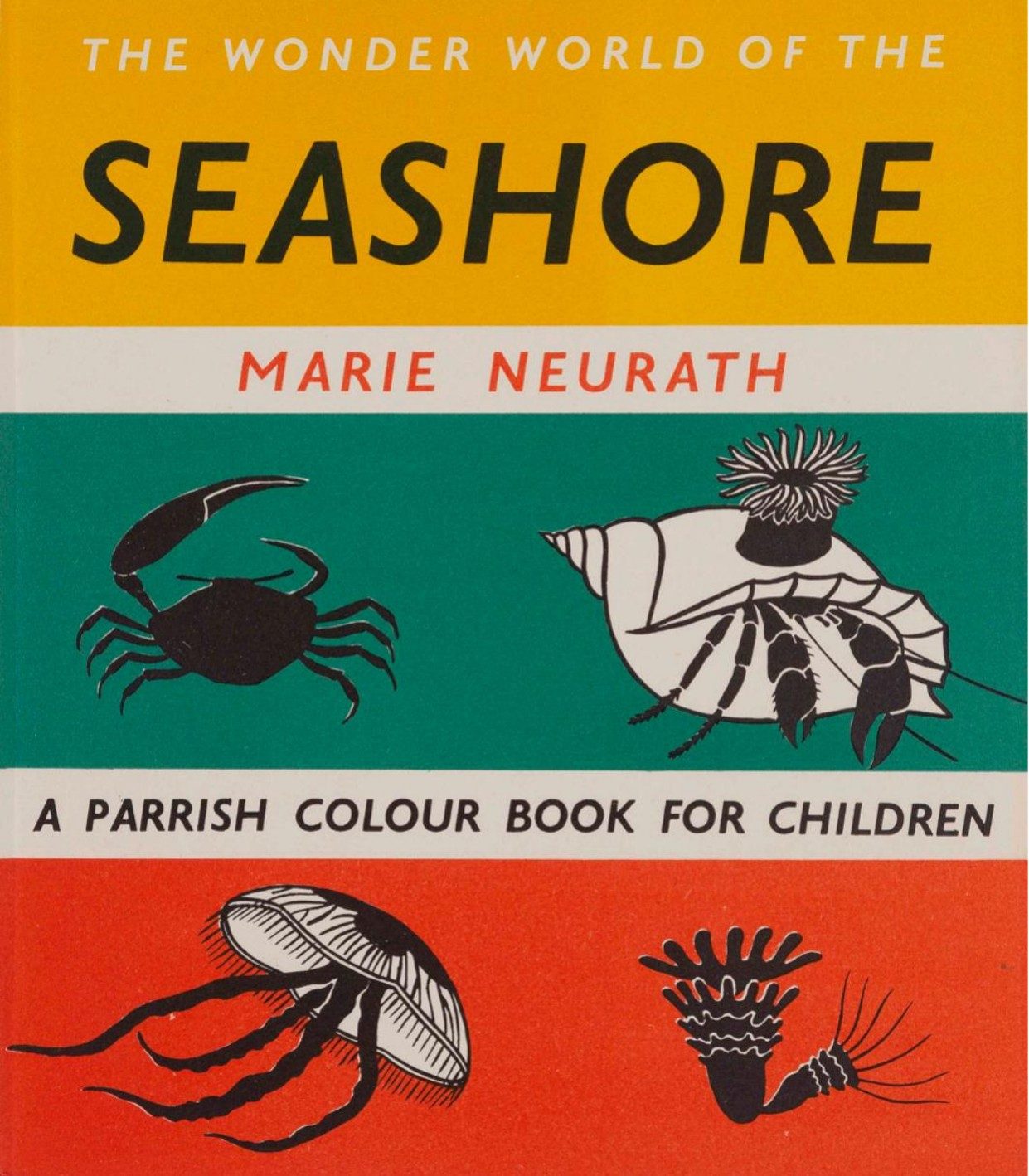
THE   WONDER   WORLD   OF THE


      MARIE    NEURATH
THE WONDER WORLD
OF THE SEASHORE
by Marie Neurath
The seashore is not only a glorious
playground; it is also a new world
tor the child to explore. In every
pool of water, under every rock,
/
he can find a fish, a plant or a
shell he has never seen before.
And each, if it is properly told,
7ERSITY OF READING
has a story which will surprise
partment of Typography
and excite him. In this book he
Sraphic Communication
can see and read these wonders.
SOME OF THE CONTENTS:
The “ flower’’ that catches and
eats a fish - A crab which fights tto & Marie
with claws that sting — Little fish
live where big ones dare not go - Neurath cs
The “ plant” where the jellyfish
grow ~ They live in the sea but Isotype
forget how to swim - Many ani-
mals whieh look like one plant —
The hermit crab shares a house
Collection
with his friend — The father who
carries his young in a pouch
Marie Neurath’s pictures are
drawn to show each point simply
and clearly, step by step ~ and
nothing else, ‘The colours are used
to make the message clearer ; the
text states it vividly in words.
Together they bring interest,
understanding and pleasure to
young minds.
2S| 18
33%
6sNo text on this page.
THE WO
  OF THE

  by Marie Ne


 The seashore
 playground;
 tor the child

 pool of wate;

 he can find .
 shell   he has
 And each, if
 has a story \
 and excite hin

 can see and re


SOME OF T
The “ flower’
 cats a fish — A
with claws tha
live where big
The “ plant” +
grow ~ They li

forget how to s

mals whieh lool
The hermit cra
with his friend
carries his youn;

Marie     Neurath
drawn to show ¢
and    clearly,      ste
nothing else.     The
to make the mes:
text   states   it    vi
Together        they
understanding          a
young minds,
THE WONDER WORLD OgF e
    SEASHORE
THE WONDER WORLD OF THE
P
seer
oe
=<oun
ees
ee
a
ee
See
BZ
Seer ao
@ ISOTYPE PRINTED IN GREAT
UMITED LONDON
BRITAIN BY GRAPHIC REPRO
DUCTIONS
SECOND EDITION 1955SEASHORE
MARIE NEURATH
Max Parrish LondonLIST OF CONTENTS
When the Tide Goes Out
onuw
The Fiddler Crabs Come Out to Play
The Living Things that Hide in the Sand
“Flowers” which are really Worms
10
The Glowing Worm that Lives in the Sand
Il
The “Flower” that Catches and Eats a Fish 12
A Crab which Fights with Claws that Sting
13
The Hermit Crab Shares a House with His
Friend 14
A Family of Crabs in a Mussel-sh
ell 16
Little Fish Live where Big Ones
Dare Not Go
17
The Strong Arms of the Sta
rfish
Cunning Sea-Creatures in Dis
guise 20
The Slow Cotton Spinner Casts
his Sticky Web 22
Keeping Eggs where the Wa
ter Won’t Wash
Them Away
24
The Father who Carries
His Young in a Pouch 26
Spinning a Thread to
Make a Nest
The “Plant” where ay
the Jellyfish Grow
They Live in the Sea
but Forget How to Sw
im 30
Many Animals which
Look Like One Plan
t 32
The Tiny Teredo D
rills Wood with its
Shell
Weeds which Stand Shs
Firm in Stormy Se
asWhen the Tide Goes Out
t strang gs sea leaves on the sand! Crabs
~all
hich seem to walk sidev sie starfishes with fiv i
ail-like creatures which live in shells of manyshaos
its own burrow under the beach. At
      ht red) and the females (show
                  the entrances wit

                                            <i


                              ~       iz)
                                            Pr
                                             y
                                             [A


b s
<— a
‘eo ®
C
o
=
eee|
\
Dx
Sa 7
At t low tide they com
(6) ( laws
like a fiddle
_~
off very differe
fiddler playing
ng a
Some also build small sandcastles.
a
e be
mo
tr
But the females usually pay
no attention. One will sim rn her b:
to her burrow, leaving th still “fi
out. But just now and t femaleThe Living Things that Hide in the Sand
If
we could see below the beach we
should find many strange
creatures hiding there. The lugworm eats its way do
wn, leav-
ing little twirls of sand near the
entrance to its tunnel. When
it
burrows forward, sand caves
in above its head, forming a
tiny
hollow in the beach, which
gives away the lugworm’s hid
ing
place. The cockle digs its
elf in with its single foot,
and feeds
through two small tubes wh
ich stick up through the
sand.The masked crab uses its long hairy feelers as a pipe leading to
the water and air above. The heart urchin is covered with spines,
like a tiny hedgehog. He has long, thin tube-feet which reach up
through the sand, grip food, and bring it to his mouth. The
prawn spends much of its time in the sea, but when in danger
it scrambles under the sand almost as fast as a swimmer dives
under water.
“Flowers” which are really                                Worms
                                  On rocky beaches along many parts
 ~
                                  of the Atlantic coast you may some-
 -                                umes find small tubes jutting out ofthe
     &
                                  sand like crooked chimney pots. When
                                  the tide covers them, brightly coloured
                                  ferns seem to sprout from their tops.


a

=
         a


=SS=a


The tubes, made of sa
                     nd and
hardened with slime,
                      are the
homes of fan worms
                   and feath-            —_—_.


¢r       worms.   The                    —
                        “ferns”    are
feelers which catch th
                      e tin y sea
                                         ———_
                                                —_


                                         ——_

animals and plants
                     that these          pee

                                         ———_—
                                               eens

                                                     __
strange worms
                    feed on,             {
10
The Glowing Worm that Lives in the Sand
The parchment worm lives all its life in a tunnel in the sand
shaped like the letter U. By moving the flaps near the middle
of its body, it keeps water flowing along to bring it a supply
of food. Sometimes its body glows with light.
IlThe “Flower” that Catches and Eats a Fish
mes U/. err
ene
—/ —_———
apres ~~
wee? ae;
BE: 3523
ese
7 | z
_
Clinging to a rock, the sea anemone looks like a flow
er with
hair-like petals. But it is an animal, and
the “petals” are the
feelers it uses for catching its food. When a
small fish swims by,
they twine round it and fold right insi
de the sea anemone’s
body. It is too late for the fish to get awa
y once the anemone’s
feelers touch it. In the skin ofth
e
feelers there are small bags
of
poison and coiled-up
hollow
tubes. The tubes shoot up
like
needles, piercing the fish’s ski
n
and pouring the poiso
n in.
12ESE ——
A Crab which Fights with Claws that Sting
4
This small crab could not defend itself against the angel fish.
But in its claws it carries two tiny stinging sea anemones.
The angel fish swims closer, ready to attack the crab. But when
the anemones sting, he quickly swims away again.The Hermit Crab Shares a House with His
Unlike other crabs, the
small hermit crab has no
hard covering over the hind
part of his body. To protect
himself, he makes his home
in an empty shell which he
can carry along. Often a sea
anemone Clings to the her-
‘zo mit crab’s house.
Theanemone protects him from
hungry fishes, and he lets the
anemone share his food.
ieAs the hermit crab grows bigger he has to find a larger shell.
He feels carefully inside it before he begins moving house.
But he and the sea anemone have always gained by living to-
gether. When he moves the anemone moves with him.
a3)The small male pea-crab
roams from one mussel to
another. In time he finds
one with a female pea-crab
living inside its shell and
sharing its food. He goes in
the shell to visit her for a
while and then wanders off
again. But she lives there all
the time—even laying and
hatching her eggs there.
When her young ones grow
up, the females will live in
other shells. The males will
roam about like their father.
16Little Fish Live where Big Ones Dare Not Go
———— eee
——_
_ —- ——$__— a
—— eg
sen ae
—SS9$=—_—_—_—__———_ ‘4 45}. A ae
|————_——
— ——_ oats
Gane ee _——
————
— |]
_—————
—————
( ('
l | KK
] )
A big fish, caught in the feelers of this Portuguese man-of-war.
would be stung to death and eaten. But some kinds of small fish
live among the tentacles, swimming about quite unharmed.
nThe Strong Arms of the Starfish
The cockle carries its house on its
back like a snail. When the starfish,
hunched up, crawls near it, the cockle
draws back into its shell. The two
halves of the shell close so tightly that
a strong man could not
open them,
The starfish fixes one or two
of its
arms, edged with suckers, to
each half
and begins to pull. It rests
a few
suckers at a time but it ne
ver stops
pulling. At last the cockle giv
es way.
Its shell snaps open and the
starfish
has won a meal.
18But the starfish has dangers of its own
to face. Its arms may be strong but
they are easily injured. This hungry
crab nips two of them off with a single
snap of each of its big claws. At first
the starfish drags itself along on three
arms. But soon the injured stumps
begin to grow, and in time the star-
fish has two new arms. If ever you see
a starfish with some arms shorter
than others you will know what is
happening.
S)Cunning Sea-Creatures in Disguise
To trick his enemies, this young
spider crab covers himself with ee
scraps of seaweed.
The sponge crab holds a piece
of
growing sponge over his back —~
with two of his feet.
20Australian sea dragons look as if they have grown leaves instead
of fins. They could almost be mistaken for seaweed. The pipe
fishes, hiding in the eelgrass, can hardly be seen.
The cotton spinner moves far
slower than a snail. How can
he escape the lobster’s claws?


As they are about to close
                              he
shoots out a mass of sti
                             cky
threads, like melted toffee.


22
lobster struggles to
free itself, the cotton spinner
crawls slowly away.
In time the threads break and—
free the lobster. But by then the
cotton spinner is safe.
23Keeping Eggs where the Water Won’t Wash
oD foto}
Most fish lay thousands of
eggs, then swim away and
leave them. Only a few ever
hatch out; most are washed
away and destroyed.
But some fishes care for
their eggs, as birds do. ‘The
father sand goby turns a
shell upside down, covers it
with sand and digs a pas-
sage leading into it.
The mother swims in, lays
her eggs and goes away
again. The eggs stick to the
ceiling, and father stays at
the entrance, fanning water
gently over them with his
tail and fins.
24The mother and father butterfish make a ball of eggs and place
it in an empty shell. Then each parent in turn lies curled up
round the ball to protect the eggs.
eae ————__- —— In spring the mother lump-
—— sucker lays her eggs in a
— rock crevice and leaves the
— father to guard them, With
4 his powerful sucker he
oy fastens himself to the rock
P—— and stays by the eggs until
they hatch out. Bigger fish
may attack him, but only
the wildest of seas can drive
him away.The Father who Carries His Young
in a Pouch
The mother sea-horse lays her
eggs in a small pouch at the
front of the father’s body. He
carries them about until the
young ones are ready to hatch
out. Then, one by one, they
leave the pouch as tiny liying
creatures, swimming about
and clinging to bits of seaweed,
just as their parents do.——— By spinning a fine thread
— round and round a piece of
growing seaweed, the father
y —— =! zy ==> nest shaped like a pear
sea-stickleback prepares a
Vim & = eam i — a ee
|
OS — —
He encourages her to enter the nest and lay her eggs there.
——cuwW~
—F ——}—_ - —— ——_—
She goes away, but he stays, guarding the eggs until they hatch
and moving his fins to keep water flowing through the nest..) “|
The “Plant” where the Jellyfish Grow
re
As this “plant” grows taller and tall-
er, deep rings appear round it, so
that it looks like a pile of saucers.
Near winter the “saucers” break off
one by one and swim away. In time
each becomes a full-grown jellyfish.


————                   —_—.
   .
——_—

——_          ———_—_—   ~~

                eS

                                ———_—
——


——                                ——__
                                     —_
                                  ee
                            Pee Sep


                                         —    ~~


            Se                       es       —
                                         ——


                               eG
                                              Bg)
The young goose-barnacle swims
freely in the water. Later it com-
pletely changes its shape and
fastens its head toa piece of wood.
There it stays for the rest of its
life, its “forehead” growing into a
long, worm-like stalk. Many bar-
nacles may live on one plank,
each using its six pairs of fringed
legs as a net for catching food.
—The baby sea-squirt is able to
swim, but after a day or two it
fixes itself to a rock and never
moves again. Its tail withers and
it grows like some strange hollow
plant. It has two openings; sea-
water enters one and brings it
food, leaving by the other. When
touched it squirts out all the
water and collapses.
Many Animals which Look Like One Plant
                                                            oer       ae


Around Florida and the West Indies, sea
                                        fans   grow like tall trees
under the sea. Here is a twig, greatly enla
                                           rged. Each “bud” is a
living creature, catching food with its
                                          feelers, The food flows
through the whole “plant” as sap
                                    does through a tree.

32
Each “bud” of this obelia is also a tiny animal. Those with
feelers catch food which passes along the stems to be shared
with all the rest. Those without feelers form little buds on a
stalk which break off and swim away like baby jellyfish.
33The Tiny Teredo Drills Wood with its Shell
The young teredo, like a tiny
cockle, has one tongue-shaped
foot, and a pair of pipes cover-
ed with hairs. With these it
swims about until it finds a
piece of timber. Then, rocking
to and fro on its foot, it drills
its way in with the sharp edges
of its shell. It eats the sawdust
made by its own drilling, and
as the hole deepens the teredo
grows longer and longer to fill
it. The two pipes at the back
of its body stick out from the
end of the hole and allow the
teredo to breathe and feed.
34
In time the teredo (and the hole it has bored) may be several
feet long. But where there is one teredo there are usually many,
each busy drilling a hole of its own and each avoiding the holes
its neighbours make. Imagine what damage a few thousands of
them can do to a wooden wharf!
Years ago, teredos were called “ship worms”. Wooden ships
were covered with thin metal strips to keep the worms out.
                     —   _—-——


                                                              35
Weeds which Stand Firm in Stormy Seas
EG .
\
SX
ANAS SS
\
WWW
Seashore life is not easy. Look at these seaweeds. At low tide
they are dry and parched. At high tide waves sweep over them.
They have no roots, but their stems, bedded deep in sand or
stuck like cement to rocks, hold them firm, even in storms.
.)
Sa ee
WAAR G K
RO ys \\
36No text on this page.
No text on this page.
The Wonder World
of Nature
Miss Noel Streatfeild has said of
this series : “They are the perfect
books for the home. . . . It is im-
    ible to recommend them too
highly.”
THE WONDER WORLD
OF ANIMALS
Teeth that fell trees, paws that
build dams ~ The strangest animal
of all — Forest animals too young
to climb — The battle to be leader
ofthe herd — It looks like a mouse,
it flies like a bird.

THE WONDER WORLD
OF INSECTS
The    parasol    ants which grow
mushrooms — Keeping the cattle
on an insect farm — The weaver
ants whose children spin - The
still watch of the fighting mantis.
THE WONDER WORLD
OF BIRDS
These birds with no nests hatch
      on their feet - The tailor
bird stitches a cradle of leaves —
Cockatoo watchmen sound the
alarm     —   The       hedge   sparrow
hatches the cuckoo’s egg.
THE WONDER WORLD
OF LONG AGO
The largest land creature that
           d giant jaws met
        - when
ever live
giant armour ~ the sabre-toothed
hunter meets his match ~ gliding
reptiles, birds with teeth.
THE WONDER WORLD
OF THE DEEP SEA
The fish that goes fishing with rod
and light flying fish and riding
fish -fishes that fight with sword
and saws   — when the giants battle
the huge jun in
            gle    sea
                mid-Atla ntic.
All uniform with this book
DESIGNED BY ISOTYPE
 Isotype Archive