Page text
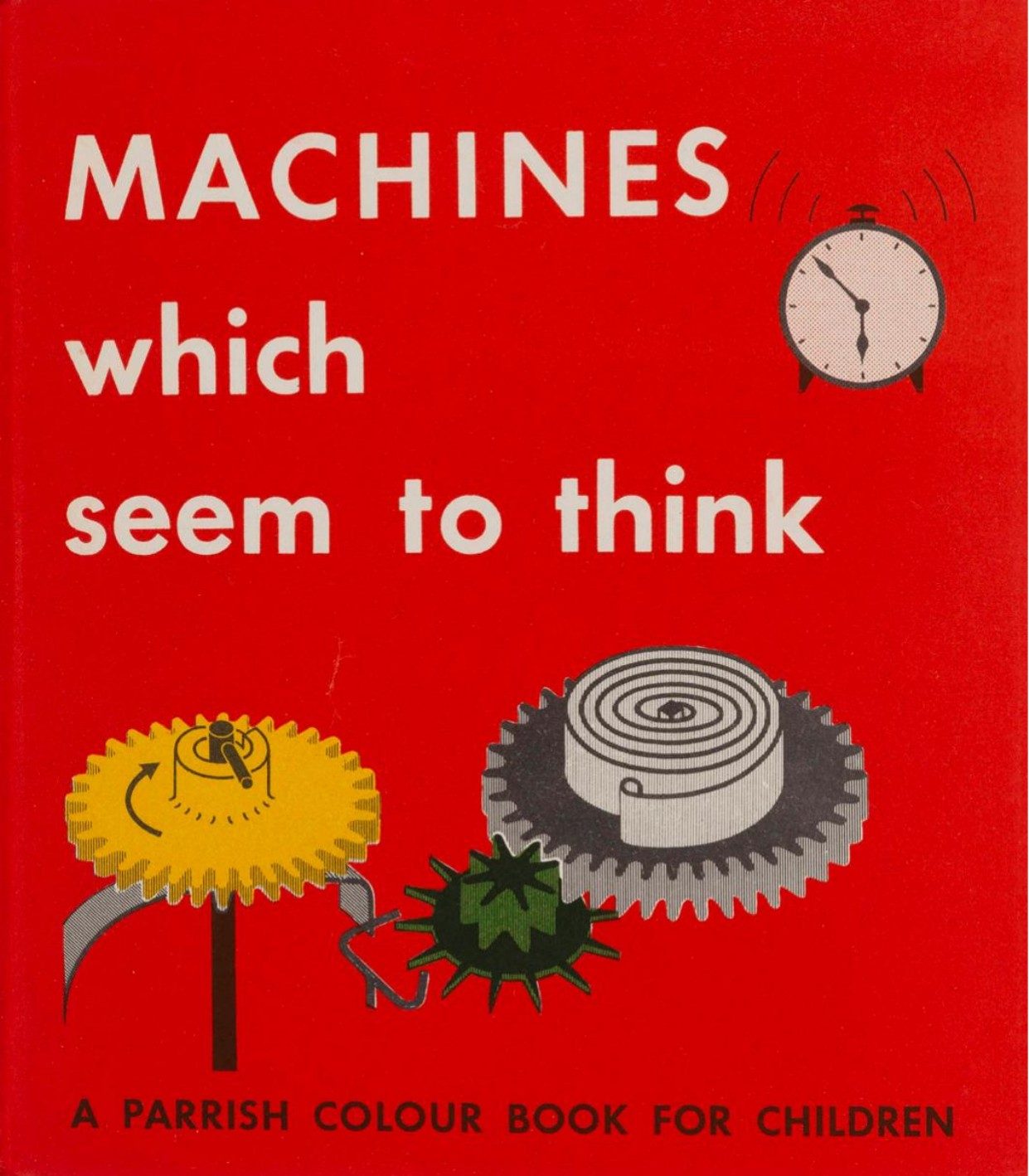
MACHINES                        _.|
which                      &
seem to think


on 2
A PARRISH COLOUR BOOK FOR CHILDREN
MACHINES

WHICH SEEM TO THINK

by Marie Neurath

If the great Tutankhamen, Pharaoh of

all Egypt, could be confronted with the

things    in   this   book,   he    would   un-

doubtedly think they were magic. And

in one way he would be right, for are

they     not   stranger   than magic, these

things    which       machines     can   do for

themselves
         ?

Consider some of the things we know:
The alarm which rings at the right time           hwatctiwte
— The door which opens by itself
                               —

The lights which must not make a mis-

take — The silent burglar and the loud

alarm —The moving belt and the count-

ing wheels — The kettle which calls you

when it boils — The aeroplane which

steers straight without the pilot — The

machine that can give the correct change

—The train which seems to stop itself

— The lamps which darkness lights.

These are magic still to the children —

until they understand them. And it is

these things which are explained in this

book—c
    accurately and
            lear   excitingly
                       ly,,

in colourful, one-idea-at-a-time pictures

and short, simply written text.


                                            6s.
No text on this page.
If

all-

thi
do

in


th’,

the
Cc

Tr


Tk


 al

 in


 ul

 tk


  ir
MACHINES
which seem to think
No text on this page.
MACHINES
which
seem to think
Marie Neurath   ie               —e
                           =


                      ep   eta
                coe              -“~    )
                A=                 A“
List of Contents
The Clock which Knows When to Wake You
How the Alarm Rings at the Right Time
Neither Too Hot Nor Too Cold
The Silent Burglar and the Loud Alarm 10
The Toast Pops Out Before it Burns 12
The Door which Opens by Itself 14
How a Machine Can Give the Correct Change 16
The Train which Seems to Stop Itself 18
When a Car Wants to Pass, the Traffic Lights Change 20
The Lights which Must Not Make a Mistake 22
The Moving Belt and the Counting Wheels 24
The Ship which Rights Itself in Heavy Seas 26
The Steamroller which Won’t Go Too Fast
28
This Kettle Calls You When it Boils
30
The Electric Kettle which Cannot Burn
31
Steering Straight Without the Pilot
32
A Spinning Wheel Keeps the Plane Straight
34
The Lamps which Darkness Lights
36The Clock which Knows
When to Wake You
All night long this clock ticks away
the seconds while the boy sleeps.
Its two big hands creep round the
clock-face; the hand of the small
alarm dial, pointing to ten minutes
to five, never moves.
Suddenly, at ten minutes to five,
the alarm bell rings and the boy
wakes up.
Co
Why did the clock ring the bell just
then? Turn over and you will see
what happened.How the Alarm Rings at the Right Time
When we “set” the alarm clock, we move the
pointer above the yellow cog-wheel until it points
to the waking time. As the hour hand moves
round, its cog-wheel turns the yellow wheel at the
same speed. The ridge on the yellow wheel keeps
parallel with the hour hand. Now look at the bot-
tom picture. During the night, a bent spring
presses up below the yellow wheel, but the wheel
is held down by the pointer above the hub. The
end of the spring holds the green lever, which
stops the green and black cog-wheels turning.Slowly the hour hand of the clock moves round,
and slowly the yellow cog-wheel moves round with
it. At last the hour hand points to the waking
time, and the ridge on the cog-wheel points in
exactly the same direction.
Suddenly, as the ridge passes under the pointer,
the bent spring can lift the whole yellow wheel.
The end of the spring jumps clear of the green
lever. The strong coil-spring begins to unwind and
the black and green cog-wheels turn. The teeth of
the green wheel set the lever moving to and fro,
the lever sets a little hammer moving to and fro,
and the alarm bell rings.
Neither Too Hot Nor Too Cold


            UMMM


The bath water comes from this tap ‘neither

too hot   nor   too cold. Near the electric

heater in the hot tank is a rod made of

two strips of different metals. As the
                                         water

gets hot, one metal expands more than
                                              the
other, and the rod bends. When the
                                         water
gets   too hot, it has bent   far enough       to
switch off the electric current.
                                   As the water
cools, the rod straightens. When it
                                       gets too
cool, it switches the current-on
                                     again,


8
Inside this refrigerator, an electric
motor compresses gas and sends it
through pipes, where it is cooled
and turned into a liquid. This passes
into a chamber, where it turns into
gas again. As it does so, it takes
heat from where the food is stored.
But the food must not get too cold.
Inside the refrigerator is a rod like
that in the hot-water tank. But
here, as the rod becomes warm and
bends, it switches the current on.
When it becomes too cold and
straightens, it switches the current
off again.
The Silent Burglar and the Loud Alarm


It is pas t
              midnight and everyone is sound asleep. Silently the burglar
                                                                          slips the
catch and opens the window. Suddenly a bell rings and wakes the houschold.
10
The house is fitted with a burglar alarm. A wire, connected to every window and
door, carries an electric current which flows round an iron rod and turns it into a
magnet. While the current flows, this magnet holds back a metal switch.
“PY
— —_— Oi"
When a window or door opens, a gap is left in the wire and no current can flow.
The iron rod is no longer a magnet and cannot hold back the metal switch. As the
switch falls, it starts another current flowing which rings the bell.
llAK
ee
jae
———
A
BB
B=
=
ze
A
———
B=
BB
This man has placed a slice of bread in the electric toaster and settled down to
read his morning paper. The moment the toast is crisp and brown, it will pop out.
12When the bread is put in, the
platform on which it rests is pressed
down and held in place by the
catch below it. The current can now
flow and heat the fine wires to cook
the toast. But current can also flow
through the smaller coil which heats
a rod of two metals. As the rod
becomes warmer, it bends upwards
and begins to push the catch aside.
At the right time, just when the
toast is nicely brown, the catch
slips off, the springs pull up the
platform and the toast pops out.
The current is cut off and the rod
cools and bends back. The toaster
is ready for the next slice.
13In front of this door, a light shines
from one post to the other. As the
boy crosses the beam of light, the
door swings open; as he enters the
house, it closes slowly behind him.
Inside the right-hand post there is
a special cell, through which a cur-
rent can flow so long as light shines
upon it. As long as the current
flows, it makes a magnet which
holds back a switch.
When the light is cut off, the cell
cannot carry a current. The magnet
loses its power and the switch drops.
At once another current flows and
makes a more powerful magnet be-
hind the door. This works a machine
which pulls the door open.
When the boy has passed through,
the powerful magnet is no longer
working, and the heavy door slowly
closes itself again.
14LA
AN
15When the shops are shut, it is
handy to get chocolate from a slot-
machine. But what happens if you
don’t have the exact money?
You place another coin in the slot
and out comes a bar of chocolate
and the correct change.
Inside the machine are two coils of
wire, ready to carry electric cur-
SS
rents. A lever just below them is
placed so that the coin will drop on
to one end of it. At its other end
there are two small switches.
When the coin drops, the two
switches rise and the electric cur-
rents can then flow through the
coils. Each coil becomes a magnet
and pulls an iron rod forward. One
pushes out the chocolate and the
other pushes out the change.
1617
The Train which Seems to Stop Itself


While the green signal-lamp shines, this train can safely go ahead.


                                  Brake-cylinder


Und:er the cars, air is compressed by electric
                                                   pumps and stored in tanks. This air

os es the valve down and cannot enter the
                                          brake-cylinder, where           springs hold
               rae from the
the bi rakes away           wheel, An electric current near the track makes
                                                                            @
magnet which
               holds the trip-c
                               ock down.


18
20 00
Red means danger. Even if the driver is taken ill the train must be stopped.
(—
, (Camm =
When the red light glows, the current near the track is cut off. The trip-cock
springs up and strikes a lever under the train. Air rushes from the centre pipe and
weakens the pressure. Compressed air from the lower tank pushes up the valve,
enters the brake-cylinder, and puts on the brakes.
19When a Car Wants to Pass,
the Traffic Lights Change
This traffic signal stands where a quie
t side
street joins a busy main road. Most
of the
time the signal shows green for the main
road and red for the side street. But when
a car comes along the side street and wishe
s
to turn into the main road, the light
changes to green to let it pass.
Near the lights, a rubber pad
fille d with air is laid across the
roadway.
As the wheels pass over it,
air is forced into a pair of
bellows. The bellows swe
ll up
and close a contac
t switch which tu
rns on an electric
current.
207 Before the current flows, a spring
holds down one arm of a lever.
When the current is switched on,
an electric magnet pulls down the
opposite arm.
As the lever moves, it closes a switch that starts an electric current, which sets an
electric motor working. The motor turns a long shaft which controls the traffic
lights. Turn over and you will see how it works.
21The Lights which Must Not Make a Mistake
I =)
| )
| E
YU The wheels fixed to the shaft are all shaped so that as
they turn they press against a switch for part of the
time. The first three wheels control the lights in the side
street; the other three control those in the main road.
In the first picture, the red light (stop) shows in the sideAy aren le rs
8
street, and the green light (go) in the main road. As the shaft begins to turn, all
the wheels turn together. Now both the red and yellow lights show in the side
street — stop, but be ready to go. In the main road, only the yellow light shows — be
ready to pull up. When the shaft turns still farther, the green light (go) shows in
the side street, and the red light (stop) in the main road.
23The Moving Belt :
and the Counting Wheels
(1) While the main current
is off, a spring holds down
the right arm of a lever.
Every day this machine counts thousand
s of pack-
ages as they pass along a mov
ing belt.
Just above the belt, a beam of
light shines on to a (2) When the current flows,
a magnet pulls the left arm
cell which carries an ele
ctric current. But each
time a parcel goes by, it
breaks the beam; no ligh
t down, turning a disc.
reaches the cell and it
cannot carry the curren
t.
This current works a switch
that controls the main
current. When the
small current flows
, the main
one stops; when
the small current
stops, the main
one flows,
The main current is
used to turn an axle
inside the
stop®
counting
(3) When the current
machine. Around the axle are four
“barrels” with fig
the spring pulls lever and
ures on them—on
e for units,
one for tens, one
disc back to the right.
for hundreds, on
e for thousand
s.
24(4) The disc slips round the axle. Fixed (7) The barrel showing tens is fitted to
to the axle is a cog-wheel, and at its far _ slip round the axle. It moves only when
end, the barrel with unit figures. the small idler-wheel turns it.
(5) When the disc turns left, a pawl (8) Inside the units barrel are two
pushes the wheel one cog forward, and teeth. As the unit figure changes from
the barrel moves to the next figure. 9 to 0, they set the idler-wheel turning.
(6) When the disc turns right, the pawl (9) The idler’s teeth move the tens
slips loosely over the cogs. The wheel __ barrel to the next figure. Hundreds and
and the barrel do not move. thousands work the same way.
25es
The Ship which Rights Itself in Heavy Seas
a
If heavy waves strike a ship, it begins to roll from side to side. If it rolls too much,
its cargo may be damaged. This ship is fitted with two huge water tanks, con-
nected by a narrow pipe. As it begins to roll to the right, the water in the left-hand
tank is higher, and its wei
ght slows the movement dow
n.
26By the time it is beginning to roll back, some of the water has flowed through
the pipe, and there is more on the right-hand side. So the roll back to the left is
slowed down too. If the water tanks were not there, the swing would be faster
and the ship would roll farther.
27The Steamroller which Won’t Go Too Fast
If this steamroller goes too fast, its engine
may be damaged. As it runs along,
cog-
wheels turn a spindle, which swings
two metal balls.
round
?
es
If the roller tra
vels too fast,
the spindle
spins rapidly and throws
the balls ou
t-
wards and up
wards, This
slows the ro ller
down again.
28A bent lever and a rod with teeth connect the spindle to a cog-wheel outside the
steam-pipe. While the wheel is held still, the valve in the pipe stays open.
When the metal balls lift, the lever tilts, moving the rod and turning the wheel.
The valve closes and no steam can pass along the pipe to drive the roller.
29This Kettle Calls You When it Boils
Here is a kettle which will not let you forget to turn out
the gas when iit come’ps ‘
to
the boil. In the middle of the lid,
which fits rather tigh
.
tly over its
<i
wide
i
-out
4,
are two small holes.
When the kettle boi
ls, steam comes rus
ss thei
hing through
with a shrill whistle bef
ore it escapes from the
holes at the top.
30The Electric Kettle which Cannot Burn
This electric’ kettle has almost boiled dry. If the current were still allowed to flow,
the expensive heating element (shown y ellow) would burn. But
as the element
becomes too hot, a pair of jaws made of two metals expand and release a spring.
The spring pushes out the electric plug and the current is cut off.
31cneaan, ~< A sudden sharp gust of wind meets this
airplane and turns it off its course.
How
can it be brought back?
the plane back
on to its proper
cou Tse,
32—p} ”
oz But what happens if the plane gets off
course while the pilot has left the controls
to look at his charts?
A very wonderful machine, which the pilot usuaily calls George, must think and
act for him, pulling the rudder-cable the correct way at the correct moment. Turn
over and you will see how George works.
33Sn SL Pr SS
A Spinning Wheel Keeps the Plane Straight
George’s “brain” is a rapidly-spinning
wheel. The spin keeps its axle (and all
the other parts shown red) pointing
steadily in one direction. While the
plane flies straight, George keeps straight,
and air flows evenly through the two
pipes on either side.
ee
When the plane turns George turns, but
the “brain” still points the same way
and closes one of the pipes. Air still
presses into the pipe, causing the yellow
partition near the front to bulge.
34 asThe partition is connected to a valve inside a network of oil-filled pipes. The oil is
kept moving by a small pump, but while the partition is straight the valve is held
down and oil cannot flow through the two pipes leading off to the right. When the
plane turns, the partition bulges and raises the valve. Oil flows into the top right-
hand pipe and pushes down the red disc with a rod fixed through it. As the rod
moves it pulls the rudder-cable.
35The Lamps which Darkness Lights\)7_
“7S
=a
When darkness falls, these street lamps light up,
yet
nobody touches a switch. While the sun shine
s, a special
cell carries a current which makes a magnet,
holding up a
switch. When no light falls on the
cell the magnet loses
its power. The switch drops and
the main current flows.
36No text on this page.
No text on this page.
BOOKS WHICH ARE
LIKE THIS ONE

RAILWAYS UNDER LONDON
Cutting the tunnels to take the trains -
Signals worked by the trains themselves
~The giant moving stairways—A station
beneath a station- How air puts on
the brakes.

FIRE !
Rescue by ladder and line- When no
one can pass down the stairs ~ The fire-
boat fights a dockland fire - How water
sounds the factory alarm ~ Planes and
parachutes save a forest.

ROCKETS AND JETS
A rocket which rises a hundred miles
How a steady jet drives the modern
plane ~ Looking inside a great jet air-
liner — A modern rocket races the sun —
A plane without a pilot.

LET’S LOOK AT THE SKY
New worlds the telescope sees — How
far are the stars? The planet where
something grows~ Red giants, white
dwarfs — The star that follows the sun —
A tiny speck in a vast universe.

AMESSAGE ROUND THE WORLD
Laying a cable deep on the sea-bed—
The current that carries a voice~ Send-
ing a message without wires - How
radio waves can carry a picture-Sending
thirty pictures every second.

SPEEDING INTO SPACE
Getting away from the pull of the Earth
— Flying too fast to fall- When a man
will weigh nothing at all— Stepping out
into empty space— Strange worlds which
men may one day see.

BY MARIE NEURATH
designed by ISOTYPE
 Isotype Archive