Page text
ROGHETS JETS


A PARRISH COLOUR BOOK FOR CHILDREN
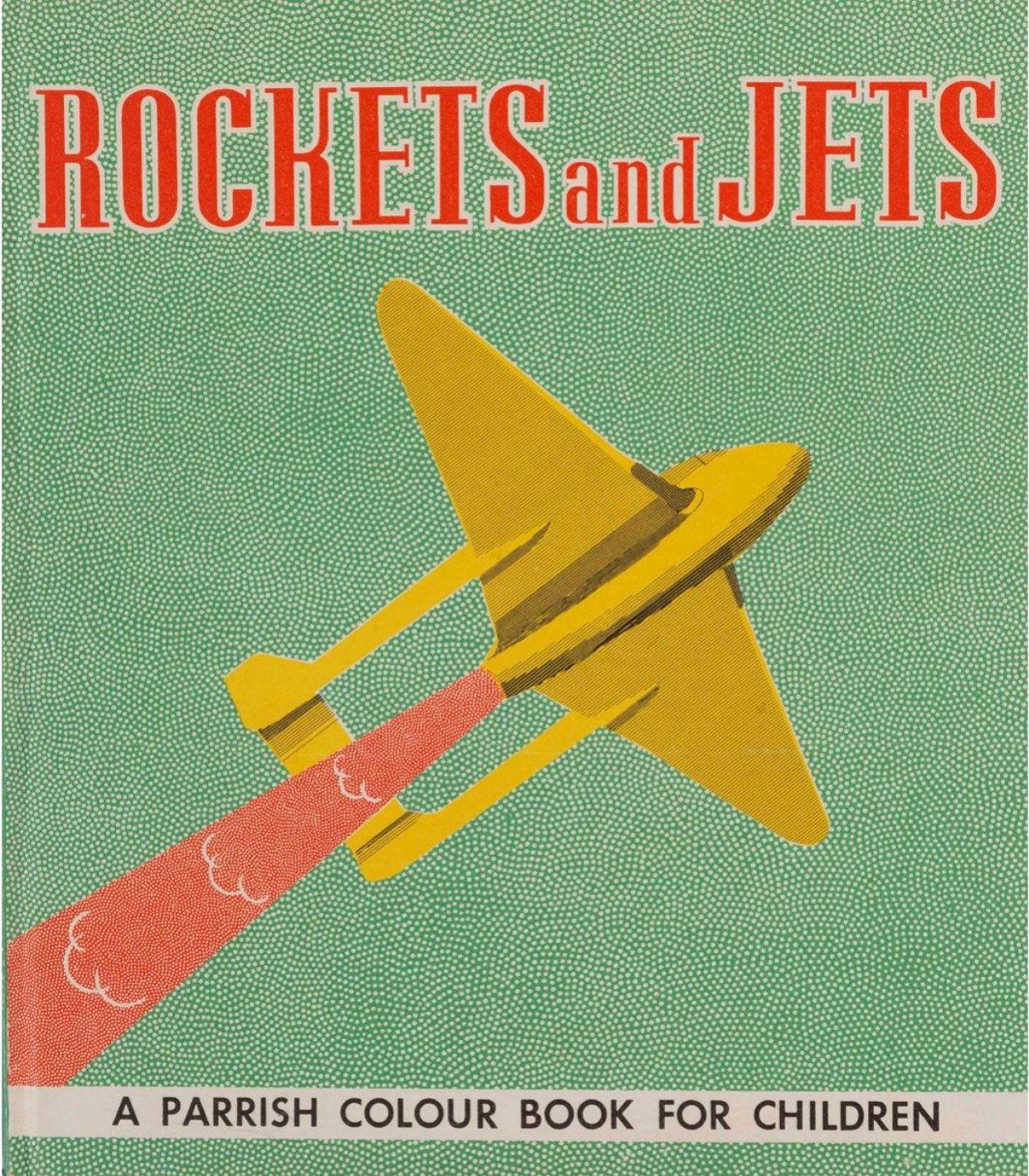
ROCKETS              AND       JETS
by Marie Neurath
Every child has thrilled to stories
of jet planes which cross wide
oceans in a few hours, of giant
rockets which soar up a hundred
miles above the earth.          But he
wants to know more.           How do
rockets and jets work ? Why can
a    rocket go     higher than    a jet
plane ? Why do some planes use
a propeller as well as a jet? Will
there ever be jet ships and jet
cars? How might the space ship
of the future be driven?

These and a score of other absorb-
ing questions are here answered
by means of pictures that explain
at   a glance.       All   unnecessary
details which might obscure the
meaning    are      rigidly   excluded.
The same object is always shown
by the same simple, unmistakable
outline ; colour is used to clarify,
not to decorate.

With its bright colours, exciting
subject and clear, lively text, this
book will hold the attention not
only of every child but also of
every father.

The    technical  accuracy of the
illustrations in this book has been
approved by C. B. Bailey-Watson,
technical editor of FLIGHT.


                              6s net
No text on this page.
No text on this page.
Rockets and Jets
eoces


aa


        @ ISOTYPE   T YPE   SET   IN   GREAT   BRITAIN   PRINTED   IN   AUSTRIA
                                                                                  8
Rockets and Jets
MARIE NEURATH
Max Parrish Londonooms
a
C)
List of Contents
eotceneaes
Burning Powder Sends a Rocket Soaring
The Thrust which Comes from Burning Gunpowder
Rockets Shoot a Seafire from a Ship’s Deck
A Rocket which Rises a Hundred Miles
ee
Rocket Gives Rocket a Flying Start
How Thrusting Gas Drives a Plane Without Pilot
nn
Six Planes of Today which are Driven by Jets
eon How a Steady Jet Drives the Modern Plane
na
Looking Inside a Great Jet Airliner
Using a Jet to Turn a Propeller
Paced
Flying High Above Cloud and Ice
Where the Air is Too Thin and Too Cold
Parachuting from a Plane at High Speed
Jet Cars and Jet Ships of the Future
ees
A Modern Rocket can Race the Sun
Space Ship of the Future
Landing on the Moon 36Burning Powder Sends a Rocket Soaring
The man lights the touch-paper and steps back. For a few seconds it burns
steadily, then—swish !—the rocket rises high above the roofs and tree-tops.
Inside its head a grey-black powder burns, thrusting the rocket upwards.
A cloud of coloured stars—glowing particles of metal—suddenly bursts out.
nocenm
  eres to oMmes
                  The Thrust which Comes from Burning


                             e                  ¥
                  Saltpetre (shown yellow) and powdered fuel (shown green) burn furiously
                  together, without the help of air.   The   mixture is called   gunpowder.   As

     aoe
                  it burns, great quantities of gas rush outwards.


     RSE


                          =¢ -                                        x


                  When the gases cannot escape they
                                                    blow


                  In an old-fashioned cannon, the gas forces its way
                                                                       out by hurling the ball
                  from the mouth of the gun. The gun kicks back
                                                                  as the ball shoots out.
Gunpowder
When a rocket is fired, the gas
shoots out through a narrow hole.
It presses both ways and thrusts
the rocket up. This thrust works
just the same whether air sur-
rounds the rocket or not.Rockets Shoot a Seafire from a Ship’s Deck
A plane must have a good speed before it can take off safely. | This
sometimes needs a longer run than a ship’s deck can allow. So the airman
%


    then uses the short, swift burst of rockets to thrust his aircraft forward at high
    speed. Once in the air, the empty rockets are dropped into the sea.


                                                                       4)
This giant roc et, ty feet high,
carries one tank of liquid fuel and
another of liquid oxygen. These
burn furiously together, and the
expanding gases thrust the rocket
upwards. A small pump worked
by chemicals controls the rate at
10Burning goes on until the rocke
is 23 miles up—four times highe
than Mount Everest. When th
fuel and oxygen are used up, the
rocket’s speed carries it up anothe
ninety miles! It is more than
hundred miles up before it falls
nose-down, to earth.
iLRocket Gives Rocket a Flying Start
This large rocket has a smaller one fixed to its head. When it is travelling at
its highest speed the small rocket is fired off. If it were fired from the ground
this small rocket would go up only forty miles, but with the flying
start given
to it by the larger rocket it climbs another two hundred miles.
Rockets have
sometimes carried cameras attached to parachutes
to photograph the earth
from great heights. Some day, perhaps, we shall have snapshots
of lands and
oceans taken from several hundred miles
above the earth.
12When it is twenty miles up, the large
rocket is travelling at nearly four thou-
sand miles an hour (six times faster than
nt
the fastest aeroplane). At that mome
ts
the small rocket is fired off and shoo
upward faster still.
13This aircraft is also thrust forward by expanding gas. Above the body of the
plane is a bullet-shaped chamber. As the plane flies along, air rushes through
valves at the front of the chamber and supplies the oxygen to burn the fuel.
In the body of the plane is a tank of liquid fuel which is pumpe
d into the
explosion chamber, where it burns rapidly with the air and produce
s a large
amount of gas. The engine is started by electricity, but after that the
explosion chamber is hot enough
to ignite the fuel.
14The expanding gas presses against the valves at the front and closes
them; all the hot air and gas shoots out from the back. This weakens
the pressure in the chamber and the outside air again forces the valves
open and rushes in. The valves open and close about forty-five times
every second. The many separate puffs of gas, thrusting both ways,
push the plane forward. This plane flies without a pilot. It cannot fly
in empty space because the fuel needs air before it can burn.
15:Six Planes of Today
which are Driven by Jets
GLOSTER METEOR
The first jet plane which the
R.A.F. used in warfare.
First British fighter to fly at more
than 500 miles an hour.
VICKERS SUPERMARINE
510
This fighter can roll easily at hig
h
speeds. It can travel almost as
fast as sound.
16STRATOJET
This six-engined American bomber,
much larger than the others, uses
eighteen rockets to give it a flying
take-off.
AVRO 707
A British plane built with tri-
angular wings. Air enters the jet
engine just behind the cockpit.
THUNDERJET
This American fighter carries extra
fuel in tanks at the tip of each
wing. When in danger, the pilot
can drop these to increase speed.
17Howa Steady Jet Drives the Modern Plane
The modern jet plane is not thrust forward by separate puffs of expand
-
ing gas, like the plane on page 15. Instead, its engine draws in a steady
stream of air and forces out a steady jet of gas.
At the front of the engine is a wheel like a ship’s screw, called an :
impeller. When this wheel whirls round, the blades draw in air and
force it back through narrow pipes. The air passes through holes in the
pipes, mixes with a spray of fuel and burns furiou
sly. A hot jet of gas
and air rushes out.
Near the back of the engine is a second wheel called a turbine, shaped
like a large electric fan. As the gas rushes backwards it spins the
turbine round. But the turbine is fixed to the impeller, and when the
turbine spins the impeller must spin with it. So once the engine is
started, the jet both drives the
plane and draws in the air.
1819
Looking Inside
a Great Jet Airliner


                       SS


20
First, in the nose, are seats for
the pilot and first officer. In front
of them are the instruments and
controls for the plane. Behind sit
the navigator and radio operator,
and behind them is the galley
where meals are cooked. Then
come the passengers (the plane
can carry forty-eight). In the tail
are washrooms and toilets. Lug-
gage is stored beneath the floors.
This plane is a Comet, driven by
four jet engines.
21Using a Jet to Turn a Propeller
22
In   the    picture     above,     the     turbine     drives    not only     the fan-like       wheels
which      draw    in   the     air, but    also   a   propeller.       The fan-like wheels press
the air back into the chambers where the fuel burns.

But how do         the    engines start?           For no air is drawn in,               and the fuel
cannot burn until the turbine turns.


On   each    airfield     are    lorries   carrying large        electric   batteries.     These    are
connected     to    the   engines,       and   when     the     pilot   switches   on,    the   electric
power starts the turbine turning.


Why do you think the thrust of the jet can be less powerf
                                                         ul when the
plane also has propellers ?


                                                                                                     23
Flying High Above Cloud and Ice
All these airliners carry roughly the same
load. The one using ordinary engines
and a propeller travels best at a height
of 20,000 feet and flies at 250 miles per
hour. It may have to fly through heavy
cloud where ice may form on the wings.
The liner with propellers driven by jet
-engines flies best 5,000 feet higher, at
300 miles per hour. At that height there
are fewer clouds, the air is thinner and
the plane can thus fly faster.
The liner driven by jets only, travelling
at nearly 500 miles per hour, flies best
at a height of 35,000 feet, where the air
is very thin, causing less resistanc
e, and
where there are hardly any clouds.25
Where the Air is Too Thin and   Too Cold


Eight   miles   up   it   is

very cold indeed, and

the air is so thin that

no one could live in it.


Four miles up, nearly

as high as Mount Ever-

est, the air is denser,

but breathing is      still
difficult, and it is still

ice-cold.


On the ground we can

breathe easily and the
air is warm.


 26
How can we warm and compress the air inside the plane which is flying at
a great height ?

The jet engine drives a small fan-like wheel which draws in air, com-
presses it until it is as dense as the air near the ground and passes it
into the cabins.   As the air is compressed it is also warmed.

Air for the cabins is sometimes compressed by the main engines instead.


                                                                      27
Parachuting from a Plane at High Speed
a
)
|
—_><
\
A parachutist can jump easily and safely from the basket of a
balloon.
T ‘o “bale out” from the cockpit of a plane travelling
at 250 miles per
hour is more difficult but still not very dangerous. But if a pilot tried
to jump from a jet fighter flying at 500 miles per hour the force of the
wind would send him crashing against the tail of the plane.
28A jet-fighter pilot is strapped to
his seat. He can touch a switch
which causes a small explosion
and shoots the seat fifty feet above
the plane. A parachute fixed to
the seat flies open, and seat and
pilot fall gently together. A
moment later the pilot’s seat-
strap is automatically released.
As soon as he has dropped clear of
the chair his own parachute opens
and he falls slowly to the earth.
29Jet Cars and Jet Ships of the Future
Here we see how a jet may drive the car of the future. The engine
will be like that on page 23. But when the jet sets the turbine moving,
instead of spinning a propeller, it will turn a number of connected gear-
wheels. The last one will turn the back axle and wheels of the car.
30
The   jet   ship   of tomorrow   will   have   a   similar engine,   but,   of course,
more powerful.      Air for the engine will be drawn in through ventilators
and waste gases will pass out through the funnel.            The turbine (in front
of the fans in this case) will turn gear-wheels to drive the ship’s screw.


                                          ty


ed
yen                                            SS


                                                                              ‘     31
A Modern Rocket can Race the Sun
As our earth turns, the sun seems
to move round it from east to
west, making one complete circle
every twenty-four hours.
But a modern rocket could fly
almost round the earth while the
sun was making only a quarter of
its circle. We are watching from
above the North Pole.
32When the rocket leaves China the
sun is sinking in the west. By
the time the sun is high over
Europe the rocket has caught up
with it. It is noon.
=
The rocket speeds on towards the
west, faster than the sun. When
it reaches California the sun is
just rising in the east. It is dawn.
33Space Ship
A space ship like this may one day carry passengers to the moon. It is made up
of four rockets fitted one above another, and stands half as high as the Eiffel
Tower. It will probably take off from some huge steel tower near the Equator.
of the Future


                When the fuel of each rocket is burnt
                up, the next one will be set off and will
                soar up faster than ever. To protect the
                people on the ground, each burnt-out
                rocket will explode and blow to frag-
                ments as it begins to fall. The last
                rocket will not fall. It will be travelling
                too fast for the earth to pull it back.


                                                         35
Landing on the Moon
The last rocket will be drawn in-
stead to the moon. If it is to land
gently, it must turn and use a jet
of gas from its tail to check the
moon’s pull, When the passengers
look into the sky they will see
the great ball of our earth.No text on this page.
designed by ISOTYPE
 Isotype Archive