Page text
'   VISUAL HISTORY OF MANKIND   _


2       VTEIAGES ©
ANID) Naat 3
;Lealei.
     wai "
|   PARRISH
ngPaeriin ofae power‘that may ne made av:
in the land.”
of Mankind iis an attempt to translate these eres writ
ted book. The picture-language, Isotype, was designe
is educational purpose, Clarity and simplicityis its chief
l is omitted, the same symbols occur over and over
recognizes them, colour creates interest but is us
merely as decoration, attention is paid to arr,
ily remembered patterns. This new instrument
ell stories ohn are not oes of background alu
ionsad diccouenies upon Shi esyaleas
yi
ice to follow with cae See and interest the grea
n“measures, law and me os
yf their own experience. Some will use them as.
eachérs use anades. “But all of them will haeintheseos
‘study and experiment”, in the words of the Re
eack ane ciateseems likely ‘to be of ag imp tance”,THE THEME OF THESE BOOKS
BOOK 1
LIVING IN EARLY TIMES
In the long, slow ages before written history began, men learned gradually to make use
of their natural environment. They found out how to make, keep, and use fire; how
to extract metals from their ores; how to shape tools. The hunters of animals domesti-
cated some and lived in partnership with them. The gatherers of herbs and berries
discovered agriculture. In river valleys, like that of the Nile, fields were cultivated and
villages grew up. By the side of lakes, in houses built on piles, small groups of men
lived more securely than their ancestors. Instead of furs, woven clothing began to be
worn; in the huts crude rushlights and torches glowed at night; on the rivers the first
boats were to be seen.
BOOK 2
LIVING IN VILLAGES AND TOWNS
These great fundamental discoveries made it possible for human beings to live in larger
groups. Families gathered into villages and towns for mutual help and protection.
This made possible division of labour with the consequent advantage of specialization.
But it set problems of social organization which it has taken centuries to solve.
BOOK 3
(WVING IN THE WORLD
ime, as towns and cities grew, they extended their influence and rule over the sur-
‘ing countryside. Later, the civilized regions came into contact with one another
‘commerce and through war. Improving techniques speeded the process of
‘amunication and led to the exploration of the whole planet, now seen to be
too slowly and painfully, mankind is learning the lesson that secure and
se comes not through the enslavement of human beings but from the
Moitation of natural resources. xWITH ISOTYFE’S ~
COMPLIMENTS
Si
WIG Sues IL lel Tk Sy I ©) IR Me oO
F
MAN KINwW®
LIVING IN VILLAGES AND TOWNSLIVING IN
AND
HONORARY EDITOR
LANCELOT HOGBEN
a
hid es ee
PUBLISHED BY ADPRINT LIMITED LONDON COPYRIGHT 1948
PRINTED IN GREAT BRITAIN BY JARROLD & SONS LTD NORWICH ENGLANDVILLAGES
TOWNS
PREPARED BY
OTTO AND MARIE NEURATH rectors oF THE IsoTYPE INSTITUTE
J. A.LAUWERYS. proressor oF COMPARATIVE EDUCATION | UNIVERSITY OF LONDON
WITH 20 CHARTS IN SIX COLOURS BY THE ISOTYPE INSTITUTE
A MAX PARRISH BOOK = 2 YO GEO Ronny Lonbow: wel - SYDNEY - WELLINGTON
F : R RAP & ©) 409)OE CON TE NOP S
How to Use this Book Pages 6 & 7
A Village of the Middle Ages Chart 1
Two Ways of Sharing Land Chart 2
Making Good Use of the Land Chart 3
How Clothes Have Changed Chart 4
Centres of Work and Worship Chart 5
A City Five Hundred Years Ago Chart 6
Trades of a Town Five Hundred Years Ago Chart W
Trades of a Town Today Chart 8
The Great Roads of an Empire Chart 9
The Empire of the Arabs Chart 10
Europe Becomes a Crowded Continent   Chart


Great Happenings in Britain          Chart


The Trade of Britain Grows           Chart


The Story of London                  Chart


Two Great Cities of East and West    Chart


Work, Play and Sleep                 Chart


Rich Man, Poor Man                   Chart


Young and Old                        Chart


Getting and Using Coal               Chart


A Hundred Years of Change            Chart   20


Things to Do Yourself                 Page   48


Some Books to Read                    Page   49
HOW                TO           USE               THIS                 BOOK

This history book is different from those you have been used to reading because:
   1. It tells different stories from those you usually find;
   2. It tells these stories in pictures rather than through written words.
We shall not tell you very much about kings and queens, battles and wars, Parliaments
and Courts. All these things play a large part in history but many books have already
been written about them. Instead, we shall try to tell you about ordinary people, their
lives and doings—what clothes they wore at different times, the kinds of villages and
towns they lived in, how they worked and played and slept.

The pictures we use to tell these stories have all been made in a special way. As you
look through them you will see that certain drawings, say for “man” or “house” or
“sheep”, are used again and again, just as words are in an ordinary book. These
drawings, called Isotype symbols, are all kept as clear and simple as possible, so that
you can recognize them at once every time you see them. As a result, they can be put
together to tell a story or to give interesting information.

We hope that you will like the bright colours we have used, just as we like them, but
their main purpose is to help make the meaning of our charts clearer and not just to
make them more attractive. For instance, if you look at Chart 1 you will see that all
the things in the village which everybody could use are coloured grey, and all the things
that belonged to the lord of the manor are coloured red. In fact you will soon find that
everything in the Isotype picture language has a meaning. All details that do not play
a real part in the story are left out. (There is no need to show, say, that some men were
short, some tall, some thin and some fat in England five hundred years ago. That is
not a part of our story.)
There are no hard-and-fast rules about how you should read these charts, but it is
usually best to look first at the chart as a whole. Next you can look carefully at each
symbol and each colour until you thoroughly understand it. Then look for the con-
nections between them until you can see exactly what the whole chart has to say. When
you have done this, ask yourself questions and try to answer them from the chart.
In each case we have given a number of questions to help you, but you will certainly
be able to think of many others yourself.

If two or more people can look at the charts together, so much the better. Interesting
discussions will spring up, and we hope you will soon find yourself seeking for more
information in other books. We have made a list of books which we think you will
find useful and interesting, on page 49.

There is no reason, by the way, for you to feel bound to look at the charts in the order
we have placed them. Just as you can look at the maps in a geographical atlas in any
order and build geographical stories around them, so you may build many stories
around our charts, and if you wish, look at the last before the first.

Very likely you will want to tell stories of your own in picture language after you have
read our stories. If you turn to page 48 you will find we have given some hints to help
you, besides suggesting other things you might like to do. Whether you do these things
 or not, we hope you will enjoy reading this new kind of book, and will find our stories
 interesting and easy to remember.


                                                                         The Editors
A Village
of ae oewevrwee
the Middle Ages AAAADAAAAAAAAAAA,
In villages long ago most people
worked in the fields. There was also a
priest at the church and a lord whose
Job it was to protect the village.
il VvVVWVWV VV VVVWVY VV
Which is the lord? Which is his) VV VY vvvvvvwy PRA IAN pth.”
house? Which are his fields? vvuvwvy Vwi vw
vvuvwy vw wv
vv
Which are the villagers? How many
villagers are shown? How many
of their houses are shown? Which
fields belong to the villagers?
What colour are the church and the
well? Who can enjoy and use the
church and the well?
Put your finger on the sheep.
Animals wandering loose are shut up
inside an enclosure called a pound.
Why is the pound coloured grey on
this picture?
How many big fields are cultivated
in the village?:
AA Tw) ne
fs D
é ;. - — : e
Vv
Vv
“
\oTwo Ways of
Sharing Land
More dots show that more crops are
got from the land.
STRIPS
;
y
1
How many houses are shown?
How many fields do the five farmers
share between them?
How many dots are there on each
square of the best land? How many
on each square of the worst land?»
What fraction of the land does one
farmer have in a field?
Count up the dots ta see which
farmer gets the most crop§.
6 ee
What animals can you see?
SS
———
To whom do they belong?
8
Which of the three big fields yields
the biggest crop? eee bk kiBLOCKS
eee eed VA badedics
\o
Ge sei behiheh adalah Which is the best land?
| www 10
ww
Which is the worst land?
11
a Which farmer has to cultivate most
land? Which farmer has to cultivate
least land?
Count the dots to see which farmer
has the most crops.
ae ee
vwwwv
13
Which farmer-has to work hardest
Si
vwwww
to produce his crop?
14
Which farmer has to work least hard
to produce his crop?
1S) $
What advantages did the strip sys-
tem have over the block system that
ae
might cause it to be chosen?
Chart 2Making Good Use
First Method
of the Land
The chart shows three ways of using
the land. Each horizontal line shows
four successive years offarming.
1
How many kinds of crop are shown
in the first line? In the second line?
In the third line? Name the differ-
ent crops shown.
What proportion of the land is used
for growing wheat in each line?
VVWVWWw i
What proportion is used for barley? VU wr
What proportion is used for flax? VvVvVWVWh Ya
Is the same crop grown on the same
piece of land each year in line one?
In line two? In line three?
4
In the second line there is always
some land where no crop is being
grown. How could this land be
used in a way which would help the
farmer and also enrich the soil for
later years?
5)
Are the crops grown in line one
bigger or smaller in the fourth year
than in the first?Would the same answer be correct
for line two and line three?
If you hired a farm for two years
only, would it be better to farm it in
the way shown in line one or in the
way shown in line two?
If you had to grow all your own food
on the same farm for the rest of your
life would it still be wise to choose
the same way?
VWVUWVN VW ww
yVWVVWN Vw
ee eo = : == In which line is the largest total of
A
V7
a ee
NA oe crops grown in the whole four years?
A |
VW WV WWW WwW 10
Artificial fertiliser is being sprinkled
on the land in line three. What effect
does this have on the total crop the
land can grow in four years?
11
Which method of farming is used
most in modern Europe and
America?
12
Why did not people use artificial
fertiliser in earlier times?
Chart 3Materials
How Clothes
Have Changed Primitive
What are the three animals shown?
2
v ani
Cotton came into use later than flax
and silk. Pre-Roman
Put your finger on the
cotton plant.
v
What drawing is shown to stand for
the making of rayon from wood?
4
Roman
On which other chart have you seen
one of the plants?
What did primitive men make their
clothes from? How did they use the
skins of animals?
Medieval
Which animal became an important
source of clothing material? Which
part of this animal was used?
What was the next important cloth- Modern
ing material to come into use?
Name five important clothing mat-
erials in use today. Which of these
moww
d
came into use most recently?9
When did people wear the greatest
number of pieces of clothing?
10
What is the name of the piece of
clothing which people wear on top of
all the others today?
11
In which period was it easiest to cut
the clothing? In which period was
it most complicated?
12
Describe the shape to which the
outermost garment was cut in lines
two, three and four.
13
When were buttons introduced?
14
Mention some ways in which clothes
now are different from those of
medieval times. From those of
Roman times.
15
Which clothes best fit the shape of
the body?
Which clothes are the easiest for
moving about in?
Chart 4|
ySumerian Temple
Centres of Work
and Worship
Five thousand years ago, the priests
of Sumer, in southern Mesopotamia,
built temples for the worship of the
gods. They became centres of craft
work and of government. Four thou-
sand years later, Christian monasteries
too were centres of work and learning.
|
What shape is the Christian church?
Why is it built in that shape?
2
Name three kinds of work done
by people living near the Sumerian a Producing
Worship Learning’ Nursing —_—_—_Burial Food Government
temple. Near the church.
Did the Christian monks. sacrifice
©
animals? Did the Sumerian priests?
4
-
The Sumerian priests did wedge-
<4
SS
shaped, or cuneiform, writing on
f
tablets of clay with a small chisel.
ed
How do you think the medieval
monks made their books?
Gate
Put your fingers on the symbols linciate
which show the “tile libraries” of
Sumer and the book libraries of
medieval Europe.Medieval Monastery
6
xroue
Put your finger on the symbols
which represent the study of the
stars, and the attempts to foretell the
future by the stars.
q
Was a hospital attached to the Sum-
erian temple? To the monastery?
What were the “magic” shells used
for in the Sumerian temple hospital?
8
Did the priests of Sumer keep their
beer and wine in the same sort of
vessel as the monks of Europe did?
Both the temple and the monastery
learned how to work in wood, leather
Worship Learning Nursing Burial Crafts and metal. Did the Sumerians use
fal Qt
the same kind of metal as the
+tt
+tt
az medieval monks?
10
y; a Were flax and wool woven into cloth
more frequently by Sumerian priests
iS or by medieval monks?
Tr
11
—
The Sumerian priests ruled the
country. Which symbol shows their
interest in overseas trading? In
commerce and banking? In law
courts? In war?
Chart 5A City Five
Hundred Years Ago
-What does the black line stand for?
What do the black circles stand for?
Why do these lines and circles go
round the town?
a)
2,
What is the big black patch?
What kinds of buildings are shown
in red on this map?
What is the open space in the centre
of the town? Which buildings are in
it or near it?
What do the green patches inside the
black line stand for?
6
Do boats ever come along the river
to the town?
What other use has the river for the
townspeople?
Why is the castle not on the bank
of the river?
9
Which is the biggest building?


What else stood in the market place?


What were these things used for?

12
Which is the bigger—the upper or
the lower part of a house?

13
What are the wide open archways
used for?


What are the steps in front ofthe inn
used for?


How are the shops different from the
ones you see today?


16
Which one is the blacksmith’s shop?


La
Why are the castle windows so small
and narrow?


                       Chart 6
Trades of a Town
Five Hundred
Years Ago
1
How is the boundary of the town
shown? What does this stand for?
What colour is used to show the
houses in this town?
Put your finger on a loaf of bread, a
horseshoe, a piece of cloth, an anvil,
"a piece of pork, a spade, a chopper.
What animals are kept on land near
to the town?
ft
How do you know it is near to the
town? (This land was called the
town’s demesne.) (ul
What does the town receive from its
demesne?
Where is the windmill?
Is the pig alive or dead when it
reaches the town?Which part of the sheep is sent into
the town?
10
What happens to the wood before it
reaches the town?
11
What happens to the wheat before it
reaches the town?
ily)
Name the other goods that come
into the town.
13
Do they come from near or far?
14
How many trades are shown in the
town? What are these trades?
1S)
Which of the things that are made
in the town are used by the towns-
people themselves?
16
Which are used by the townspeople
but also sent away to other places?
yl
Which trade do you think the town
might be important for?
Trades of a Town
Today

1
How is the boundary of the town
shown?    Is this the   same   as   the
boundary of the town 500 years ago?

2
How has the boundary changed?
Suggest reasons for this.


Are there more or fewer houses than
in the town 500 years ago?


Put your finger on the gasholder, the
power station, the water reservoir.


What comes into the town so that
the gas and electric power can be
provided?


6
Do the people have to fetch their
water from wells or streams?


How many goods are shown? Name
them.


8
Name one trade which has to do with
animals which is no a carried
on in this town.
9)
Name any other trades which were
carried on in the town 500 years ago
but are not found in the town today.


10
How    many     industries   are      shown
being carried on in the town?


11
Were these carried on in the town
500 years ago?


12
Which of these industries enables the
town   to   buy   the   things   it     needs
from outside?


13
In which building is the cloth made?


14
Will   many   people     work      in    this
building?


Was cloth-making as important to
the town 500 years ago as it is now?


16
How does the town pay for the goods
coming into it?


                         Chart 8
The Great Roads
of an Empire
This map should be compared with
those in an atlas. The period shown
is about A.D. 250.
I
What colour is used to show the land
the Romans came from?
What colour is used to show the
lands the Romans conquered?
3
Name six modern countries which!
were part of the Roman Empire.
4
Name three towns shown here which
are still important today.
5
In which three parts of the Roman
Empire were towns found most
closely together?
Did the Romans conquer large parts
of Germany? Of Russia?
Did the Romans reach the Persian
Gulf? Red Sea? Atlantic Ocean?
Baltic Sea?
8
 Why do you think the Romans did
 not get farther south     into   Africa?
 Can you think of any reasons why
 the Romans did not get farther north
 into Europe?


 9
 How many big defence walls did the
 Romans build?


 10
 Look at your atlas and try to decide
 why the big walls were built in the
 places where they are.


 Did the Romans depend more on
 roads or on sea routes?


 12
 What kind of traffic do you think
'|passed along the Roman roads?


 13
 Name some places to which the main         .
 Roman roads in Britain led.

 14
 How did the Romans make their
 ships move?


 15
 What   goods   do   you    think   were
 carried from Egypt to Rome?


                          Chart 9
The Empire Large Towns
of the Arabs
What colour is used to show the
Arabian Empire?
2)
Name four modern countries which
were part of the Arabian Empire.
Which of these countries had also
been in the Roman Empire?
4
Which was the biggest town in the
Arabian Empire?
About how many people lived there?
Name two rivers near this town.
i
Where were the other big towns of
the Empire?
Which. were the two most important
parts of the Empire?
fs
9
In what parts of the world outside
the Arabian Empire were there large
towns in A.D, 750?
Each square represents 100,000 peoplePopulation
10
mata
itty Where did the Arabs sail to in their
ships?
vit Spain
11
Pete Hid ny
a tt How were their ships different from
The Arabian Empire the Roman ships?
A.D. 750
“— petveete N.W.Africa
1
me | peti : PLL LLL Which countries have more people
living in them today than in A.D.
ie i
7502 Which countries have fewer
people living in them now than in
Egypt
A.D. 750?
feni t t
13
Hi it
Arabia
About how many people lived in the
Arabian Empire? About how many
Syria,
Iraq, ete. of these people lived in large towns?
14
About how many people lived in
uth
Persia Britain in A.D. 750? About how
many people live in Britain now?
15
About how many people lived in
ie Mo
Spain in A.D. 7502 How many live
there now?
16
man
Which has the greater number of
people living in large towns, Britain
or the modern Arabian countries?
Pere amin eer CC
Black figures show those. living in large towns
ittt
Ha
eaentet:
(over 100,000 people )
Chart 10Europe Becomes a
Crowded Continent Roman Period
The red portion of the top rectangle AhAAAAAA AAA ADS
a || corresponds with the green area with- $AAAAAAAAAAAAGD
a | in Europe on Chart 9. AAAAAAARAAADS
AAddA
AAAAADAAAS
I AAAAAADAGS
How many people were there in Ahhhbabbaada
Europe in Roman times?
Middle Ages
2
i Look at Chart 9 and then say where
1) | most of the people lived—in the
south, north, east or west of Europe? AbAAAAAAAAS
AAAAAAAAADS
3 AAAAADAAAAGS
Was more land used for crops or for
Opp
lg bg 0 — cee
i woodland in Europe at the time of
Hi the Roman Empire? In which part
of Europe was most of the wood-
land found?
What kind of animal pulled the
|
plough in the Roman period? In the
Middle Ages?
)
How were these animals
TUL
harnessed
to the plough?
6
By how many millions had the popu-
lation increased between Roman
times and the Middle Ages?Has the amount of woodland in
Europe become bigger or smaller?
Has the population increased more
since the Middle Ages than it did be-
tween Roman times and the Middle
Ages?
9
What is Europe’s population now?
Can you tell from the diagram of the
town today whether the people have
any occupation other than farming?
11
Is there more or less agriculture now
than there used to be in Europe?
WZ,
Are ploughs bigger or smaller?
How many furrows will the modern
plough shown make?
13)
What has happened to the woodland
in Europe today?
14
Where are there most people today
—in the countries of the old Roman
Empire or in the rest of Europe?
Each symbol represents 5,000,000 people
Chart II
Each square represents 100,000 square milesGreat Happenings
in Britain
1
What does green stand for? |
For about how long did the Romans
fa [e
rule Britain?
3
How soon after they left B did
their empire die out?
4
Was their empire built up m
| Seereolnc ee
slowly or more quickly th
broken d.
5
How many times has B n_ bee!
invaded since‘
xe
es
gs) l2r, ey >
|
BRE
(a)
BESS
~
on
Sal
oPopulation
10
Give two reasons for thinking that
Britain has become more important
since those times.
A.D. 1 4 ff 11
What was happening in Britain in the
Middle Ages?
12
When did Britain begin to colonize
parts of America?
13
500 When did Britain lose some of her
American colonies?
14 ,
Which country did those colonies
become a part of?
15
1000
Which countries on the American
continent are still part of the British
Commonwealth?
16
How many more people are there in
Britain now than there were five
hundred years ago?
Can you think of any reasons that
help to explain this great growth in
population?
Each symbol represents 2,000,000 people
Chart 12|I5th Century
The Trade
of Britain Grows
1
What colour stands for land? What
colour stands for sea?
2
Name the countries and the seas
which are shown.
Which animal was very important in
Britain in the 15th century, and what
was it used for?
Where was wool spun and woven
in the15th century? In the 16th
century?
5
Was anything else spun and woven
in the 16th century?
Where did this come from?
Tl
Name an industry that died in
Flanders in the 16th century.
From which country did wine come
in the 15th century? From which
in the 16th century?
British ships and products are shown in red, others in blue16th Century
From which region did hides and
timber come in the 15th century? In
the 16th century?
10
Put your finger on the symbol show-
ing the spices which came from the
east. By what route did they come
in the [5th century? In the 16th
century?
11
Name the new countries Britain is
trading with in the 16th century.
12
Were British or foreign ships carry-
ing most goods in the 16th century?
In the 15th century?
13
How have the ships changed from
the 15th to the 16th century?
14
How was Britain paying for the
goods she had from other countries
in the 15th century? In the 16th
century?
15
Put your finger on the symbol which
shows valuable Flemish exports such
as brass and copper wares.
Chart 13The Story of London|
1
What does the red on the maps
stand for? The blue? The green?
2
How are the roads shown?
3
What is the black line?
On which side of the river was
Roman London built?
iS)
How many people lived in London
in Roman times?
6
How many more people were there
in Tudor than in Roman times?
7
ae
Mace
mS
zs
Where were the new houses of Tudor
times built, and on which side of the
river were most of London’s houses
then found?
Why have houses in Tudor times
been built at only one place on the
other side of the river?
Were there more or fewer roads in
Tudor times than in Roman times?
10 miles10
How do the people move about on
the roads in Tudor times?
11
Period How did the Romans move about on
Roman
their roads?
12
hes
What change in the way of harnessing
a horse is there between Roman and
Tudor times?
U3)
During which years has London
grown most quickly?
14
Tudor Period
What are the small patches of green
amongst the houses and buildings
in present-day London?
; 15
What are the patches of blue on the
right-hand side ofthe plan in present-
day London? What does this tell
you about London?
16
Put your finger on any roads in
present-day London which were
there in Roman times.
Each symbol represents 10,000 people Chart 14Peiping
_Two Great Cities
of East and West
Look at the plan of Peiping first.
1
Which country is Peiping in?
What shape was the city when it was
first built? After 1270
3
How was it divided by the roads
inside it?
4
How many people lived in Peiping
in A.D. 200?
5)
How is the Emperor’s palace shown
on the map?
Were there gardens inside the city?
7
Was the city still in the same place in
A.D. 1270? Was it still the same
shape then?
Did an Emperor still live in the city?
Has the city grown very much in size
since A.D. 1270?
123 4 5 6 7 8B miles Each symbol represents 100,000 peopleNew York 9
y 1770
How many people live in it now?
10
Do they live in more crowded con-
ditions than they did in A.D. 1270?
Now look at the plan of New York.
Where were the first houses built?
12
How did the city start to spread?
1820
13
About how many people live in New
York today?
14
Ts this more than live in London?
15
Do you think New York City is in a
good place for a port?
16
Which was the last to be built, Lon-
don, Peiping or New York?
ral dian
ti
Look at Chart 12 and suggest a
reason for this.
diinlynehi
Chart 15Work, Play
Middle Ages
and Sleep
1
One man in the first picture does not Wy
live in the house. Which is he?
2 CLMECMUOT
MOM
How many rooms are there in the
Seventeenth
house? Where does the family sleep
Century
at night?
3
nae =)
What is the woman doing? What
ne
are the men doing?
4
Does the child in the first picture
Pe 1
aa
have to do anything?
Nineteenth
Century
How has the house in the second
picture been made bigger?
What is the man using the horse for?
nnn!
MMMM
UMLcc
Today
Has the man a garden to work in?
What is the woman doing in the SSJ
= 2T
| tal-A3
second picture?
i
9 ys
What is the big building in the third
picture? Who is working inside it? T MMMM LMM10
Do they have to work for a long ora
short time?
11
Where do the children work in the
fourth picture?
/
12
Do the children do anything else
except work?
Who works in the factory in the
fourth picture?
14
Do they work as long as the people
in the other factory?
ylilllEELLLLLL
Ia)
How many rooms are there in the
house in the fourth picture?
paca (8 Red stands for the time the men
spend working, blue for their leisure
time, and black for sleeping time.
ZZ
a Ni]
Ulladdd Why are red and blue shadings
mixed in lines | and 2, but separated
is a et
in lines 3 and 4?
17
Describe the sleeping arrangements
during each of the four periods.
|
|
yfMilled Chart 16Rich Man, Poor Man
On which other charts are houses
like these two shown?
2
To whom does the big house belong?
To whom the small?
3
When did the rich begin to have glass
in the windows of their houses?
4
How long did the rich have glass
windows before the poor had them?
5
At what date did the rich have a bath
in their houses? A bedroom in their
houses?
6
When were books first printed?
q.
How were books made before print-
ing was invented?
In which other chart can you see a
carriage like the one shown?
°)
When were watches first used by the
rich? Did poor people have watches
in 1700?
10
               Which are the most recent inventions

1100 A         used by the rich? Do the poor have
               these as well?


               il
               How    long    have poor people    had
1200
               baths in their houses?


               12
               How many years longer than this
1300           have rich people had baths in their
               houses?


               13
1400           Name things which rich people had
               in   1600   but   poor people still had
               not in 1800.


1500           14
               Name something that poor people
               began to get during the seventeenth


         fal
               century.

1600
               15
               Name three things that rich people
               have today and poor people usually
               have not.
1700


1800


                                       Chart 17
Young and Old
about | 820
1
What colour stands for old people?
For young people? For the rest of over UJ
the people? o Wie
0 (08 ee
When were there most young people
in every 50? Most old people?
Which age-group was the biggest in
1820? Which two age-groups were
the smallest in 1820?
Which two age-groups were the
biggest in 1940?
5)
How is it that there are more people
aged 10-20 than aged 0-10 in 1940?
6
How many old people are there in
every hundred in 1940? In 1820?
i 7
i How many children below the age of
10 were there in every hundred of the
population in 1820? In 1940?
8
ORPTETTITIEETE
Do you think a child born in 1820
would have one chance in two of
Each symbol represents 2 per cent of the population
reaching the age of 60?9
Do you think a child born in 1940
would have one chance in two of
about 1940 reaching the age of 60?
10
naeeee
over If those older than 60 and younger
60 than 14 do not work, how many non-
workers does every worker support
in 1820? In 1940?
tiie
ih
50-60
What is the ratio of the number of
men aged between 30 and 40 to those
men older than 60, in 1820? In 1940?
40-50
eee I,
If you put people in order of age, the
oldest at one end and the youngest
eeeeeiit
at the other, how old would the
middle one be in 1820? In 1940?
30-40
13
The little picture on the left shows a
cesspool and a pump. Could dirty
20-30 water seep through from the cess-
pool to the pump?
reeeeiee
14
How do people get water in 1940?
10-20
iI)
Is it always clean?
0-10
idetid
Chart 18Getting and
Using Coal
1
What does the grey colour with
white dots stand for?
2
What do you think the wavy blue
linestands for? What is in the
bucket coloured blue in line 3?
About when did coal-mining begin?
How did the men get at the coal in
those days? How did they take it
away from the mine?
What was coal used for seven hun-
dred years ago?
Did the miners go farther under-
ground after 1400?
6
How was the coal taken to the sur-
face in 1400?
How has the drainage of mines
changed since the year 1200?
8
For what reasons had it to be
changed?Forging Lime Brewin; Dyeing
9
burning
Had coal more uses in 1400 than in
the first days of mining? What were
the new uses?
10 .
is
When did people start using coal for
smelting iron?
iil
Salt House
making] heating
What use was made of animals in
coal-mining after 1600?
12
What is the purpose of the little
flame in picture 3?
so
13
What had been done to make mining
Export
easier after 1600?
14
How is coal hauled to the surface
nowadays?
15
a
Look at Chart 8 and suggest a use
& Iron Steam Gas
for coal not shown here.
16
smeltin; power
How long has this country been
selling coal abroad?
Chart 19)A Hundred Years
Our great-great-grandparents
of Change
ii
1
Which row of pictures tells about
things as they are now?
2)
What kind of lamp is shown in the
Our great-grandparents
bottom picture?
Two of the pictures show gas lamps
in the streets. Which are they?
4
Which picture shows the streets lit
by oil lamps? About how long ago
Our grandparents.
was this done?
fi
One kind of gas lamp has a mantle,
the other a fish-tail burner. Which
was the kind used first? Which gave
a brighter light?
6
Our parents now
Which part of the picture shows
if
where the gas is made?
7, :
Which part of the picture shows the
dynamo which makes the electricity?
8
Which lamps would take the longest
time to look after and light?9)
What is being taken in the cart for
the lamps in the top picture?
Which picture shows how your
parents dress?
11
Which picture shows how your
grandparents used to dress?
12
How long ago used men generally to
wear a top hat?
13
Have men’s clothes or women’s
clothes changed more in the last
hundred years?
Were there any motor cars a hun-
dred years ago? How did people
travel by road then?
15
What is the pump in the top picture
used for?
16
How many times faster do cars go
now than they did thirty years ago?
Could the first cars go more quickly
than a horse and carriage?
Chart 20THINGS TO DO YOURSELF
1. Try to do an essay in picture language on one or more of the following subjects,
using either scissors and coloured papers or a box of paints. You may copy our symbols
if you wish, but you should try to invent at least a few new ones yourself.
a. Great Cities of Modern Europe. (Using your atlas, show all cities with over a
million inhabitants. Compare your chart with Chart 9.)
S . Two Farmers Go to Market. (Make two pictures showing what happened when a
farmer went to a town market in. the Middle Ages and what happens now. How
does each one travel? How long does each take on the journey? What does each
buy and sell?)
& Making More Use of Iron. (Many things shown in this book are made of iron.
Make a chart showing when all these things, and any others you can think of,
first came into use.)
2. You have seen how history can be read from pictures. See now if you can read
history from bricks and mortar. Look round a town you know and try to find one
building that was built in the Middle Ages, one in Tudor times, and one in modern
times. Write an essay, either in words or in pictures, on the kind of life the builders
of the first two buildings led, and of the tools they worked with. (If there are no
medieval or Tudor buildings in the town, try to find out why that is, and when your
town first began to be built.)
3. The village or town in which you live has an interesting history of its own. Borrow
some books about this from your teacher or from the local library, and try to find out
things that are not in the books by asking questions of your parents and grandparents.
Here are some things you may wish to discover:
a. How many hours per day did your grandparents and your parents work when
they first left school?
6. In which trade or industry do most of the people of your town work today?
When did this trade first become important there? Are any of the materials used
in it brought from across the seas? If so, from which-countries?
48SOME BOOKS -TO: RESS
Below is a list of books which will give you further information about some of the
subjects dealt with in our charts. The easier ones are marked *. Some of the others are
rather difficult to read but most contain interesting pictures. Many of them may be
found in any public library, and possibly in the Children’s Section. You will also find
it well worth while to look at the Children’s Encyclopaedia, Harmsworth’s History of
the World, and Newnes’ Pictorial Knowledge, and at handbooks issued by museums
——
like the Horniman Museum.
ABRAM, A. Social England in the *LITTLE, W. B. Science in the City
Fifteenth Century Routledge Pitman
BEARD, C. AND M. The Rise of American MARTIN, E. A. A Piece of Coal
Civilization Cape & 0/= Hodder & Stoughton
*BOFF, CHARLES. Boy’s Book of Roads MUMFORD, L. The Culture of Cities
Routledge Secker & Warburg
*BOULTON, W. H. The Romance of NICHOLSON, DOROTHY. The Londoner
Archaeology Sampson Low & Co. Collins
*BRERETON, F. S. Clothing, an Account *POWER, EILEEN AND RHODA. Boys and
of its Types and Manufacture Batsford Girls of History
Cambridge University Press
CANTRILL, T. C. Coal Mining
*QUENNELL, M. AND C. H. B, A History of
Cambridge University Press
Everyday Things in England Batsford
*CARTER, E. H. Man’s Social Story
*ROUSE, EDWARD CLIVE. The Old Towns
E. J. Arnold
of England Batsford
CHILDE, V. G. The Most Ancient East
*STEPHENSON, TOM. ‘Romantic Britain
Kegan Paul
Odhanss Press
CHILDE, V.G. Progress and Archaeology
*STUART, DOROTHY MARGARET. A Child’s
Thinkers Library
Day Through the Ages Harrap
COULTON, G..G. The Mediaeval Village
. *TENEN, I. The Ancient World.
Cambridge University Press
Macmillan
HAMILTON, HENRY. History of the TITMUSS, R. M. Poverty and\Population
Homeland Allen & Unwin 18/—
Maemillan
*HARTLEY, DOROTHY. Mediaeval Cos- TREVELYAN, G. M. English Social
tume and Life Batsford 2/6 History Longmans, Green & Co,
HARTLEY, D., AND ELLIOT, M. M. Life and WILLIAMS-ELLIS, M. A., AND FISHER, F. J.
Work of the People of England A History of English Life, Vol. II
Batsford Methuen
*LAUWERYS, J. A., AND GLOVER, A. H. T. *WooD, JOHN MACKENZIE. The Story of
Making Light Nelson England Nisbet
*LAUWERYS, J. A.. AND GLOVER, A. H. T. WOOLLEY, SIR C. L. Ur of the Chaidees
Man and Metals Nelson Penguin |
PRY D62 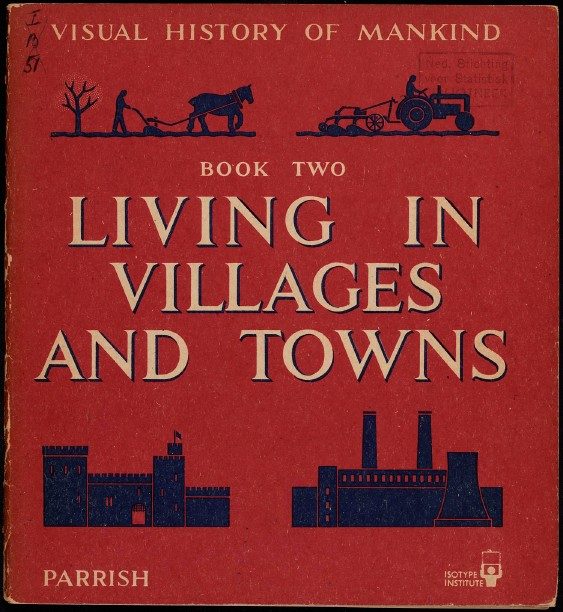
 Isotype Archive