Page text
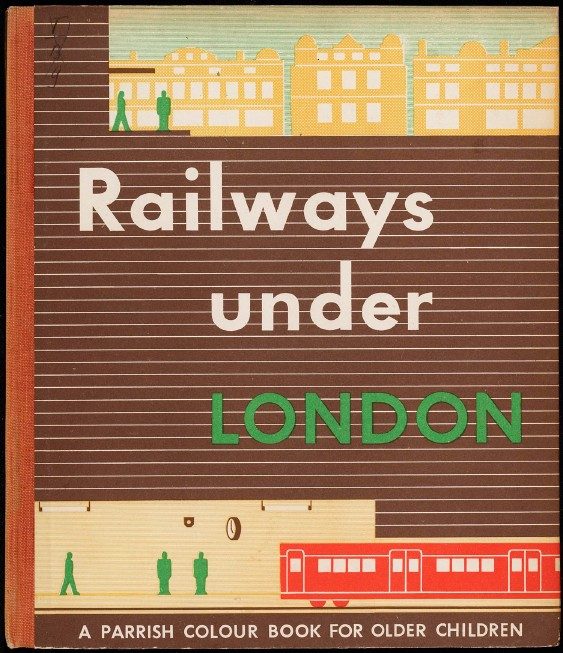
A PARRISH COLOUR BOOK FOR OLDER CHILDREN
WITH ISOTYFE’S 7,
 COMPLIMENTS y;
No text on this page.
Railways under LONDON
by Marie      Neurath


Bio ace | lea a asl lal (loess aaa


     DISTRIBUTED BY MAX PARRISH & CO LTD LONDON
Railways under
LONDON
List           of
Hundreds of trains roar beneath the streets of London      6


A million people use this station every week               8


The machine that prints your ticket and gives you change   10


The giant moving stairways which take you up and down      12


A platform built for speed                                 14


How the doors open without being touched                   16

The power which drives and lights the trains
Contents
 How air puts on the brakes                20


 Signals worked by the trains themselves   22


 Cutting the tunnels to take the trains    24


 Walking out of a tunnel in safety         26


 Cars which lock themselves together       28


 Going up in a   giant lift                30


 A station beneath a station               32


lll lls cll ml on                               lem
Hundreds             of      Trains         Roar             Beneath      the
                                                                            |
                                              Wa     .
                                             ale         \


All through the day and for much of the night trains follow one another every few
aeroplane, during a rush hour, they would look like this. Every red symbol repre-

6
minutes on London’s Underground. If suddenly you could see them from an
sents a train; each train has six or seven coaches and carries several
hundred people
7<ar
i .S
==a CCCAN
TreSo om an pad |
. belLL
oo iiVOY
Under the hub of London, Piccadilly Circus, two tube railways cross (at an angle, as
and change, and eleven moving staircases carry them quickly to and from the plat-
8yy
Tesr
ny ahd
ay
i
=
a ——O—R]}R)O?¥[ seanaaal
| the map shows). To speed the crowding passengers, machines give them both tickets
forms below. Red shows people entering the station, and blue shows those leaving it.
9The Machine
that Prints Your Ticket
and Gives You Change
Put sixpence in the slot.
It rolls down a chute and drops on a lever.
Its weight switches on the current.
Y (
Z
j
|
| [ere ero] h hi } Z
Then two things happen at once.
|
ZY First, the current flows round
a coil
/ PG
7 which then attracts an iron ram.
Z
This pushes out your change.y ON OW
—_g
\
Second, the current starts
an electric motor, which
sets the printing press in
motion. The first pair of
rollers prints the names
of the stations and the
number on the ticket;
the second pair prints the
date, the third cuts off the
ticket, and the fourth
holds it out, ready to be
taken. All the tickets are
made from one long roll of
thick paper. Everything
happens in a twinkling,
and the more machines
there are, the more travel-
lers can get their tickets
without waiting.London’s tube railways are so deep
below ground that to climb to the surface
by stairs would be slow and very tiring. So some
stations have stairways which move; if you stand on
one, you will be taken down; on another, you will go up.
ee
Each stairway is arranged like a huge belt round two circular
drums, and can turn either way; the top drum is driven by an electric
motor. The wheels of the steps run on rails, or hang from rails when upside
down (look how cleverly the change is made at each end). The rails are
arranged so that the treads are always level under your feet; the handrails
move, keeping pace, on separate drums. Often the stairways are built in
groups of three so that two can move in the way most people are travelling.
12The Giant Moving Stairways
é which Take You Up and Down
aes
i
TAN TAN AANA IDSA Platform Built for Speed
As a train approaches a station it climbs a slight slope, which helps it to slow down.
On the platform everything is done to help the passengers find their way quickly
Indicators show where the next train is going; notices show the way out, and
14
how to change on to other lines.   A man standing in a kiosk near the end of the

platform makes announcements which are broadcast through several loudspeakers.


                                                                               15
How the Doors Open Without Being
om mt
IN
ll
When a tube train draws up at a platform, passengers
cannot open the doors. Compressed air pushes
against the small end of a piston, which holds down
an arm fixed to the door, keeping it firmly closed.
16AT
=
@ Em _.a i — == |The Power which Drives and Lights the
= felf zc ee ||
[-} O"O OO 00 oN o¥o one
Every car has heaters and lights; some have motors underneath which drive
the trains. The current for the motors and heaters comes from the live rails:
the same power also drives the generators which make the current for the lights.
“
%,
a ey
doors lights heaters brakes motors
The guard controls switches which work the
doors, the lights and the heaters.
When. the train is ready to start he signals to the driver
with an electric bell.
The driver controls the driving motors and the switch
for the brakes. In emer-
gency, passengers can pull handles which
put on the brakes by compressed air.
18he i
—
sil
Vlddldddddllyyy
e
4 “%,
Y
\S
WS
WS
WWW
WN
é
2
{HHHHow Air Puts on the Brakes
l, fh fr lr | (a
[oe) x (ore) 00 (oe) (oe) (oe) 0oO0o
|:
Air is compressed by electric pumps and held in tanks, one tank underneath each car.
OFF
VALVE CYLINDER
The brakes are off. While pressure is high in the tanks and pipes, the upright
valve is held down and the air cannot enter the brake-cylinders. The brakes
are held off by springs. In an emergency, the driver, the guard, or a passenger
can pull a handle which turns tap-pipes and lets air out of the centre pipe.
20me) 0000 8 ogo 00 Ff 0060 00 F OO
1r, Connected to the tanks are the brake-pipes, which run the whole length of the train.
The brakes are on. Why ? Someone has pulled the handle, and pressure is
lowered in the centre pipe. The compressed air in the tank has forced up the
valve, rushed into the cylinders and pushed on the brakes. If the handle is put
up again, the brakes will at once spring back. Can you see how this works ?
217
YY)
Lda
While
i trip-cock in the
t s held down by a currentoe
Te
La
WideNo text on this page.
25
Walking Out of a Tunnel

 in Safety

 The train has stopped in a tunnel and
 cannot be started again;                the passengers
 must     walk       to   the    next    station.        How
 does the driver make safe the dangerous
 electrified rails ?        He reaches out of his
 cabin    and     touches        together       two      bare
 wires which run along the tunnel walls.


Immediately most of the current which ran through the magnetic Fé
coil runs instead along the easier path                         through the bare wires.


The magnet is weakened and the switch it was holding up falls.                            Le


Now begins a fascinating chain of events,
for attached to the switch is a second
one, which also falls and starts a current
through the second magnetic                    coil.

ea
                                                        This

                                              ae
                                                                          m      kon

                                                                                          iMilliil
     Mietcranialleverhnd
                                                                                            ST       \
                                 alihied      estat     calle                             ‘ue   a   aM


cutting off the strong current through the                                                ccMutat

                                                                                             ||;
                                                                                          | hid
live rails.
No current now flows through the third
coil and its magnet              lets   fall the fourth
switch.       This     starts    the    current        which
lights up the lamps in the tunnel. So the
rails are safe and the tunnel is lighted;
passengers       can      walk    to    the    station     in
safety.

26
a ilett
ai\
cn
ni
liTTTitir
iCars which Lock Themselves Together
< —
le. \\
NY
WR
MUM _
Vd Ma “
Here we look down from the top on two cars which are being pushed together.
The hooked tongues press against wedges (shown in yellow) which force them
into slots, where the wedges (pushed by the compressed air) fix them firmly.
28o7mS
Laaa
e—
ime a
N
WW
_ U TN << ae
W
Once the cars are joined, the current flows through the spring contacts. One
current opens the taps in the pipes of compressed air. To separate these cars,
we must push the wedges back again. Can you think how this could be done EEIeS)
7 ROAt many stations, great lifts carry passengers up and down. Some of them
are raised by strong wire ropes driven by electric motors. Heavy weights on
30
No text on this page.
ey

        SANA
        —

—. bs
   bebl |
No text on this page.
No text on this page.
No text on this page.
designed by ISOTYPE _
 Isotype Archive