Page text
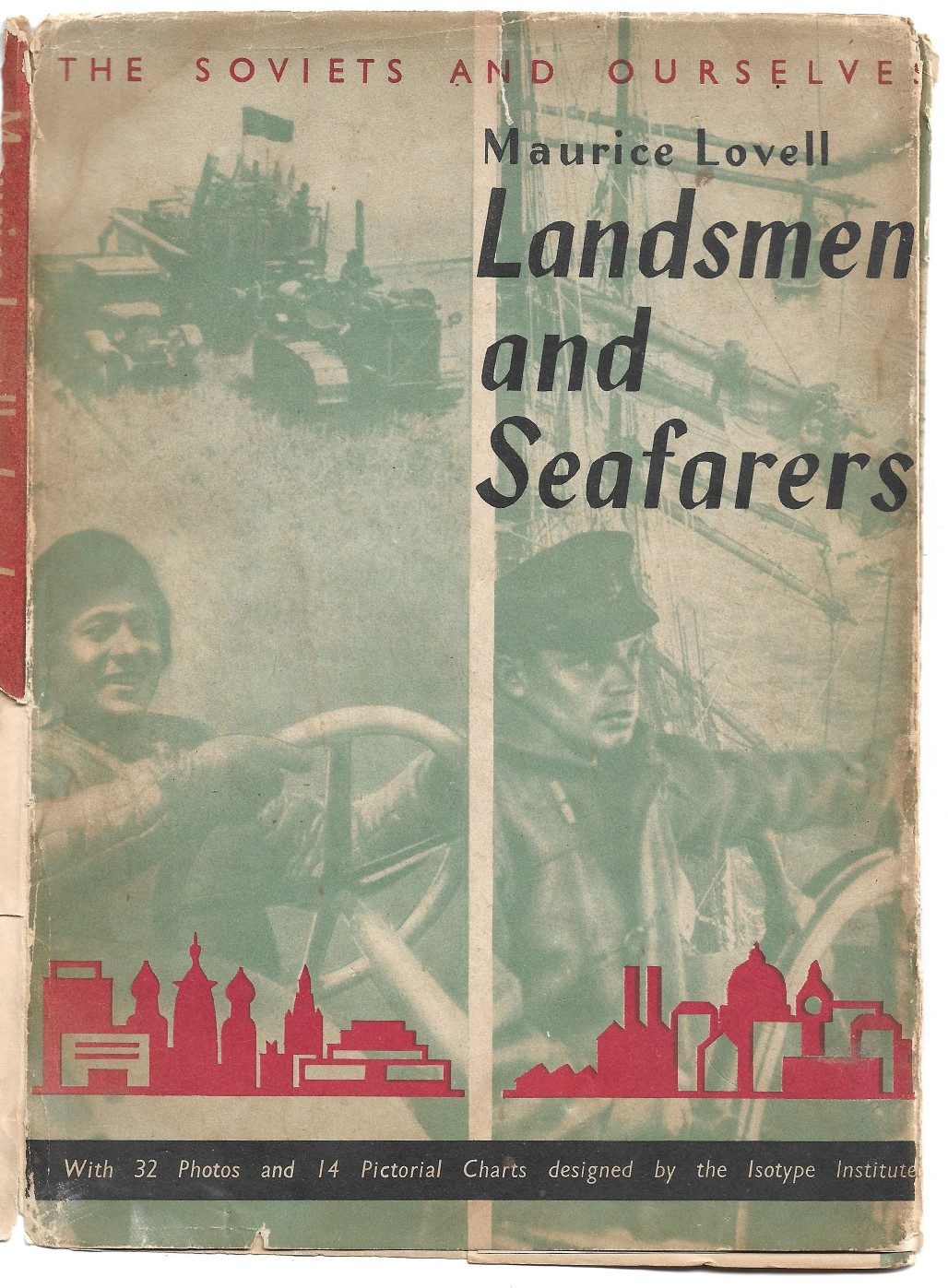
S.THE          SOVIETS              AND          G@URSELV E

                                       Maurice Povell |

2S                      4.            Landsmen

                                      Seafarers


B, With 22 Photos and 1/4 Pictorial Charts designed by the Isotype Institutd
CONTENTS
PAGE
“THE TROUBLE WITH THE RUSSIANS IS...”
“HOW BIG IS THE QUESTION ?” 23
BYVVELL IT?S A -LONG STORY...” 28
“WHAT ARE THE FACTS 2” 39
MORE FACTS 44
“GETTING ON WITH THE RUSSIANS” 61
LIST OF PICTORIAL CHARTS IN COLOUR
ISOTYPE VOCABULARY Chart
CLIMATE: RAIN, AND TEMPERATURE Chart
SEA ANIMALS AND LAND ANIMALS Chart
TRAVELLING DISTANCES Chart
CROSS-SECTIONS THROUGH THE SOVIET UNION Chart
CONQUERORS ON RUSSIAN SOIL; CONQUERORS ON BRITISH SOIL Chart
AREA AND POPULATION Chart
PIG IRON PRODUCTION Chart
HISTORY OF NATURAL EXPANSION Chart 9
NAVIES AND ARMIES Chart 10
MANKIND: COLOUR AND RELIGION Chart 11
WORLD PRODUCTION Chart 12
CONQUEST OF NATURE Chart 13
ALLIANCES AND CONFLICTS Chart 14ISOTYPE VOCABULARY
Britain Russia
Soldiers
i Plague
: 1700 Naval Ships
i meee a Minerals
SE
i ig
1750 Pa
Oil Production
a)
Rt SS
1800 Coal Production
“i ea &
&>-
1850 : |
: Wheat
——_-_
: 1910 ne ¥ Rice
rite Population alice Sea Transport h v : Ve
ce el
i
. :
a Tank 2 Air Transport ( volts
Land ee | Sea vA War
An index of the more important symbols which occur in this book.Climate: Rain and Temperature
JULY JANUARY JULY JANUARY JULY
JANUARY JULY JANUARY
Oxford Archangel Verkhoyansk (Siberia)
Winnipeg
90
90° 90° 90°
60° 60° 60°
60°
32) 32° 32: 32°
0
30 -30°
Calcutta Astrakhan
Johannesburg
Vladivostok
90°
90° 90° 90°
60° 60° 60° 60°
32’ 32: 32°
NYA ANVATA
YAY A
SSE
The blue lines be oecck the average monthly sraralitn inches ce line 1 inch)
count
The ground-level of the scenery indicates the temperature in degrees Fahrenheit INSTITUTE}
Extreme cold is a commonplace of Soviet experience, and its influence is deeply
.
impressed upon Russian history and character construction.Sea Animals and _Land_ Animals —————
blue outline coast: accessible the whole year
brown coast: not accessible in winter
other brown areas: inland (British and Soviet Union) ;
connected by red shipping lines: British areas <——————e =
crossed by green railway lines: Soviet area ee
ISOTYPE
‘Communications are the blood-stream of a Commonwealth. Ours are on the oceans ; but the Soviet Union has little open coastline, and comparatively few of its
citizens have ever seen the sea.
3Travelling Distances
London 1830 en ee ee ee] Cape Town
_London 1930 SS
SSS —= Cape Town
vag
London 1930 = Cape Town
Mescow
Moscow me Vladivostok
Moscow 1930 H! Viadivostok bl
ISOTYPE
Each complete unit of distance stands for one week of travelling INSTITUTE
The locomotive shortens effective distance on land, the steamship on the sea. But the aeropline is the greatest annihilator of distance in both cases.
4|
Cross-sections through the Soviet Union
|
||
|
4i hyE ; \
|
me
a
I) li
yO) SSE Moscow
|
mys ilka
if
i
— 20,000 feet brown: agriculture
ISOTYPE
15.000 green: forest, grass INSTITUTE
grey: steppes, desert
_ 10,000
black: tundra, mountain flora
5,000 red: oil industry, cities
,
blue: cotton
Mountains ¢
A land of vast plains and forests, with waste lands and deserts in the north and south. Its cultivated areas are scattered and segregated.Conquerors on British Soil: | ot | Conquerors on Russian Soil
Viking
Jf|i) Nernices
K
Poles :
id | Dutch Charles Xil y :
= i. The Kaiser St i)
Napoleon _ 2 “
; | The Kaiser
red: Vikings, Nor : . Hitler Hitler iis :
a‘own: Mo!ee ee i |
black. Ger
blue thenersArea and Population
UNITED STATES CHINA
- BRITISH cad enc SOVIET UNION
COMMONWEALTH d denci ‘di di
Canada RSE S.R.
other
American
in Europe
in Africa
(except Union|
Ukrainian and
White Russian
SSR.
Union of
South Afric other
Australasia rena ntind neriitity bet ititi
India :
eC ee
other Asiati
-Rest of the World
Each small rectangle between two black lines represents 1 million square miles
Each man symbol represents 10 million population sree
INSTITUTE
The British Commonwealth is much larger than the Soviet Union in area and in
population. But four-fifths of its population is in India.
7Pig-iron Production
Great Britain Russia (Soviet Union)
and British dependencies
1900 SREEEEERE 1900 San
SREEREER eel
BEBE BESE BEG
ite =I)
EERE REES
EEREREEEE
1905 EERE 1905 gaa
SERRE aan
HERR EEERS
HERE RERERS
EEREEEEGEE
1910 ERE 1910
SHER RREERERE
SESRSRRERE
HREEREEREE
SERGE
EREEREES
MBB DEPRESSION
tit Le
SHRERERES
REGEEEER ©
1925 EEREEESE
HBOS strike
HERERRES
SERERRRES
BREERESE =
1930 { {fl pay 1930
HaERSa
MMGBE DEPRESSION
SREB
EREEREEE
1935 SERaae 1935
HEEERERE GS
EEREEEREEED
BEEREERESE
BREREEEABESS
Each unit represents 1 million tons blue British dependencies
otver i
INSTITUTE
A reliable measure of the growth and variation of industrial power. Compare the
steady expansion of Soviet production since 1920 with the fluctuations of the British
peeduccich: and note the growing importance of British production outside Britain.
8da
BS WI Ga B®»
‘S
[~a)
up to 1500
1500 - 1650
a
Sarees
=
Ss
=a 1650 - 1763
1763 - 1830
1830 - 1914.
1914 - 1930 surrounded by black line: lost or aiven up courlgl
INSTITUT
Russia expanded by land, outward to a coastline; Britain by sea, from coastlines inward. The Russian was the earlier.
9British Navy and Army Russian Army and Navy
1700
ind eed
Oe oot
scotMankind: Colour and Religion.
Chinese Religions
SSS aS Japanese
ate!
Religions
BRASS
Roman Catholic Church 8
Anglican, Lutheran
Orthodox: Coptic and other Churches
and other Protestant Churches
Animists, etc.
Gasserevasusseesccateasy
UTED
Each symbol represents 50 million population
black outline: Whites and Red Indians grey screens: Christian Churches
5 : blue screens: other
brown outline: Chinese, Japanese, Burmese etc. religions
: *
full brown: others surrounded by red line: British
: ; : ; : ISOTYPE
surrounded by green line: Soviet Union INSTITUTE
The citizens of the Soviet Union are overwhelmingly a white population, belonging mainly to the Christian tradition. Those of
the British Commonwealth are overwhelmingly
brown and mainly non-Christian. The two countries between them contain half the Moslems of the world.
a] 'World Production Each symbol represents 5 per cent. of world production in 1938
i | : | ovis! Union
Great Britain wheat and rye, rice
wheat and rye, rice
flax RREEREEEER
ETE flax
coal
BREE GG coal
oil BE oil
iron ore ogee iron ore
manganese ore
EEEELEL manganese ore
yy
aby") Rest
of
of EEurope
est
iy } other British Territories wheat and rye, rice
wheat and rye, rice ¥
Tey Mae Ne eee al
flax eeadES flax
coal SEEEEE coal
oil
oil
Geegeeeea iron ore
18 ia
iron ore
manganese ore ia LE| i@ ia @ @ manganese ore
Rest-of the World
wheat and rye, rice the santte
United States
Gbeeeey wheat and rye, rice
flax
flax
coal
LLL E coal
oil
oil
iron ore TT:
es
iron ore
9g
manganes: e ore sorrel
manganese ore INSTITUTE
commodity are contained within the Soviet section of this world-chart.
Soviet production is increasing steadily ; note how many of the.symbols for each
l2Britain Russia
Conquest of Nature Science and Art Conquest of Nature Science Gnd Art
Scientists “Writers Composers
; Scientists Writers Composers
Plague Inundation Fat
Fire; oN Fire;
‘Wolves Plague Inundations Wolves
1550
Malad
lid a Did Bd Bia De
1550
RRRAARARALALRARAR
RARAW2AW2W
Tallis
1600 us i | } Shakespeare W. Byrd
i 1600
orchester : Orlando
Giabens
Pi Purcel
Boyle
ROYAL :
SOCIETY Milton
1700 a.
lorthampton
— : Dryden
1700
Defoe ACADEMY
arwi Swift
Handel
re ‘avesend
am 4
ues
ENCYCLOPAEDIA
BRITANNICA,
Priestley
1800
oS avy, Wordsworth
Byron Pushkin
St Petersburg Lebachevsky Glinke
Scott
Faraday Riga _
a os
Sir W.R. Lermontov
Hamilton
Dickens
Thackeray
St Petersburg Turgenev
Darwin Kiey Mendeleef Dostoevski Borodin
Kelvin Moussorgsky
ENCYCLOPAEDIA Sisto Rimsky-
Korsakov
Sullivan Chekov
Tschaikovsky
Irkutsk :
1900 Hard;
] 900 Timiryazev Glazeunoev
Rutherford ay Elgar Paviov Scriabine
Kipling
Bragg
Galsworthy Gorky Stravinsky
Shaw
Kapitza
Shostakovitch
Walton «
Man must win the stru ggle with Nature before he can triumph in
the realms of the
mind.--
13 aSAlliances and Conflicts
— 1650 Britain Russia
os
against
= Charles XIl
1800 against
& Napoleon
- 1850 Crimean War
-— 1900
= against
the Germans,
etc. Intervention
against
— 1940
the Germans
blue: wars in which Britain and Russia were al ies il
black: wars in which Britain and Russia were enemies § &
grey : other wars
directed towards centre: European wars
directed outwards: wars and expeditions outside Europe ae es
ISOTYPE
~ black screen: state of war without hostilities INSTITUTE
Comradeship In arms between Russia and Britain against would-be conquerors goes
back to the eighteenth century. We are not proud of the wars in which we have
been on opposite sides.
14‘ww a J *- * es -
 Isotype Archive