Page text
SOCIAL
ISECURITY


The Story
 of British Social Progress
}and the Beveridge Plan

      by SirRonald Davison
     ~ visualized by ISOTYPE .
No text on this page.
No text on this page.
SOCIAL
SECURITY
The Story of British Social Progress
and the Beveridge Plan


                                  By
                                  SIR RONALD DAVISON
                                  (Author of   “The Unemployed: Old
                                  Policies and New,”’ etc.)


                                  Visualized        by ISOTYPE


 GEORGE G. HARRAP AND COMPANY, LTD.
                            LONDON     TORONTO     BOMBAY     SYDNEY
Designed and produced by
ADPRINT LIMITED LONDON
FIRST PUBLISHED 1943 by GEORGE G. HARRAP & CO. LTD.
182 High Holborn, London, W.C.1
COPYRIGHT 1943. All rights reserved
PREFACE


    The main purpose of this book is to show in diagrams
  Britain’s progress towards Social Security. Our poverty
  problem, and the measures for combating it, past and
  present and future, have been illustrated by the graphic
  visual means of coloured charts. In this way many vitally
  important facts can be presented in vivid, gay, and easy
  shape to the ordinary reader—facts and figures which
  would normally be buried in statistical tables which he
  has no time to unravel.
    Latterly the minds of all of us have turned more than
  ever to the future; as a nation we are bent on social
  reconstruction after this war is won.    That is also the
  intention of this book;      it might have been entitled
  What Is and What Might Be.
    Although this is not primarily a treatise on Sir William
  Beveridge’s Report, the proposals in his Plan have been
, naturally taken as the best guide to the future. True,
  that Plan has so far only been given a general blessing
  by the   Government ;     indeed,   they dissent on some
  important features. When their official scheme is worked
  out in full and passed into law, then it must clearly be
  accorded first place. But that has not happened yet, and
  meanwhile the Beveridge Report contains the only
  coherent plan for building social security in Britain   ;
  therefore its main provisions for the reform of our social
  insurances and allied services have been described and
  illustrated in the later pages of this book.
CONTENTS
PAGE
PREFACE
Chapter BRITAIN’S SOCIAL PROGRESS REVIEWED
Chapter - THE PRIMARY NEEDS AND RISKS 20
Chapter SOCIAL SECURITY IN ACTION 28
Chapter THE STORY OF ADAM BLACK AND EVE
BROWN 37
Chapter ADMINISTRATION AND FINANCE 50
POSTSCRIPT ay)
LIST OF CHARTS
PAGE
POVERTY SHORTENS LIFE 10-11
OVERCROWDING AND INFANT MORTALITY
UNEMPLOYMENT 15
POVERTY AND ITS SOURCES 18-19
THE CHANCES OF SURVIVAL IMPROVED 22-23
REQUIREMENTS 26-27
THE PROBLEM OF RENT 29
SOCIAL SERVICES DEVELOPED 32-33
THE SIX CLASSES AND THE AGE GROUPS 38-39
HOW THE AGE GROUPS SHIFT 43
ADMINISTRATION COMPARED 48-49
FINANCE 52-53
THE BURDEN ON THE EMPLOYER 56
THE BURDEN ON THE EXCHEQUER OU.THE STORY OF BRITISH SOCIAL PROGRESS
AND THE BEVERIDGE PLAN
CHAPTER I
BRITAIN’S SOCIAL PROGRESS REVIEWED
(1) BackcRoUND TO THE PRESENT SCENE
At the start of the present century Britain was coming
to realize that poverty and want in an industrial com-
munity were not just part of the natural order of things,
but could: be prevented by social action. In forty years
this realization has led to a profound improvement in our
standards of living. A steady stream of social legislation
cineca rank hac cone far to—— the lives
of the great
setter educated,
ERRATA
ve more leisure
Page 13, line ee for Chart 6 read Chart 7.
Page 13, line 22: omit reference ‘o chart There is still a
it is far smaller
CHART REFERENCES
The charts referred to in the text are to be ok reveal clearly
found at the following pages:
y do so because
Chart pp. hich the further
Nw
LOT
Chart p.
uD) At present the
Chart
12} 18, 19
DW
Chart
1olds the field of
PP: 20,, 27,
Chart p- 1e blue; it does
X
Chart NI
PP: in British social
COON &
325
OW
WW
Chart 9 Pee Oo
Chart 12 pp-
‘ally out of our
b Ne)
b
Chart 13 p.
YIU
Chart 14 Pp
Chart 15 AW bv
p.
Chart 16 p- A NIPoverty Shortens Life
Overcrowding
Stepney
BENE NSN NON
NG NarNe NeeNEN NNONG
he
VSO Sd decent cdckcks
RSS ee ee
fo SSSSSSSSSS SSS SS
Hampstead
SERRE
RSC
OOOO
NG NERS SNE Nee
NoyRAN
Isle of Wight
SSSSA
SESS
hes
So Sees
LA RACAL CASESSSEe
SOS
JWOOOOOOOOO00E“sisisini ty
Each unit represents 1°/. of tenements black
: overcrowded
10Infant Mortality
Stepney
otgSeaseacessea senseastacans
-. on Te ~
¢ erste Sersto ners ot HS
Aaah
fpiacaeek
OHSAS ORS
2 Rae
Each cross represents 1 infant death per 100 births
It
soreexperience, particularly our experience of contributory
insurance, and from the past draws a pattern of the
future, thereby serving as a model for the post-war
expansion of our existing social services.
(2) Tue InsrRuMENTS OF PROGRESS
It is, of course, through our modern social services
established since 1900, that we have done most to
diminish poverty, disease, and ignorance—three of the
giants in the path of social progress. But we could not
have achieved so much without the accompanying
increase in the nat‘onal income and in real wages during
the years 1900-39. Higher average earnings have been
rendered possible (a) by the growth of national resources,
(o) by the acceptance of collective bargaining between
employers and workers, (c) by minimum wage legislation,
Trade Board Acts, etc.
All this has led to an upgrading of the lower incomes, a
mitigation of the inequalities of wealth among our
citizens, and a better spread of purchasing power. A
simultaneous decline in the average size of the dependent
families of workers has also had something to do with it,
but this is not a matter for congratulation. The economic
function of the social services has been to redistribute a
further portion of our national wealth—about ro per cent.
of it—in the form, not of wages, but of social-services in
money or in kind. It is this process which we must carry
farther in the post-war world. Meanwhile the results
already achieved are impressive ; our provision for sick-
ness and disability has been a weak spot, but in all other
respects the British measures for security are already
more comprehensive and more adequate in cash payments
than those of any other country in the world, except
New Zealand.
I2(3) Socrat Servicers DEVELOPED (Chart 6)
The typical social services of this century have been
those which furnished income-maintenance to wage-
earners as a right whenever earnings were interrupted or’
had ceased during the main emergencies of their working
lives and their old age. In 1939 old age pensions! (£94
million), unemployment pay (£90 million), and sick pay
(£18 million) were the main items of expenditure,
accounting altogether for a total social budget of £236
million. These main new services were all based on the
contributory insurance plan. Workmen’s Compensation
(£62 million) and Public Assistance (Poor Law) (£24
million) filled up the gaps. Comparing 1939 with the
year 1900, when the Poor Law was the only social
service, we find that little more than £3 million per
annum was spent on out-relief or income-maintenance at
the opening of this century. This budget does not include
social services in kind, such as institutional relief, educa-
tion (which before this war was costing well over £100
million) or housing (over £20 million a year). Between
1920 and 1939 we built some four and a half million new
houses of the working-class type (see Chart 5).
Moreover, it is a notable fact that, in spite of the war,
we have since 1939 expanded some of the social services
listed above. In particular we have lowered the pension
age for women from 65 to 60, thereby bringing in for
pensions some 400,000 extra women who are either the
wives of pensioners or are themselves insured ; and we
have added a scheme of Supplementary Pensions by
which the old persons can get State help up to a maxi-
mum which almost doubles their weekly pensions of
1 This figure of £94 million includes both non-contributory and
contributory old age pensions, and widows’ and orphans’ pensions.
aSIos. each, subject to a proof of need which is not very
exacting. Unfortunately, however, there are still many
gaps in our social security system which are unfilled or
only inadequately filled. These are sharply revealed in
the emergencies of sickness and old age; and also in the
hard-pressed years when a man and wife are struggling
to rear a young family. It is wrong that children should
be a cause of poverty.
(4) Tse Gaps mv our Socriat Security (see Charts 1,
2, and 3)
(a) National Health Insurance. Take the case of sickness
first. When National Health Insurance started in
July 1912 a sick man only got 10s. per week, and a sick
woman 7s. 6d., from insurance. Even to-day (1943) a
man can only draw 18s. per week and a single woman
15s. per week ; after 26 weeks of sickness the rate falls.
There are no dependants’ allowances, and the sick man
with a wife and young children obviously cannot live on
185. per week. Failing family resources or the charity
of friends, he has no option but to go “on the rates ”—
1.e., apply for Poor Law relief, now called Public Assistance.
This means real poverty. True, there has been a striking
amelioration in Poor Law methods since the famous
Royal Commission Report of 1909. ‘“‘ Social welfare ”
rather than “deterrence” is the rule and practice of
many local authorities, especially in London, but the
whole system, with its means test, etc., still retains a
stigma. In 1942 as many as 107,000 cases representing
about 250,000 people were on out-door relief through the
sickness of the breadwinner. Some of these breadwinners
were not insured at all, and it is, of course, only ‘the
Public Assistance Authorities who are responsible for
meeting all the proved needs, in sickness or otherwise, of
14sll
i
ia
TA
‘a
!
oe
| iu teany of the five or six million people of working age who
have been left outside the range of our British Social
Insurance schemes.
There is no reason why National Health Insurance
should not be expanded and should not provide for a
man’s wife and children in the same way as Unemploy-
ment Insurance does to-day. The unemployed man
with a wife and two children draws 38s. per week as a
right. Clearly the remedy is (1) to pay the same rates of
benefit in both kinds of emergency, where home income
is interrupted, (2) to see that the rates are sufficient for
reasonable subsistence, and (3) to widen the range of
insurance.
(b) Families in Want. Where the family earnings are
low the possession of children has always been a cause of
poverty ; and the larger the family the more destitute it
becomes. Nor is this confined to emergencies such as the
unemployment of the wage-earner. Many a man on full
wages with four children or more is desperately poor
until his older children reach working age. His high
rent alone may ensure this, if he tries to provide a healthy
and not overcrowded home. Expert social surveys have
demonstrated that, in the towns of Britain, nearly one
quarter of all the disclosed poverty has been due to
failure to relate incomes during earning to the needs of
the family groups. How much hardship due to this cause
has remained hidden no one can estimate. It is hidden
Note—In this and other chapters the words ‘subsistence rates’ or
‘minimum of subsistence’ have been used. What do they
mean? No final answer to cover the future can be given in
terms of money, but in Chart 5 are shown the estimated
requirements of different households, covering the cost of food,
rent, and other needs at 1938 prices.
The regional variations of house rent—a very intractable
difficulty—are shown in Chart 6.
16partly out of pride, and partly because the present remedy
is to go “‘ on the rates.” Not only do many living children
suffer, but, by the same token, many more are never born.
In future we must solve this social problem better, if only
as part of a vitally needed population policy. Cash
allowances with some allowances in kind (¢.g., free milk
and school dinners) for children up to the school-leaving
age will be a proof of our resolve to care for the nation’s
youth, and, if possible, restore their numbers. Such
allowances cannot well be made part of our contributory
social insurance system ; they must be direct State grants
to the parents—to all pavents irrespective of their
incomes. Not that the future allowances will represent
100 per cent. of a child’s maintenance! Every parent
will still have to bear at least half of the full burden of
maintaining his children, but in future the community
will step in to share the cost.
(c) Other less conspicuous gaps appear in our present
social security system, but there is no space here to discuss
them all. What is clear is that we can go far to abolish
the remaining sub-standard living in Britain if we can
effect a further moderate redistribution of income through
an expanded social insurance system and children’s
allowances. Such poverty as still remains will be due to
faults of character and non-compliance with reasonable
rules. If we, as a nation, can accept this quite practicable
ideal, and if our Government legislates broadly on the
lines prescribed, we shall start the post-war era by setting
a worthy goal for our nation and a finé example to
the world. :
57Poverty and its Sources
Among 100 workers the causes of poverty were:
IS99.. =
Old age, iilnsss
Large family
dill
Low wages
Unemployment
Others
Esai
Each symbol represents 1% of all workers
The symbols on a background are the workers living in poverty
The causes of poverty are indicated by additional symbols and wordsi936
Old age, iliness
Large family
Low wages
Unemployment
Others
ISOTYPECHAPTER I
THE PRIMARY NEEDS AND RISKS
The primary needs which must be met in any adequate
system of social security are fairly easy to define. In our
modern industrial community they arise out of the
following contingencies.
(a) Unemployment. ‘This is a term which in itself needs
definition before you can relieve it with cash benefits
drawn as a right without any test of need. An insured
man should prove that he is seeking a job of a kind which
normally exists in his community, and that he is capable
of performing it, but unable to find any vacancy. As a
general principle he should be ready to go wherever a job
can be found, provided his expenses are met. ‘There
must be a right of appeal in hard cases. It should be
noted here that non-workers and people working on their
own account, such as employers, shopkeepers, or profes-
sional people, cannot reasonably be insured against
ordinary unemployment. They are under no contract
of service.
(b) Sickness and Disability. This means the inability of a
worker through illness or accident to carry on any gainful
occupation. ‘The first need is a comprehensive medical
service for the prevention and cure of illness, followed,
where required, by post-medical rehabilitation. But all
citizens, whether employed for wages
or not, should have
access to medical treatment—from general practitioners,
specialists, and hospitals. Social insurance, as we in
Britain understand it, can hardly be made to cover such a
health service for all. The present medical benefit from
panel doctors should therefore be taken out of our
National Health Insurance scheme and merged in some
wider national health service which must be constructed
20in future. Income-maintenance or sick pay is an
easier problem.
Any wage- or salary-earner who is certified sick by a
doctor and unable to work should be entitled, after three
waiting days, to cash benefits for himself and his family
at full subsistence level. But here again several millions
of our fellow-citizens of working age are not wage-
earners, or the dependents of wage-earners. For instance,
independent shopkeepers—about a third of a million of
them—and men or women working as employers do
not normally suffer any loss of income when they go
sick for a few days or weeks. They should have a full
medical service, but as a class, they can hardly expect
to be made eligible for cash benefit like the weekly
wage-earners.
(c) Old Age. That the aged should suffer want when
they can no longer earn wages after fifty years of toil is
regarded as an intolerable condition in our democracy.
For thirty-five years we in Britain have sought to prevent
it by providing small Old Age Pensions of various kinds.
But the basic pension to-day is only ros. per week (20s. for
a couple), and that is manifestly insufficient for people
who can no longer work and have no other resources.
Pre-war social surveys such as that by Mr Rowntree, at
York, showed that about one-third of all State pensioners
were living below a reasonable human needs standard.
Since then, in 1940, the State has provided Supplementary
Pensions on a mild means test, and the figures show that
over one-third of all pensioners have claimed and obtained
such supplements from the Assistance Board. This seems
to cancel out Mr Rowntree’s figure. How much poverty
in old age still remains no one knows. Many thousands,
not being insured persons, are disentitled to any pension
at all, yet they do not apply for Public Assistance. A
married couple of pension ages can to-day, in certain
21y
The Chances of Survival Improved
How long wiil 10 children live
born about i916
04
%
*
29
49
$9.
79__.years and over
The position of the symbols indicates the end of the life
Sine.
22How long will 10 children live
born about 1938
aie)
ISOTYPE &
33circumstances, secure a State income up to about 4os. a
week if they really need it.
They are, however, up against the means test, which,
even in the mild form in which it is now administered by
the Assistance Board, is still disliked and feared. Some,
who might now qualify for a supplement, still refuse to
apply. Others, with savings or help from their families,
can and do subsist on their basic pensions of ros. (or
205. joint). The general demand is, however, for a more
generous basic insurance pension—even up to double the
present rate. This and the related question of retirement
are further discussed below (Chapter V).
(d) The Marriage Needs of a Woman. Whether or not a
girl needs a marriage dowry from the State may be open
to question. The Beveridge Plan proposes to give £10
(but only to women who have been regular insured wage-
earners) at the rate of £1 for every 40 contributions.
What is certain is that women need better provision for
maternity. On the cash side National Health Insurance
now furnishes a lump sym of 4os. on confinement, to a
woman with 42 contributions to her credit. This sum is
insufficient ; it should be increased and extended to all
married women. But what of the woman who continues
to work and earn after marriage? Does not she deserve
a maternity cash benefit, comparable to sick benefit,
payable for two or three months covering the birth of
her child? We want to make it easy and attractive for
her to give up employment in good time and not return
too soon to the factory. On the health side we need a
wide extension of the best maternity and midwifery
services, including more maternity wards in hospitals.
Children are a more precious asset than ever in these
days in face of our dwindling birth-rate.
During marriage a woman should still be regarded as
an insured person by virtue of her husband’s contribu-
24tions. Even though she does not work for wages, her
pension qualifications should be preserved, and she should
probably be entitled to pension irrespective of her own
age when her husband retires in his old age (65 or over).
She should also be insured against widowhood and legal
separation.
(e) There are many other needs and risks which are
sufficiently common to be covered by insurance, but
whether by compulsory methods or voluntary action is
not so easy to determine. Funeral expenses are the
commonest of all, though it is a question whether we want
to encourage and perpetuate the wasteful national habit
of a costly burial, complete with hearse, black plumes,
etc. Funerals might well be rationed. In any case, at
present, it would be eminently desirable to include a
universal funeral grant in the enlarged social insurance
scheme. The Beveridge Plan proposes a grant -of £20,
part of which would be needed for other expenses than
the funeral itself. Incidentally, this would give to wage-
earners a much cheaper form of funeral insurance than
that offered by the commercial insurance companies,
which now draw from their pockets a premium income
for death benefits of no less than £80,000,000 a year.
For some other purposes voluntary insurance is certainly
a desirable resource and should be encouraged. It is a
form of thrift, and the saving habits of our people are
going to be an even more valuable asset in the post-war
Britain than they have been in the past. Let us hope
that, among other popular insurances, the provision for
expenditure on education, holidays, and travel will
become increasingly fashionable. Before this war and
the now widespread concession of holidays with pay, not
more than one-third of our people were ever able to enjoy
as much as an: annual week’s holiday away from home.
23
ooRequirements
t., a single man
fuel, light, clothing . margin
sundries :
fuel, light, _ clothing margin
sundries
fuel, light, sundries clothing
Each circle represents } shilling per week at 1938 prices
26Requirements
Ht of aEinof four
fh &
needs i
a?
3i
fuel, light, sundries dothing
27 : ISOTYPE ic.CHAPTER Il
SOCIAL SECURITY IN ACTION
(1) Tue Srx Socrat SEcuRITY CLASSES
The moral to be drawn from the foregoing analysis is
that we must expand and improve the income-main-
tenance services, particularly National Health Insurance.
We must aim at bringing the whole community intc the
social security scheme, and must try to provide'for each
group and for each contingency a scale of benefits or
grants adequate to their needs. The Beveridge Plan
provides the model and the g-neral lay-out.
First of all, here is a definition of the groups into which
the people are divided according to their status or
condition of life. ‘There are six main classes (see Chart 9)
to be catered for in any comprehensive scheme of social
" security and insurance (the symbols used for each class
in the chart are indicated in brackets).
(a2) Persons of Working Age. Class I: Employed
persons (full red symbols). This means everybody working
under a contract of service, normally described as wage- or
salary-earners. There should be no upper income limit
for insurance in future and no fixed age limit. Men and
women should, according to Beveridge, become pen-
sioners only upon retirement from earning. In insurance
all should contribute compulsorily, irrespective of their
varying personal risk. Married men’s insurance should ;
cover their wives: husband and wife should be. treated
as a team. Under Beveridge there would be a flat rate
of insurance contributions varied only according to age
and sex. A company manager on £5000 a year would
pay the same rate (45. 3d. per week) as an agricultural
labourer on £3 per week. Their employers would add
28~~ 4 | The Problem
2 “eas
&
of Rent
green: agricultural
red: industrial
households
The groups of circles
A: Scotté represent the weekly rents
= ae Each circle
ee represents 2s. 6d.
Midland °
and Nort.
Wales
London
@
st
ISOTYPE ra}their share (gs. 3d. per week). In actual practice such
complete symmetry might not be attainable nor even
desirable. Men and women in Class I should be eligible
for all benefits (see list of proposed benefits on pag> 36).
=
~.Class II (full black symbols). Beveridge calls this class
“others gainfully employed.” In practice they will be
the active employers and people working on their own
account, including shopkeepers, farmers, professional
men, artists, etc. These are to be brought into insurance
for the first time, and would have to pay the same weekly
contributions as Class I, but they would not be covered
for ordinary unemployment, nor for ordinary sickness
benefit, nor for industrial accident. There would, of
course, be no employer’s contribution in their case. The
retirement pension would be their main benefit. If
during their working age they fall on evil days and need
to take a job they might sometimes be helped by a course
at a Government training centre to prepare them for their
new work. A grant in cash or wages would be paid
during training.
Class III (black and white woman symbols). This
class comprises the housewives, married and under 60.
These are to be insured by virtue of their husbands’
contributions ; they should pay none themselves, unles;
they work for wages. They are covered for pensions and
maternity grants, and
they qualify for dependants’
benefit whenever their husbands are sick or unemployed.
Class IV (red outline symbols). Others of working
age, but not earning. They are, in the main, persons of
private means, single women engaged in housework, and
students over 16. Their insurance status resembles that
of Class II ; they have no employers. Here again it is an
open question whether the Beveridge Plan is quite just
in requiring this class to pay the same contributions as
Class I.
30(6) Persons outside Working Age. Class V (green
symbols). Those below working age mainly to be
covered by children’s allowances.
Class VI (blue symbols). Those retired above working
age and covered by pensions. These pay nd contributions.
-«—
(2) Tue New BENEFITS AND THE GOVERNMENT'S PRO-
POSED MopIFICATIONS WHERE KNOWN
Now as to the improved benefits which are offered to
these classes under the Beveridge Plan. The governing
principle of the adult scale is that 24s. per week for a
single man or woman and 4os. per week for a man and
wife represents at present aminimum of subsistence when
earnings are interrupted by any cause. The Government
do not quite accept this principle. They do not see how a
fixed contractual benefit can always be guaranteed to
be a minimum of subsistence, which is bound-to be a
variable figure in money: costs of living vary both in
time and in place. The Government have postponed
their decision on the actual figures for benefits, but their
proposals are unlikely to differ much from those put
forward by Sir William Beveridge.
(a) Outside Insurance. There should be Family Endow-
ment in the form of children’s allowances for children up
to ages 15 or 16 if still at school, at an average rate of
. 8s. per week for each child except the first child. Thus,
a man with three children would have 16s. per week
added to his normal wage income. During unemploy-
ment or sickness of the breadwinner allowances would be
paid for his wife and all three children, making his cash
benefits up to 64s. per week, i.e., 405. for self and wife, and
24s. for the three children. The Government have
accepted this proposal in principle, but will probably
reduce the cash allowances to 5s. (average) while giving
rather more assistance in kind to all young children.
31Social Services Developed
. Cash Benefit Paid in Great Britain
1901 (
1911 3 (
ae OODDODDO
°°! QOOODDDOOGDOG4
i DOOOODOOOGHO G4
Public and Unemployment Assista Unemployment Insurance
Each circle represents 10 millio n pounds
ae
yments on ssS page are a measure of unemployment, as well
s of the provision made for relieving it
seents on the opposite page are a measure of growing social
reGo
CXC
\ESOG®
BSC GOGHOOG®
POOGOHGHOHOGOHOGH
Hae Insurance = ————~—‘~ Old Age Pensions, ete.
Me ccaaaue
38(6) Inside Insurance. New benefits of many kinds will
be added :
For all citizens Gomprehensive medical and _ hospital
treatment; a death benefit or funeral
grant of £20; a retirement pension at
minimum age 65 (men) and 60 (women).
These vast items of the Plan have all
been accepted, subject to further con-
sideration of the actual rates of grant
and pension.
For all wage- or Extension of unemployment benefits
salary-earners beyond 26 weeks if required; industrial
pensions after 13 weeks of incapacity
due to injury or accident. The Govern-
ment are not committed to these two
propositions.
For housewives Marriage grant of £10; maternity
benefit of 36s. per week for 13 weeks for
women wage-earners; maternity grants
of £4 lump sum. Widow’s benefit
(instead of pension) of 36s. for 13. weeks,
guardian benefit and separation benefit. ,
The Government’s proposals are likely
to be different.
(c) Widows’ Pensions. ‘The existing widow’s pension of
ros. per week for life is to be cut out. After 13 weeks the
able-bodied widow without young children should become
‘a wage-earner, says Beveridge. Similarly, old age
pensions will be converted into retirement pensions. This
means that, in principle, no one should draw both pension
and wages. Both these changes are designed to keep
people working as long as they can, in order to
keep up production, and to reduce the enormous pensions
bill which confronts the nation. Both have been
34criticized as being less generous than the present arrange-
ments, and the Government are unlikely to cut off the
widow’s pension altogether, e.g., for the lone widow
between 50 and 60.
(d) Medical Treatment.
Medical treatment for all is to
be taken out of the insurance field.Presumably there
will be an end to the present system of N.H.I. panel
doctors, etc. A new national service for the prevention
and cure of disease and for rehabilitation is one of the
basic assumptions of the report. Probably it will be a
public service. This vast transformation with all that it
promises for our national health has been accepted in
principle by the Government.
(e) Retirement Pensions for the Old. ‘These are to be 245.
as a right for a single person in future, as against the
present basic rate of 10s. plus the chance of a supplement
from the Assistance Board. A married couple will get 40s.
a week instead of £1. But these are “ eventual ”’ pensions,
not payable at the full rate till 1965. This is a scheme
which can only be fulfilled on a contributory basis in 20
years. The immediate proposal for mid-1944 is a pension
of 145. for a single person and 255. joint. Thereafter basic
pensions will increase at the rate of 15. 6d. joint or Is.
single every second year.
The new classes not hitherto insured for State pensions
will have to pay contributions for a qualifying period of
10 years. ‘Those. among them who are already aged
over 55 can claim exemption from this part of their
contribution.
The Government have definitely rejected this scheme.
They are prepared, said Sir John Anderson, to fix a higher
basic pension now and keep it there ; but they refuse to
burden posterity with a commitment to a rising scale
which would run into ‘‘ many hundreds, if not thousands,
of millions of pounds in future’ (see also Chapter V).
35(3) Tse Rares or BENEFIT AND OTHER PAYMENTS
Here are the “‘ Beveridge ” rates of benefit, allowance,
and grant set out in tabular form. They are based
approximately on current cost of living in 1942, but
would have to be reconsidered if post-war prices were
very different :
(a) Unemployment and Disability (Sickness)
Benefits
Single man or woman aged 21 or over . 245.
Married man with wife working 245.
Married man with wife not working 40S.
Married woman with husband working . 16s.
(Lower rates for boys and girls under 21)
(b) Retirement Pension (in 1965)
(Liable to partial reduction for any
earnings)
Man and woman (joint nas 40S.
Single man or woman . 245.
Man with wife working or womaniia
husband below 65. 5 245.
(c) Women only: Maternity Benefit (13 weeks)
(In addition to maternity grant of #4)
Married woman wage-earner. 0 36s.
Widow’s benefit (13 weeks) . 36s.
(d) Dependant Allowances (in addition to one
For each childin family ‘ 8s.
For each dependant above age 16 . 16s.
(e) Industrial Pension
For total disability (after 13 weeks’ sick pay) Two-thirds of weekly
wages, but not more
than £3 plus chil-
dren’s allowances and
not less than sick pay
plus dependant
allowance if any.(f) Marriage Dowry (lump sum) .« b . Grants up to £10 for
woman wage-earner.
(g) Funeral Grant (lump sum)
Adult . ; ; : E 5 3 £20
Child under 3 year ; ; é ; £6
(With graded sums for children 3 to 20
years)
CHAPTER IV
THE STORY OF ADAM BLACK AND EVE BROWN
(IN A.D. 1945—2000)
So far our story of social progress has been strictly
general and impersonal. What follows in this chapter is
individual and personal. It is an attempt to forecast how
an ordinary citizen may be expected to fare through life
under our British social services a few years hence. The
story, in the main, follows the Beveridge Plan so far as
cash benefits are concerned, and it is worth noting that
the Government’s modifications announced by Sir John
Anderson would make little difference to the story save
at the stage of old age pensions. |
Imagine, then, the case of Adam Black, a demobilized
sailor, who returns to his civil employment at the age
of 25 and passes through a fairly normal working life
to old age in the years after the war. Adam is one of
those who are able to get back to their old firm ; they give
him a rather heavy job as a boilerman in London at a
wage of £4 per week. He obtains his employment book
from the local Employment Exchange and hands it to
his employer, who keeps it as long as Adam is working
for him. The employer’s duty is to buy stamps of 7s. 6d.
in value and stick one on the book every calendar week
in which services are rendered. The stamp for one day’s
Sy|
a
@ otraso
as@ <{ ©) ®
Ned esfpene gti
us iiay, <dttere, «fine
apse Raunt Rin
Males
i AR OR OFRIOd wR
population
Pipa (een Glow " Ce eee
6= EB
ret ne ens ie ei oe tee
Se ee
a’
100,000
jrcuaon
ons@ WF? p= \o 2 rm) v) ® 7)
Each symbol represe ntsNo text on this page.
work is the same.as for the whole week and covers the week.
Adam?’s share of the total contribution is 4s. 3d., and this
sum is deducted from his weekly wages on pay day.           He.
finds this large deduction rather a shock at first, as com-
pared with the 1s.       10d. which men used to pay, but
becomes reconciled in view of the far bigger and more
numerous benefits he can now draw.          In practice he still
manages to put by a bit each week in a savings scheme
for holidays and such-like.
  When Adam falls sick or is discharged he is given his
employment book, because that stamped book will be
his passport to obtaining sick or unemployment benefit
of 245. per week.      He knows that his record satisfies the
contributory conditions for full benefit—i.e., 48 contribu-
tions paid up or excused in the preceding contribution
year.   He knows, too, that he will have to go without
cash benefit for the first three days—i.e., the three waiting
days.   Assuming he is sick, how does he proceed?           He
will send word to his panel doctor or, if he can walk out,
will apply to the Health Centre or possibly to a smaller
Medical Aid Post round the corner.           There he gets a
medical certificate.                                   oe
  Adam’s ailment required diagnosis and was         serious, so
he was passed on to the Health Centre, where his chosen
doctor took him in hand.        <After’a day or two it was
decided that he should have his appendix removed, and
he was conveyed to one of the Regional Hospitals ten
miles away.     Here, after the first week, if he had no
expenses at home, they might charge him 15s. per week
for “board and lodging.”            His cash benefit was 245.
per week.     There would be no charges of any kind for
his medical treatment.
  When Adam was certified fit for work again he found
that the boilerman’s job was finished.        He went to the
Exchange and was told, ‘‘ No vacancies for boilermen
                               40
to-day.” So he signed on for unemployment benefit.
As he had served his three waiting days when he first
fell sick, he probably would not have to serve them again
now. His 24s. benefit would run straight on, provided
that he signed the unemployed register every other day
at the Exchange and did not refuse an offer of any
apparently suitable job. Supposing he did so refuse,
then he would be disallowed by the Insurance Officer ;
but if he thought he had a case on the ground that he
. was not capable of this particular heavy work or that the
job was too far from his home or the wages not good
enough, he might decide to appeal to the local tribunal
set up for this very purpose—the Court of Referees. In
due course he would be summoned to attend the Court
and plead his case. He would come before three people—
the chairman, who is usually a lawyer or an ex-civil
servant nominated by the Minister of Labour, sitting with
one representative of workers,and one of employers. The
chairman reads the case paper and asks Adam all about it.
If the Court find against him they can confirm the
disallowance up to a maximum penalty of six weeks. The
same penalty would be imposed if he had left his job
without justification or had been sacked for misconduct.
In Adam’s case, however, the Court granted his appeal
and allowed his benefit. They found that his doctor
had strictly warned him only to take fairly light manual
work ; it was doubtful, in view of his operation, whether
he was any longer fit for an ordinary boilerman’s job.
Adam therefore continued to draw his 245. per week, but
he still could not get a job to suit him. In these post-war
years the building trade was the obvious resource for
men out of work. There was an abundance of new
building, but pre-fabrication, concrete, plastics, and other
new devices of the architects were transforming the
industry, and there was nothing to suit Adam.
41
S
, ee
eeeAfter a few more weeks the Insurance Officer called
Adam up on one of his signing days and told him he
would have to seek some other line of work or risk being
disallowed benefit on the ground of not being really
available for employment. Would he like a course of
training for light engineering at a Government Training
Centre? Probably he would have to be “ directed ” by -
the Ministry of Labour to some other town for the
sixteen weeks of training and for suitable work after-
wards. They could not let him continue drawing unem-
ployment money and going to seed while waiting for a
light job of a special kind which scarcely existed
in the area. However, his travel and removal expenses
were to be paid ;
also temporary lodgings found.
Adam hated changing his trade and did not relish
moving his home; but what was the alternative?
Benefit would stop. He had a bit of money saved, but
not enough to live on. He was a young man. If he
applied to the National
Assistance office the means
test would not be too severe, but it hurt his pride to think
of himself sinking into the class of dilapidated human
beings who had to seek relief. He accepted the training
and went. Adam knew that thousands of ex-Service
men were in a like case ; they had to change their line
of work to fit in with the changing incidence of labour
demand. More fluidity in the labour market was the
order of the day ; it was the only way to keep up a high
level of employment.
Apam BLack MARRIES EvE Brown
Adam went to a Government Training Centre in the
Bristol area. His course was in light engineering,
precision work which required a good deal of learning ;
but he was an intelligent man, fitted for something better
than his old work. The Ministry of Labour paid him a
42How the Age Groups Shift
an tLe
fi
Dit
1951
entity
1971
Each complete symbol represents 2.5 million population
green: youth blue: old age
red: working age contd
43trainee’s wage with increments as he progressed ;_ that
was a better plan than paying him a level rate of unem-
ployment benefit at 24s. per week. Eve Brown was taking
a different course at the same centre. They met and
walked out in the evenings. At the end of their respective
courses they asked to be placed in jobs near one another.
A year later they married and settled down in Bristol.
Adam got fairly steady employment, and his troubles
were over for a spell of years. His work was connected
with shipping repairs and involved some fluctuations
and changes of employer. Adam had to go where he was
told, but all the jobs were in the Bristol district and were
pretty well dovetailed by the Employment Exchange.
There was, in general, rather a shortage of labour, and
Adam suffered no long gaps of idleness. The old system
of casual engagement by the day had given place to the
guaranteed week.
It was Eve who now became the chief beneficiary of
our social services. Of course, she drew the marriage
grant at the rate of £1 for every 40 contributions which
she had paid before marriage. But Mrs Eve Black
did not give up her job. She went on earning and paying
her insurance contributions until the first baby was on the
way. She was wise. About six weeks before her confine-
ment she retired and claimed her maternity benefit of
36s. per week as an employed woman. This lasted for
13 weeks. (It is the highest rate of benefit under the
Plan, and she would not have got a penny of it if she had
left work on marriage.) In addition, like all women,
whether employed or not, she received her £4 maternity
grant. She had her confinement in hospital. Once
home again, Eve got free milk for herself and little Tom.
All was arranged by the Health Centre.
The following spring Adam took them both away for a
holiday. He was entitled to a statutory holiday of two
44weeks on full wages, and he had been putting by a bit
for the fares. But they could not afford the ordinary
commercial seaside lodgings, so they tried one of the
Holiday Hostels, run by the National Holiday Camps
Corporation. This was a public body set up by the
Government to convert, run, and maintain some of the
ex-munition hostels as holiday centres for the people. It
was a lovely place among the high hills in the north.
There was a créche for babies, including Tom. They
repeated this jaunt in other years. Needless to say, this
episode in their story had nothing to do with the
Beveridge Plan.
In course of time two more children were born, Mary
and Edith. No maternity benefit was payable at these
births, because Eve was no longer a wage-earner, but she
drew the £4 maternity grant. On both occasions the .
local Health Centresupplied paid Home Helps to look after
little Tom and the home while Eve was away in hospital.
No ordinary children’s allowance had been payable for
Tom, because he was the first child, but when Adam
had one or two spells of sickness, each lasting a couple of
weeks, he drew 40s. per week for himself and Eve and
8s. for Tom. “His normal weekly earnings were £4 105.
at this time. He worked a 48-hour week with occasional
overtime. With the second child, Mary, the regular
allowance of 8s. per week began, and the arrival of
Edith put it up to 16s. Thus the family’s normal weekly
income was now £5 6s. less insurance, dropping to £3 45.
if Adam fell sick. It was Eve Black, not her husband,
who drew these children’s allowances from the local
Security Office.
The school-leaving age was now 15 in Bristol, but Tom
was a good scholar and his parents kept him at his
secondary school till 16. They were able to draw the
458s. allowance for him till his sixteenth birthday
, but no
longer. Mary and Edith left school at 1 5 and got small
jobs, but they had to attend a Day Continuation
School
or Workers’ College on three afternoons a
week. No
allowances were payable for them after 1 5.
At this time—we are in the 1960’s—the higher school-
leaving age and the compulsory part-time Colleges
or
Schools up to 18 were no longer novelties. Another
new feature which had become conspicuous in our
educational system was the Camp School for the
use of
school children whose homes and daily lives were
“ in
city pent.” These were schools built by the Governm
ent
in attractive rural settings. They were filled by relays
from urban schools all the year round. Every year
between the ages of 12 and 16 Tom Black went out
with
his school class for a whole term to one of these Camp
Schools. His parents always called it “ Tom’s holiday,”
and they declared that this three months’ spell
in the
country, whether it came in winter or in high
summer,
did him more good, both mentally and physically,
than
all the rest of his schooling put together. These Camp
Schools (thirty-two of which already exist ; they were
built in 1939) had by then become the “ Public Boarding
Schools of the People.”
The years passed and the Black family grew up;
the
children left home and married. Adam was a steady man,
but he was not strong and lost a good deal of time through
sickness. Eve, a healthy woman and younger than
Adam, decided to go out to work again. There
was a
shortage of female labour in Bristol at this time, and
she
easily got a good job. She could have been exempted
from her share of the weekly insurance contributi
on
(3s. 6d.) as the wife of a wage-earner and the holder of
a
Housewife’s Policy, but she preferred to pay. She wanted
46to qualify for her pension at 60 and to be covered for
‘sickness and unemployment benefits in her own right.
Eve qualified for pension first. She did not have to
wait for Adam to reach 65 a year later, because she had
been a worker and contributor. What was the rate of °
her pension? Although we are now in the year 1985,
the State had never been able to put pensions as high as
24s. single and £2 per week for a couple. There were
far too many pensioners for that—about 9,000,000 of
them to provide for. The rate was 16s. for a single
person or gos. joint ; and old people could always claim
a supplement up to another 12s. from the Local Security
Office on proof of need. But few did so at that period,
and for two reasons: one reason was that the Govern-
ment had made certain extra provision in kind. There
were pleasant cottages and small flats for couples at low
rents and a few free luxuries like tobacco. Another reason
was even more important and was the main factor in the
case of Adam and Eve Black. It was the saving habit of
the people, prompted and fostered by every known
device. The continuation and extension of the War
Savings habit after the war to practically the whole
community of wage-earners had become a vital feature
of British economic policy. It was called ‘‘ Saving for
Security,” and was the Popular Capitalism of the new
age. The Blacks had saved a tidy sum for their retire-
ment. For thirty years they had been putting by four
or five shillings every week in these special Savings
Schemes run by the State. They could now count on
15s. per week of their own money when they needed it.
That made their weekly money 455. joint, and out of this
about 5s. was taken for rent.
And so they ended their days. Adam died at the close
of the twentieth century. His death benefit of £20 more
than sufficed to pay the cost of his decent burial.
47Administration Compared
Under present schemes
Unemployment _| Employmen
t
Insurance Exchanges
Ministry of
Labour
Unemployment
Assistance Assistance Board
-|Supplementary | Area
Offices
Pensions
Assistance
Board
Contribut.
ension: | Post Offices
&
6 PAinistry o
=
Sc
“a”
Health
S County (Borough)
E Public Council
S| | Assistance Public Assistance
wu“. Committee
5
E
=<
= :
Sickness Health Insurance
Benefits Approved Societies
EmployersUnder Beveridge Plan
Employment
Exchanges
All benefits| and|assistance
Insured
Ministry of © Ministry
Social Security
of Social
Local Offices
Security
h
Ministry of
. Health
Health Services
ISOTYPE |
49CHAPTER V
ADMINISTRATION AND FINANCE
(a) Insurance Unified (see Chart 12).
Quite apart from the amplification of insurance benefits
and other social payments, one of the reforms which is
already overdue in this country is the administrative
rationalization of the greater part of our social services.
We ought to unify our insurance schemes and tidy up the
services which give relief on a basis of need or proved
poverty. This could be done by associating all
kinds of social payments under a Ministry of Social
Security working through a network of local Security
Offices all over the country. Not only National Health
Insurance and Old Age Pensions (now under the Ministry
of Health) and Unemployment Insurance (Ministry of
Labour), but also Workmen’s Compensation (Home
Office) and the services of the Assistance Board are all
involved. Beveridge proposes to transfer all these to the
new Ministry, as also the remaining functions of local
government in respect of public assistance, other than
institutional treatment and the maintenance of the blind.
As regards the three big insurances, the idea is that
there should in future be only one insurance card for
each person instead of two as at present, and that em-
ployers should have to lick only one weekly stamp for
each employee. Self-employed people in Class II and
non-employed in Class IV would stamp their own cards.
All cards will be exchanged and renewed in July of
each year.
Another large-scale change, and one that the Govern- *
ment seem to have accepted, is that the present
administration of National Health Insurance sickness
benefit through the agency of some thousands of Approved
50Societies (chiefly insurance companies) should be dropped
in favour of direct administration by the new Ministry.
No one can doubt that this all-in unification under. a
Ministry of Social Security would be simpler, more
efficient, and, in the long run, more economical to the
State. All payments such as children’s allowances,
retirement pensions, and death benefits would be made
through the local Security Offices. The new scheme of
assistance or relief on proof of need might also be
administered there. Whether the issue of future cash
benefits during sickness should also be taken in is open to
serious question. Ideally they should not; for there is
a real advantage in associating sick pay with the treat-
ment of sickness and the service of sick visiting. The
family doctors of the future should work from the local
Health Centre. Domiciliary treatment will radiate out
from there to all sick persons who are not sent to hospital.
It seems to follow that sickness benefits should also come
from the local Health Centre, even though the ultimate
responsibility for the unified social insurances is to be in
the hands of the Ministry of Social Security. Still less
should the payment of unemployment benefit be separated
from the agency which tests a man’s unemployment claim
and tries to find him a suitable job.
That agency is the
local Employment Exchange, and our whole national
network of Employment Exchanges must certainly
remain under the Ministry of Labour. Here again the
function of making the actual benefit payment must be
delegated by the Ministry of Social Security.
(5) The Costs of Social Security (see Charts 13 to 16).
To make financial estimates of the costs of our improved
social services after the war is a precarious and speculative
business. In the appendix to the Beveridge Report the
Government Actuary had to take the plunge, but, in the
opinion of the writer of this book, his task was well-nigh
51Finance
Under present schemes
Income from Expenditure for
Exchequer accamunss creme Pensions
Sencewane Sa
SRR
p>. eRe gee t
ny
Insured Lypayaad hens aroera Sickness, Healt
E ERRAND sere
molest: nen al — Children’s
Allowances
Each arrow of full length represents
50 million pounds
The difference between income and expenditure—half an
arrow—
covers the cost of administrationUnder Beveridge Plan
Income. frorn Expenditure for
Exchequer prem raceme Pensions ;
Bese
— Ce Unemployment
Insured —a psennee Sickness, Health
extetre > ais
cama manawa
Employers = pened Children’s
: ’
ee
—— Allowances
Exchequer pomenon | ee Pensions
jesse amemmeanende
eeeoneusete risers
ae se
wememn Rae
ecrmvaame§ SSE Unemployment
‘arin.
Insured joao ag Sickness, Health
eee psoas §
Ree
myer —| |=
—— mamma Children’s
> Allowances
53 sore)impossible ; he had to make so many theoretical assump-
tions. On the whole, he seems to have made rather
pessimistic ones. With reasonable conditions in this
country, the cost of the whole Beveridge Plan in 1945
might well be below the Actuary’s gross figure of
£700,000,000. Many economies may be realized,
especially in the early stages after the war. What is
more reliable is his estimate that the cost of our present
services in 1945 will be nearly £450,000,000 without any
new legislation. That means at the worst an increased
burden of about £250,000,000 as the price of the reforms
now projected. Of this possible increase the insured
contributors will bear the greater part—£120,000,000—
while their employers will pay an extra £50,000,000 and
the Exchequer an extra £80,000,000. By 1965 the
estimated total cost is to be about £850,000,000, of which
60 per cent. would come from the Exchequer. Pensions
are the great query here !
(c) Pension Costs. Let the reader note that in 1945
retirement (old age) pensions alone are going to cost
£126,000,000. That is a fairly firm figure, though it
involves speculative assumptions about the effect of the
retirement rule. It is the largest in the list of all our social
service charges. In 1965 the much-increased pensions —
will cost not less than £300 millions a year with a smaller
working community to pay for them. These are formid-
able figures, even though the Beveridge Plan puts off the
evil day some years into the future. The only ways to
mitigate the future cost are either to scale down the basic
pension rate below £2 per week joint, retaining the chance
of supplementation as proposed by Sir John Anderson for
the Government, or, what might be socially more desir-
able, to raise the retirement ages to 67 for men and 62 for
women. If sacrifices are necessary this might prove the
most tolerable. At the present time it is safe to say that
5475—85 per cent. of male pensioners at ages 65 to 68 are
working and earning good wages in addition to their
pensions. ‘That,of course, is largely due to the urgent
call for their labour when we are in desperate need of man-
power, but at least it is evidence that they are capable of
useful work. As regards the proposed retirement con-
dition, thereis a real likelihood that if we say in future
“no pension without retirement,” we shall thereby put a
premium on prompter retirement. It might well be
wiser to leave the rule of unconditional pensions as it is
now, but to raise the ages slightly. In a time of good
employment that might be politically possible; if
achieved it would make a large cut in the costs to the
nation. Let us remember that the vital needs of the young
and virile section of any country, their health and nutri-
tion, should always have clear priority over the claims of
the old. This applies particularly to Great Britain,
which will inevitably have a eee ageing population
after this war. &
(d) Can We Afford It? This is a vague question as
applied to our social services as a whole, and it deserves
only a vague answer. In fact these services, started since
1906, have amply justified themselves on social grounds.
So far they have been a paying proposition, for they
have vastly improved the quality of our people. Without
them, for instance, we should have been lamentably
worse off in this dread war. We could neither have
fought so well nor have produced such mighty armaments.
The Blitz might have been our undoing.
Even the higher costs of more adequate social services
in the future should certainly be within our capacity to
pay. With a slightly higher level of national produc-
tivity the all-in cost of social security should still be under
10 per cent. of our total national income. Nor can this
10 per cent. be regarded as so much extra consumption ;
55The Burden on the Employer
Output of Mining and Industry —
1934-38 SOSSGSOSOeot
annual average
Contributions (taxes excl.)
1938 ag
1945 ee
Under Beveridge Plan
1945 See
1965 OSes
Each circle represents 50 million
pounds
corm
56The Burden on the Exchequer
Expenditure
other than social services social services he
1938 @@SQSSLO
r+
++++++Jh +4
1945
ee?
Under Beveridge Plan
Each circle represents 50 million pounds
conn
ig
57‘it is essentially a small redistribution of consuming power
_ and that redistribution of income will be mainly
“horizontal ” between millions of households of modest
means. It is the men and women in these households
who will pay 85 per cent. of the insurance contributions
and the great bulk of direct and indirect taxation. We
have already entered upon a more equalitarian age than
our fathers knew. It will be a case of corporate self-help
and the citizens as a whole will pay the bill for their own
social security. They will pay partly through their
contributions and partly through their taxes and rates.
The question has been raised whether the wage-earner
at the lower wage levels (say £3 per week) can afford
to pay the proposed weekly insurance contribution of
45. 3d.The fact is that the typical citizen has for years
been accustomed to paying more than this weekly sum in
compulsory and voluntary insurance premiums together.
In future he need not continue his usual voluntary policy
of funeral or death insurance, because that will be covered
by the State scheme. On the other hand, there is no need
to make a fetish of symmetry and uniformity of contribu-
tions and benefits, if and when there is a good case for
differentiation. Agriculture may constitute such a case
in the future as it has done in the past ; the farm worker
has always had a cheaper unemployment insurance
scheme. But in the war our agricultural economy has
risen to much higher levels.. If these gains in wages, etc.,
can be held or expanded after the war, no reason will
remain for distinguishing between industry and agriculture
in the field of social insurance.
POSTSCRIPT

Tue CONSTRUCTIVE PRINCIPLE
 The realization of post-war social security will not
merely be a question of finding the money for better
benefits, higher pensions, and ampler assistance. Real
progress must be won in the industrial field, in the field
of work, wages, and better conditions, based on higher
productivity. As compared with that, the Beveridge
Plan is only an “ Ambulance Service,” co-ordinated from
the bits and pieces of the past and brought up to date.
But we are, as a nation, ready and waiting for that
improved service. Its success will depend also on the
acceptance by all parties of new obligations of many
kinds. Prevention of misfortune as well as its relief
must be the common duty. The emphasis must be
on the speediest possible rehabilitation of each indi-
vidual; that is to say, on remedying the condition,
such as sickness or unemployment, which causes him
to claim benefit. In the past low rates of benefit’
or a deterrent means test have been deliberately relied
upon as incentives to applicants to return to self-
support at the earliest possible moment. That was
 at best a negative remedy.      No longer do we want
 to starve people back to health by cutting down their
_benefit ; nor use the spur of want as a cure for a man’s
 unemployment. Positive remedies must be our motto
 for the future. No man should lack any form of medical
 care which will most quickly restore him to health and
 wage-earning. By the same token he should be obliged
 to avail himself of that care and cure and to co-operate
 whole-heartedly with the service provided for him by the -
                            39
community. An efficient system of sick visiting will
be
indispensable.
Similarly, in the field of labour the
Employment Exchange acts positively
to get men and
women back to work as soon as possible
. If there is a
job which a man can do, even if the offer
is at a distance,
it may be quite necessary to insist on his
accepting the
offer,rather than to remain idle on the benefit
list.
Something like the war-time regulation
of the labour
market—both employers and employed—will
still be
needed if we are to maintain full employm
ent. Mass
unemployment is the peril of peace. In a
word, we must
aim at a more socially minded community whose
citizens
are ready to make common cause against
their personal
misfortunes and are ready to accept the common
remedies
for them in the interests of all.
60LIST OF COLOUR FLATES
PAGES
POVERTY SHORTENS LIFE 10 and 11
OVERCROWDING AND INFANT MorrAa.ity
Sources: Report on the Overcrowding Survey in England and Wales,
1936 (London, 1936) ; Annual Reports of the Chief
Medical Officers of the Ministry for the years 1936
and 1937.
UNEMPLOYMENT é
1899 - 1908 - 1916 - 1921 - 1927 ~ 1932 - 1942.
POVERTY AND ITS SOURCES
Old age, illness—large family—low wages—unemployment
—others.
Each man symbol represents one per cent. of the workers,
the symbols for old age (and illness), large family, low
wages, unemployment, are in accordance with the other
charts.
Source : B. Seebohm Rowntree, Poverty and Progress ; A Second
Social Survey of York (London, New York, Toronto, 1941)
THE CHANCES OF SURVIVAL IMPROVED 22 and 23
How long will ro children live born about 1910?
How long will 10 children live born about 1938?
Based on the official statistics on the number of surviving
out of 100,000 born.
REQUIREMENTS é 5 26 and 27
of a single man of a family of four
of a single woman of a family of six
of a married couple of a retired couple
According to the estimates in the Beveridge Report.
THE PROBLEM OF RENT a 29
Scotland- Midland and North Wales- Soude ee aceh Tendon
The groups of circles represent Hts weekly rents, each
circle 25. 6d
SOCIAL SERVICES DEVELOPED
: 32 and 33
Cash Benefit paidin Great Britain: Public and amas
ment Assistance - Unemployment Insurance - Health
Insurance and Workmen’s Compensation - Old Age
Pension, etc.
61| PAGES
THE SIX CLASSES AND THE AGE GROUPS . - 38and 39
Males: 65 years and over - 15 and under 65 years - under
15 years.
Females : 60 years and over- 15 and under 60 years - under
15 years. : ye
This chart is based on the census figures of 1931. The
divisions into classes follow the Beveridge Plan.
HOW THE AGE GROUPS SHIFT : 5 ; 7 43
IQIT = 1931 - 1951 - 1971
Based on estimates of population groups, as quotedin the
Beveridge Report.
ADMINISTRATION COMPARED é c . 48 and 49
Under present schemes- under Beveridge Plan.
FINANCE 5 ' é - 52and 53
Under present sh pee1945 - ai Bercdice Plan 1945
and 1965.
Based on the estimates in the Beveridge Report, on the
assumption that the average unemployment does not
exceed 8} per cent.
| THE BURDEN ON THE EMPLOYER . A 56
Output of Mining and Industry 1934-38- Contributions
(taxes, etc.) 1938 and 1945 - under Beveridge Plan 1945
and 1965.
{ The black circles on this chart correspond to the black 4
1 arrows on chart Finance on pages 52 and 53.
1 Only the socialinsurance contributions are included
;
| the taxes and other payments to the Exchequer are
| excluded.
THE BURDEN ON THE EXCHEQUER : © 2 57
Expenditure for other than social services and for social
services 1938 and 1945 - under Beveridge Plan 1945 and
1965.
The blue circles on this chart correspond to the blue
arrows on chart Finance on pages 52 and 53.
62PRINTED BY LOVE & MALCOMSON, LTD.
REDHILL 2-3 - SURREY
PRINTED   BY   LOVE & MALCOMSON, LTD.

REDHILL        2-3       -    SURREY
Is. 6d. net
THE STORY OF BRITISH                SOCIAL PROGRESS
           AND THE BEVERIDGE                PLAN


                           CHAPTER
                                 I


       BRITAIN’S SOCIAL PROGRESS REVIEWED


 (1)   BACKGROUND TO THE PRESENT SCENE
   At the start of the present century Britain was coming
 to realize that poverty and want in an industrial com-
 munity were not just part of the natural order of things,
 but could: be prevented by social action. In forty years
 this realization has led to a profound improvement in our
 standards of living. A steady stream of social legislation
 since 1906 has gone far to transform the lives of the great
 mass of our people; they are to-day better educated,
 better housed, and healthier; they have more leisure
 and are longer lived than ever before. There is still a
_ submerged class in our city slums, but it is far smaller
 than it used to be.
     The first charts or diagrams in this book reveal clearly.
  our past progress in these respects. They do so because
  this is the proper background against which the further
  necessary reforms ought to be viewed. At present the
  Beveridge Plan, in its main provisions. holds the field of
  reform. That plan is not a bolt from the blue ; it does
  not propose a sudden or total revolution in British social
  life. On the contrary, it grows naturally out of our
                               9
B 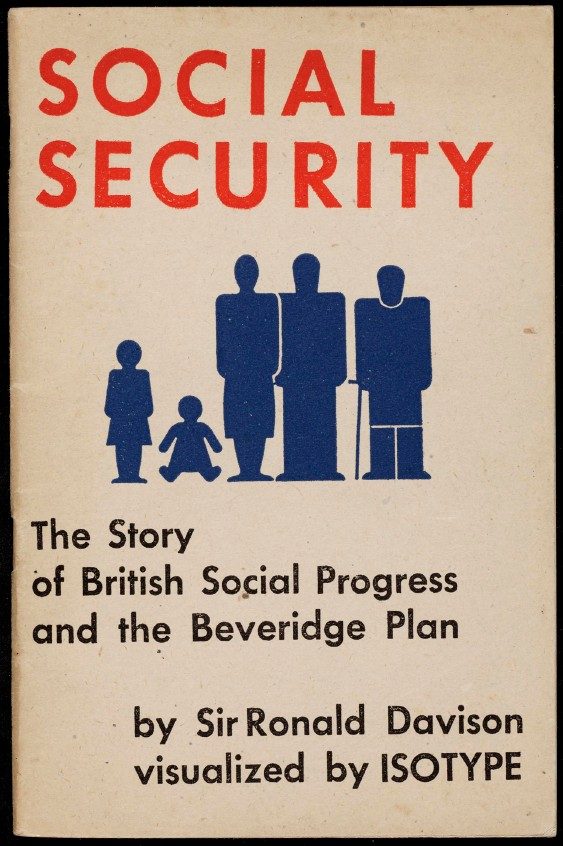
 Isotype Archive